
Pac-Man Clone
Demonstration project — provided as an example of what the PixelRoot32 Game Engine can do. It is not a product: parts may be incomplete, experimental, or deliberately simplified to keep one idea in focus.
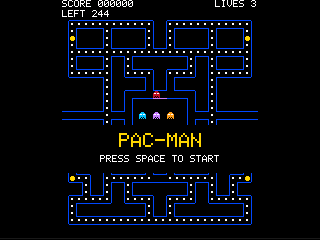
A grid-locked arcade maze game in the classic style: run the corridors, clear every dot, and stay away from the four hunters that patrol the maze. The interesting part of the demo is not the game itself but how it is put together — every rule lives in an engine-independent layer that can be exercised by a host-side test with no graphics session at all.
Language: C++17 Engine: gperez88/PixelRoot32-Game-Engine@^1.12.0 Environments: native, esp32dev_ST7789, esp32dev_ILI9341 Category: Games
Requirements (build flags)
| Flag | Value | Why |
|---|---|---|
PIXELROOT32_ENABLE_GAMEPLAY_GRID_SPACE | 1 | The rules layer moves actors between cells with pixelroot32::gameplay::GridMotion. Building without this flag is not an error — the grid primitives are compiled out and the rules layer stops compiling, because GridMotion is guarded by the same flag. |
PIXELROOT32_ENABLE_AUDIO | 1 | Sound effects for dots, pellets, defeated hunters, a lost life and a finished level. Building without it is not an error — the game plays silently. |
PIXELROOT32_ENABLE_PHYSICS | 0 | The game resolves its own collisions on the grid; a physics engine would only add a second, conflicting source of truth. |
PIXELROOT32_ENABLE_PARTICLES | 0 | Nothing in the game emits particles. |
PIXELROOT32_ENABLE_UI_SYSTEM | 0 | The interface is a status band and a few text overlays, not a widget tree. |
PIXELROOT32_ENABLE_DEPTH_SORT | 0 | Nothing overlaps, so there is nothing to sort. |
Platforms
| Environment | Display | Driver | Cells | Audio backend | Input |
|---|---|---|---|---|---|
native | 320×240 logical, windowed | SDL2 | 7 px | SDL2 | Arrow keys, Space, Enter |
esp32dev_ST7789 | 240×240 | ST7789 (TFT_eSPI) | 7 px | ESP32 I2S (MAX98357A-class DAC) | Six GPIO buttons: up, down, left, right, A, B |
esp32dev_ILI9341 | 240×320 panel, turned a quarter turn to 320×240 | ILI9341_2 (TFT_eSPI) | 7 px | ESP32 I2S (MAX98357A-class DAC) | Six GPIO buttons on the board |
Both environments run the same rules layer. The native build is the fast iteration loop; the ESP32 builds are the target the demo is written for.
The level is the arcade's own: 28 cells wide and 31 cells tall. At the arcade's own eight pixels it would be 224×248, which no 240-pixel-high screen holds, so every build uses seven pixels and the sprite generator emits the tables at that size.
The esp32dev_ILI9341 environment is the ESP32-2432S028 "Cheap Yellow Display": an ILI9341 panel with an XPT2046 touch screen. The panel is mounted in portrait and the build turns it a quarter turn, so the logical framebuffer is the 320×240 landscape the board is held in — the same arrangement games/top_down_city uses. The touch bus is left unclaimed: the game is played with the six buttons.
The layout follows the logical size rather than the panel: the status band stays at the top, lines up with the playfield, and the maze is centred in what is left, so the same build serves both panels.
Controls
| Action | Native | ESP32 |
|---|---|---|
| Move | Arrow keys | D-pad buttons |
| Pause / resume | Space | Button A |
| New game | Enter | Button B |
A direction pressed before an intersection is remembered and taken at that intersection, exactly like the arcade original.
The rules
The demo implements the rule set of the classic game: run the corridors, collect every dot, and stay away from four hunters that patrol the maze. The pieces are worth 10 points, a power pellet is worth 50 and turns the hunters around for six seconds, and a frightened hunter is worth 200, 400, 800 and then 1600 points for consecutive hits inside one power effect. The player starts with three lives and earns a fourth at every ten thousand points.
Each hunter hunts in its own way: one goes straight for the player, one aims four cells ahead of the player, one aims past the player measured from the first hunter, and one hunts from far away and retreats when the player gets close. All four find their way by asking a breadth-first route field for the distance to every neighbouring cell, which makes their behaviour deterministic and testable.
The level is the arcade's own maze: 28 columns by 31 rows, with the ghost house in the middle, a tunnel on each side of the middle row, and exactly the arcade's 240 dots and 4 power pellets. The maze is a table of ASCII rows under src/rules/PacmanMaze.cpp, and a validator rejects a level with a ragged row, an open border, a start inside a wall, nothing to collect, or a corridor that cannot be reached from the player's start - before a game ever begins.
The ghost house has a wall of its own, the way the cabinet drew it: a closed blue rectangle with a pink door across the opening, not a block of the maze's masonry. The four hunters start where the cabinet put them - one above the doorway, the other three inside the house.
The player is drawn with the cabinet's own walk cycle: three shapes - the mouth shut, half open and wide open - that the character walks through while it travels and returns to when it stands still. The head is a disc with the mouth bitten out of it, and the eye is drawn over the head in black with a highlight inside it, the way the cabinet's player wears one. All of it is original artwork written as ASCII art in tools/generate_sprites.py, which emits the engine's packed 1bpp tables at the cell size the build uses.
The sounds
The demo follows the 1980 Namco cabinet's sound design, synthesised by the engine's NES-style audio subsystem rather than played from samples:
- The theme. The arcade's jingle, in four bars with a bass line under it. The title screen plays it as the attract-mode tune, and it stops as soon as the game starts. The arcade also plays the same tune under the level, slower and quieter, so that it stays out of the way of the sound effects; that part is written (
PacmanAudio::startBackgroundMusic()) but not switched on yet, so a level plays in silence for the time being. - The waka. Two notes that alternate on every dot, the way the arcade alternates them, so the rhythm of the eating is audible.
- The hunters. Every hunter has a pitch of its own, and the siren that follows the player belongs to whichever hunter is closest to him. While the power effect lasts the siren becomes a fast, high warble.
- The moments. A chirp that climbs when a hunter is defeated, a long wail that falls away when the player is caught, a warble for the power pellet and a rising figure for the extra life.
The rules layer never plays a sound: it reports what happened as a set of flags, and the scene asks for the matching effect. That is what keeps the audio backend out of the rules, and it is why the game would still play correctly with the audio subsystem compiled out.
What it demonstrates
- A grid-locked actor. The player occupies exactly one logical cell at a time and interpolates between cells for drawing. Gameplay rules never see the player straddling two cells, so a collision is always resolved at a cell, not at a frame boundary.
- A rules layer with no engine in it.
src/rules/holds the maze, the player, the enemies, the scoring and the game states. It includes the engine's gameplay primitives but never its drawing system, its input device or its audio backend — which is what makes the whole rule set testable headless. - A level as data. The maze is a table of ASCII rows — the arcade's own layout, with the same 240 dots and 4 power pellets the cabinet had. A validator rejects a level with a ragged row, an open border, a start inside a wall, nothing to collect, or a corridor that cannot be reached from the player's start — before a game ever begins.
- A fixed logic step. The simulation advances in 20 ms steps, capped at four steps per frame, so the game plays the same whether the screen is redrawn at 30 or 60 frames per second.
- Rules that report, presentation that reacts. The rules layer never plays a sound: it reports what happened as a set of flags, and the scene decides what that should look and sound like. The same split keeps the audio backend out of the rules.
- A synthesised soundtrack. The theme and the effects are built from oscillators and a sequencer instead of samples, so the demo ships no binary audio assets at all.
Project layout
games/pacman/
├── platformio.ini          # envs: native, esp32dev_ST7789, esp32dev_ILI9341, rules_test
├── lib/platformio.ini      # [base] / [base_native] / [base_esp32] templates
├── screenshots/            # screenshot.png
├── src/
│   ├── main.cpp            # platform selector only
│   ├── platforms/          # native.h, esp32_dev_ST7789.h, esp32_dev_ILI9341.h
│   ├── assets/             # generated sprite tables (CC0, original art)
│   ├── audio/              # the sound effects, synthesised rather than sampled
│   ├── PacmanScene.*       # presentation: reads input, draws the rules
│   ├── PacmanPalette.h     # the demo's colours, in one place
│   └── rules/              # the rules layer: no drawing, no input, no audio
│       ├── PacmanConfig.h      # every tunable value, in one place
│       ├── PacmanMaze.*        # the level, its validator and its walkability
│       ├── PacmanRouteField.*  # shortest-route distances over the grid
│       ├── PacmanPlayer.*      # grid-locked movement and buffered turns
│       ├── PacmanEnemy.*       # the hunters, their states and their targets
│       ├── PacmanSession.*     # score, lives, collectibles, game states
│       └── ...
├── test/                   # host-side Unity suite (no graphics session)
│   └── unit/test_pacman_*/
└── tools/
└── generate_sprites.py # regenerates src/assets/PacmanSprites.hBuild
pio run -e native
pio run -e esp32dev_ST7789
pio run -e esp32dev_ILI9341Host-side unit suite (no window, no SDL, no hardware):
pio test -e rules_testThe suite compiles only src/rules, which is the point: the rules have no dependency on the drawing system, the input device or the audio backend. The environment installs the engine for its gameplay headers but never builds it, so the suite runs on a machine with no display stack at all.
Upload (ESP32)
pio run -e esp32dev_ST7789 --target upload
pio device monitorSwap esp32dev_ST7789 for esp32dev_ILI9341 on the 240×320 panel.
Engine documentation
- Engine repository: https://github.com/PixelRoot32-Game-Engine/PixelRoot32-Game-Engine
- Gameplay framework (
GridSpec,GridMotion): https://docs.pixelroot32.org/guide/gameplay-guidelines - Getting started with the engine: https://docs.pixelroot32.org/guide/
License
- Sprite and level artwork — original work created for this demo by
tools/generate_sprites.pyand by hand insrc/rules/PacmanMaze.cpp. Dedicated to the public domain under CC0 1.0. The artwork is drawn from scratch and is not derived from any copyrighted game's assets. - Code — MIT, matching the engine's licence.
This demo is a clone of a game genre, not of a specific commercial title. No trademarked names, characters, sounds or level layouts are used.
Source code: https://github.com/PixelRoot32-Game-Engine/PixelRoot32-Demo-Projects/tree/main/games/pacman