
iso_dungeon — an isometric dungeon on a generic projection
Demonstration project — provided as an example of what the PixelRoot32 Game Engine can do. It is not a product: parts may be incomplete, experimental, or deliberately simplified to keep one idea in focus.
Requires engine 1.10.0 or newer. This demo uses the projection API (
gameplay/Projection.h,math/Projection.h,graphics/SpanTable.h,graphics/StaticLayerSnapshot.h), which first ships in1.10.0.
Language: C++17
Engine: gperez88/PixelRoot32-Game-Engine@^1.10.0
Environments: native, esp32dev
Category: Graphics
Two isometric demos, two questions.
iso_tilemap_exportis the pipeline demo: does the engine paint what the Tilemap Editor showed? This one is the gameplay demo: once the tiles are on screen, how do actors move and sort on them — exact tile-to-tile motion throughGridMotion, projection-aware depth ordering viacompareByDepthKey, and rooms wired by aRoomGraph. Read the other one first if you are bringing a map in; read this one if you already have one.
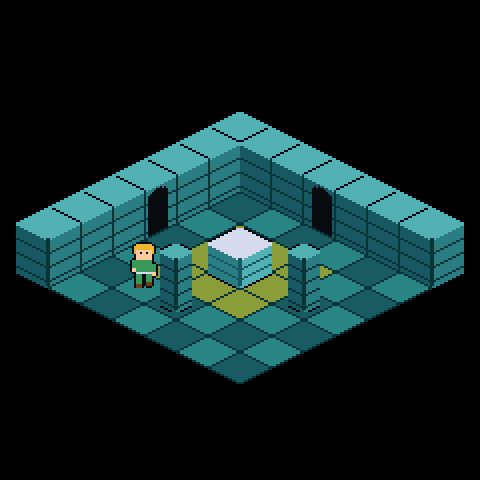
Three dungeon rooms drawn in 2:1 isometric, with a hero that walks them tile by tile and passes between them through doorways. The opening room has two stone walls along its back edges with a doorway in each, an altar on a ritual square, and two pillars flanking it; the doors lead to a pillar hall and a shrine.
The point of the example is not the dungeon. It is that PixelRoot32 has no isometric mode. The view here is one gameplay::ProjectionSpec — six integers — and every other system in the example is the same projection-blind code an axis-aligned game would use.
The whole isometric view
inline constexpr gameplay::ProjectionSpec kTileProjection{
    120, 88,      // screen position of tile (0,0)'s diamond centre
     16,  8,      // +1 tileX -> right and down
-16, 8}; // +1 tileY -> left and downThat is it. Orthogonal, isometric 2:1, isometric 1:1, oblique and mirrored layouts are all values of this one type; there is deliberately no isometric function, enum or template parameter anywhere in the engine. Point kTileProjection at {0, 0, 16, 0, 0, 16} and this example becomes a top-down board game with no other edit.
Build flags
The feature flags as set in lib/platformio.ini. The =1 entries are required for the example to work as described; the =0 entries are deliberately off to save Flash/RAM.
| Flag | Why |
|---|---|
PIXELROOT32_ENABLE_AUDIO=1 | On in the shared base profile so the platform stub can instantiate its SDL2_AudioBackend. The example emits no sound. |
PIXELROOT32_ENABLE_PARTICLES=0 | No particles. Disabled to save Flash/RAM. |
PIXELROOT32_ENABLE_PHYSICS=0 | Movement is tile-based (GridMotion), not physics. Disabled to save Flash/RAM. |
PIXELROOT32_ENABLE_UI_SYSTEM=0 | No menus or HUD. Disabled to save Flash/RAM. |
PIXELROOT32_ENABLE_PROJECTION=1 | Projection.h. Without it the header compiles to nothing and the room has no geometry at all. |
PIXELROOT32_ENABLE_TILEMAP_PROJECTION=1 | Renderer::drawTileMap's projected overload. The floor's diamonds are placed by one drawTileMap call instead of 49 hand-rolled drawSprite calls. Requires PROJECTION=1. |
PIXELROOT32_ENABLE_DEPTH_SORT=1 | Entity::depthKey and gameplay::compareByDepthKey. Off, entities draw in insertion order and the occlusion is simply wrong half the time. |
PIXELROOT32_ENABLE_GAMEPLAY_GRID_SPACE=1 | gameplay::GridMotion. This example declares no GridSpec at all, but GridMotion shares the grid flag rather than taking one of its own — see below. |
PIXELROOT32_ENABLE_GAMEPLAY_ROOM=1 | gameplay::RoomGraph. Holds which door leads where, the current room index, and the onEnter callback the whole transition hangs off. |
PIXELROOT32_ENABLE_2BPP_SPRITES=0 | The art is 4bpp; the 2bpp draw paths stay compiled out. |
PIXELROOT32_ENABLE_4BPP_SPRITES=1 | The art is 4bpp on a custom 16-colour palette. Not cosmetic: the engine gates its 4bpp draw paths with if constexpr, so building without it is not an error, it is a black screen. |
PIXELROOT32_ENABLE_STATIC_LAYER_SNAPSHOT=1 | Caches the drawn room so a static floor costs one memcpy per frame instead of 49 sprite blits. |
PIXELROOT32_ENABLE_DIRTY_REGIONS=1 | Narrows that restore to the cells last frame's movers disturbed. Without it the snapshot still works, it just restores the whole 57,600 B buffer. |
What the example actually demonstrates
Movement is projection-blind
The hero walks exact tile to exact tile — always either at rest on a cell or travelling between two named cells, never anywhere else. gameplay::GridMotion holds that state and gameplay::tickStep advances it, on a fixed 16 ms logic clock so a slow frame stretches nothing.
HeroActor supplies only the two policies the engine deliberately does not own: which cell may be entered, and where the direction comes from. The isometric view enters in exactly one line:
position = gameplay::interpolatedWorld(motion_, kStepsPerCell, kTileProjection);That overload projects both endpoints through the spec and lerps between them. Under a non-identity basis a step along one cell axis moves both screen axes, which the GridSpec overload cannot express — and it is the whole reason an isometric game does not reimplement cell-to-cell navigation.
The D-pad needs no remapping
Under kTileProjection the cell axes project to the four screen diagonals: +cellX goes down-right, +cellY down-left. So the four buttons already cover the four directions a player can see, and the input code is byte-identical to an orthogonal game's.
This is a property of this basis, not a general truth. A game with a different basis has to decide it again, and the engine takes no position.
Row-major iteration IS the painter's order
RoomRenderer draws the floor and walls in one plain for y / for x sweep, with no sort. Screen depth under this spec is 8 * (x + y), so a tile is always drawn after both (x-1, y) and (x, y-1) — exactly the two neighbours whose extruded blocks can overlap it from behind.
The back walls are drawn in that same static pass rather than as sorted entities, and that is not a shortcut: both walls hug the two back edges, so their depth is lower than any reachable tile's. Nothing the player can stand on is ever behind them.
Occlusion is real, and it is the engine's depth sort
The altar and the two pillars are entities, on the same render layer as the hero, for exactly one reason: the hero can reach tiles on both sides of them, so whether a prop draws over or under the hero changes from frame to frame.
Each entity writes its own depthKey from its projected anchor and the scene uses gameplay::compareByDepthKey. compareByBottomY would be wrong here: it orders by world Y, which is the correct paint order only while screen depth is a monotone function of world Y — true for an axis-aligned room, false the moment a projection shears the grid. Cells (2,0) and (0,2) sit on the same screen row at completely different cell-space Ys.
Verified both ways against the same altar (depthKey 136):
| Hero tile | depthKey | Result |
|---|---|---|
(3, 2) | 128 < 136 | the altar draws over the hero |
(3, 4) | 144 > 136 | the hero draws over the altar |
Screen Y happens to be the isometric depth for this spec, because cellToScreenY reduces to originY + 8 * (x + y) when both cell axes share a vertical component. That identity is a property of this basis, not of projections in general — which is exactly why the engine takes the key as data instead of deriving it.
The dungeon is a graph, not a map
RoomGraph stores topology — which room a door opens onto — and nothing else: no tiles, no sprites, no spawn points, because those differ for every game with rooms. RoomCatalog.h supplies them, and the two are joined by using the same room index for both.
The doors do not line up on a plane, and that is forced by the art rather than chosen. Doorway sprites exist only for the two back walls, because a wall drawn along a room's front edge has a higher screen depth than the tiles behind it and would paint straight over the hero standing there. That is the isometric front-wall problem. So every door is carved into a back wall, you leave room 0 walking up-right and arrive beside room 1's up-left door, and the connection is topological.
RoomGraph models exactly that — its RoomDir slots are keys, not geometry — which is why an example with no spatial room grid can still use it unchanged. The camera rects it also stores are degenerate here: one room is one screen, so nothing scrolls.
Arriving through a door always faces you forward
You reach a door by walking into a back wall, so the hero's pose at that moment is its back. Carrying that facing through the door would stand you in the new room looking like you arrived walking backwards.
HeroActor::enterRoom turns the hero along the step from the door to the tile it lands on, reusing the same facing rule walking uses so the two cannot disagree about which way +x faces. Because doors only ever sit on back walls, that step is always +x or +y — both of which project toward the camera. The forward-facing arrival is therefore a consequence of where doors can be, not a rule bolted on top, and everyArrivalFacesInward asserts at compile time that no arrival tile escapes it.
The catalog checks itself at compile time
RoomCatalog.h is hand-written in four places that have to agree — layout chars, prop list, door list, arrival tiles — and every disagreement is silent at runtime: a prop drawn with nothing under it, a door leading nowhere, a hero spawned inside a wall, a player bounced between two rooms forever. Each is a static_assert instead:
| Assert | Catches |
|---|---|
propsMatchLayout | a prop on a tile the layout does not declare, or an A/P tile with no prop |
doorsAreWellFormed | a door off a doorway char, a target room that does not exist, an arrival inside a wall, or an arrival on a door — which would re-trigger the transition and bounce the player straight back |
everyDoorIsTwoWay | a one-way room, and an arrival that does not land beside the door you came out of |
everyArrivalFacesInward | an arrival with no door beside it, which would leave the hero facing whatever way it last walked |
Move a pillar in a layout and the build stops at the line that caused it.
Decisions worth knowing about
The tile size was not free. 32x16 is the largest 2:1 tile that keeps a 7x7 room inside a 240 px display without scrolling: (7 + 7) * 16 = 224. A 48x24 tile would need 336 px. A static_assert also pins the basis determinant at 256 — a power of two, so screenToCell's single division strength-reduces to a shift. Change the tile size carelessly and that assert is what stops you.
GAMEPLAY_GRID_SPACE is on for a capability it does not name. GridMotion shares the grid flag rather than taking a ..._GAMEPLAY_GRID_MOTION of its own, so an isometric game that wants cell-to-cell navigation must enable the grid flag even though it never declares a GridSpec. GridMotion.h states this outright. The cost is one unused header, not one unused byte.
This room draws through the projected tilemap path. drawTileMap places, culls and marks cells through a math::ProjectionSpec (PIXELROOT32_ENABLE_TILEMAP_PROJECTION), so the floor's diamonds are placed by one projected drawTileMap call instead of 49 hand-rolled drawSprite calls. StaticTilemapLayerCache is still not usable here: its layer-list entry (a TileMap4bpp* plus an origin) carries no projection field, so it cannot express this room's basis even though a TileMap4bpp now exists to hand it.
graphics::StaticLayerSnapshot is the piece that already worked here: it caches what the room drew, never drawing anything itself, so it does not care whether that draw was 49 sprite calls or one projected drawTileMap call. The 49 tiles are painted once; every later frame restores them, and with PIXELROOT32_ENABLE_DIRTY_REGIONS on it restores only the cells the hero and props disturbed last frame — a few hundred bytes against 35,072 pixels of 4bpp decode. The price is one logical framebuffer of heap (57,600 B), which is why both flags are opt-in and set per example rather than defaulted on.
The props stay outside the snapshot on purpose. They are captured neither with the room nor after it: the hero walks both behind and in front of the altar, so they have to keep taking part in the per-frame depth sort.
The span-limited blit copies descriptors, it never casts. The tiles are diamond-shaped: a 32×16 floor bitmap whose top and bottom rows are almost entirely transparent padding, yet drawSpriteInternal decodes every one of the 512 nibbles. init() builds a per-row opaque span for each tileset entry via computeSpanTable, which records the first and last opaque column of every row so the blit can skip the leading and trailing transparent nibbles.
The exported TILESET_SPRITES are const and, on ESP32, PIXELROOT32_SCENE_FLASH_ATTR, so rowMinX/rowMaxX cannot be written back into them — that write is undefined behaviour on every target: a LoadStoreError on ESP32, an access violation on Windows (the const objects land in read-only .rdata). init() therefore copies the descriptors into a static RAM array, computes the spans there, and repoints each room's tiles at the RAM copies. The pixel data stays where it is; only the descriptors move. The span buffers and the descriptor copies are static so the pointers they feed stay valid for the program's lifetime, and computeSpanTable reads the pixel data through PIXELROOT32_READ_BYTE_P (pgm_read_byte on ESP32), so reading flash-resident art is safe on every target.
Standing still costs nothing. shouldRedrawFramebuffer() reports whether the hero would draw differently from the frame already on the panel, and the engine skips both draw() and present() when it would not. That is not a CPU optimisation: present() pushes 240×240 RGB565 over SPI, about 23 ms at 40 MHz, which is the frame budget. The hero is the only entity that can move, so one flag answers for the whole room — a scene with several movers would need to OR their answers together.
graphics::Color is a palette INDEX here, and its name lies. This example installs a custom 16-colour palette, so Color::Black is index 0, which the renderer treats as transparent, and index 1 — spelled Color::White — is where the palette puts pure black. kVoidColor names that index so the trap lives in exactly one place. Nothing paints it today: it is already the colour beginFrame() clears to, so RoomRenderer skips the backdrop fill rather than writing 57,600 identical bytes over 57,600 identical bytes. Repalette the room and that fill comes back.
Art
Isometric art is geometry, not draftsmanship. Every block in src/assets/ is the same diamond extruded downward by a different amount — a wall by 24 px, an altar by 14, and a pillar is a narrower 16×8 diamond extruded 26 — which is why they stack without seams.
Two rules the art keeps, both learned the hard way:
- No face may reuse the outline colour index. A cube whose lit face equals its outline loses its silhouette and flattens into a hexagon.
- The floor is a checkerboard, not a flat tone. A single tone gives the eye nothing to judge which cell the hero is standing on, which is the one thing a player of an isometric game constantly needs to know.
Every sprite ships a *_FOOT_Y: the bitmap row that must land on the target cell's diamond centre. One anchoring rule (IsoDraw.h) for the 16px floor, the 40px wall, the 34px pillar and the 24px hero alike — the alternative, an ad-hoc Y offset at each call site, is how isometric art quietly goes crooked.
The tilemap export contract
The room's tile layer is not authored in this example. It is exported data, in the shape the PixelRoot32 Tilemap Editor emits:
| File | Holds |
|---|---|
src/assets/IsoDungeonRoomTileMap.h | dimensions, ISO_PROJECTION, the tileset and foot-table declarations, init() |
src/assets/IsoDungeonRoomTileMap.cpp | TILESET_DATA_POOL, TILESET_SPRITES, TILESET_FOOT_Y, ROOM0/1/2_INDICES, init() |
src/assets/IsoDungeonRoomTileMapPalette.h | TILEMAP_PALETTE_DATA, TILEMAP_PALETTE_MAPPING |
That is the same three-file shape as the real editor output in examples/metroidvania, which is orthogonal. Read the two side by side: this example exists to make the difference concrete.
The Tool Suite emits this shape. Its tilemap exporter has an isometric projection mode that writes ISO_PROJECTION with its validity, determinant and paint-order static_asserts, a separate TILE_WIDTH/TILE_HEIGHT cell stride, and TILESET_FOOT_Y — all as inline constexpr. The list below is therefore the contract an isometric export satisfies, not a wish list.
Four things an isometric export needs that the orthogonal one does not:
- A rectangular cell stride.
TILE_HEIGHThere is 16 — the vertical distance between neighbouring cell centres — while aWALLbitmap is 40 px tall. Isometric tiles overhang their cells; that overhang is the extrusion. TILESET_FOOT_Y. An orthogonal tile fills its cell, so its corner is its position. An isometric tile is anchored: the renderer places it atcentreY - footY. Without the table every tile would need the same height.ISO_PROJECTION, outside the 4bpp guard. The tileset is 4bpp data and is correctly gated. The projection is not: gameplay places the hero and the props at cells where it draws no tile at all, so gating the geometry on a sprite-format flag breaks a game that turns 4bpp off.inline constexpr, notstatic const. The orthogonal export's constants are read only by its own.cpp, so internal linkage is harmless there. Here they cross translation units and initialise the game's own constants, which an internal-linkage constant cannot legally do.
A rule cannot be exported — only its result
Worth stating plainly, because it is the change most likely to be undone by someone trying to be helpful. This room's floor used to be a checkerboard computed at runtime: the same . in the layout became FLOOR_A or FLOOR_B depending on (x + y) & 1. An editor has no way to emit that. It emits the resolved indices, and so does this example — the rule exists nowhere in the shipped code any more.
The layout chars did not go away, because they carry things rendering does not: which cells are walkable, where the doors are, where the props stand. So the split is chars for gameplay, exported indices for rendering, and the differential test in test/unit/test_iso_dungeon_projected_conversion/ is what stops them drifting: its oracle still walks the chars and draws sprite-by-sprite, and it is compared against the exported map with a full-frame memcmp. Flip a single exported index and it reports 224 differing pixels.
Controls
| Button | Cell direction | On screen |
|---|---|---|
| Up | -cellY | up-right |
| Down | +cellY | down-left |
| Left | -cellX | up-left |
| Right | +cellX | down-right |
Walk onto a doorway to change rooms. Doorways are walkable for exactly that reason — standing on one is what the scene watches for.
One axis at a time, fixed priority Up > Down > Left > Right. Diagonals are unrepresentable by construction, and a step in flight cannot be redirected — that refusal is what makes the movement read as a board rather than a walk.
Documentation links
math/Projection.h— the projection math (gameplay/Projection.hforwards to it)gameplay/GridMotion.h— cell-to-cell step stategameplay/DepthCompare.h—compareByDepthKey- Memory system — per-capability budgets
Build
cd examples/iso_dungeon
pio run -e native        # SDL2 desktop
pio run -e esp32dev # ST7789 240x240Source code: https://github.com/PixelRoot32-Game-Engine/PixelRoot32-Demo-Projects/tree/main/graphics/iso_dungeon