
Depth Sort
Demonstration project — provided as an example of what the PixelRoot32 Game Engine can do. It is not a product: parts may be incomplete, experimental, or deliberately simplified to keep one idea in focus.
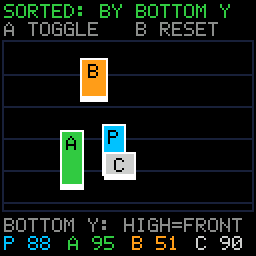
Four boxes of four different heights share one render layer and walk over each other in a top-down field. With Scene::depthComparator assigned, whoever is standing lower on screen is painted last and therefore in front. Press A and the comparator is cleared: the same four actors are drawn in the order they were added, which looks almost right and is wrong. The four bottom-edge values under the field are the entire sort key, printed live, so the rule can be checked against the picture instead of taken on trust.
Language: C++17
Engine: gperez88/PixelRoot32-Game-Engine@^1.9.0
Environments: native, esp32dev
Category: Graphics
Requirements (build flags)
Set in lib/platformio.ini (base template, inherited by every environment).
| Flag | Set to | Why |
|---|---|---|
PIXELROOT32_ENABLE_DEPTH_SORT | 1 | The topic. The engine default is 0 (include/platforms/PlatformDefaults.h) and it is #if-tested, so the =1 is required — but read the next paragraph, because this flag does not work the way most engine flags do. |
PIXELROOT32_ENABLE_AUDIO | 0 | Off on purpose. Frees roughly 17 KB of RAM: mixer voices, the SPSC command queue, and the sequencer state. This demo makes no sound. |
PIXELROOT32_ENABLE_PHYSICS | 0 | Off on purpose. Frees roughly 9 KB: CollisionSystem's actor tables and the fixed-timestep PhysicsScheduler, both members of every Scene. The actors here overlap; they never collide. |
PIXELROOT32_ENABLE_UI_SYSTEM | 0 | Off on purpose. Frees roughly 9 KB: UIManager's widget and hit-test tables, again a per-Scene member. The HUD here is four Renderer::drawText calls. |
PIXELROOT32_ENABLE_PARTICLES | 0 | Off on purpose. Frees roughly 2 KB of particle pool. Nothing on screen sparkles. |
PIXELROOT32_ENABLE_DEPTH_SORT gates your code, not the engine's.Scene::depthComparator, Scene::depthSortEnabled and Scene::shouldPrecede() are plain unguarded members of core/Scene.h; gameplay/DepthCompare.h has no #if around it either. The capability is compiled in whether or not you set the flag. What the flag buys you is platforms::config::EnableDepthSort, a constexpr bool your own scene can branch on — which is exactly how games/bomberbot uses it, and how this demo uses it.
So building without the flag is not a compile error and not a black screen. It is worse than either: everything still runs, applyMode() simply never assigns the comparator, and the four actors overlap in add order forever. This demo refuses to lie about that — the banner reads DEPTH_SORT FLAG OFF in red and A does nothing, because a toggle wired to a disabled branch is a toggle that should not move.
The other four zeros are the category rule from CONTRIBUTING.md: a demo enables the minimum set of flags its topic needs. Leaving those subsystems on would spend roughly 37 KB of ESP32 RAM on machinery nothing here touches.
Platforms
| Environment | Display | Audio backend |
|---|---|---|
native | SDL2, 128×128 logical size | none — PIXELROOT32_ENABLE_AUDIO=0 |
esp32dev | ST7735 128×128 (GreenTab3 profile), SPI pins in platformio.ini: MOSI 23, SCLK 18, DC 2, RST 4, CS -1 | none — PIXELROOT32_ENABLE_AUDIO=0 |
Controls
| Button | native | esp32dev | Action |
|---|---|---|---|
| D-pad | Arrow keys | GPIO 32 / 27 / 33 / 14 | Walk P, the cyan actor, anywhere in the field. Cross the other three to see the overlap decided. |
| A | Space | GPIO 13 | Assign or clear depthComparator. The banner switches between SORTED: BY BOTTOM Y and UNSORTED: ADD ORDER. |
| B | Enter | GPIO 12 | Every actor back to its starting row and patrol direction. |
A, B, C pace up and down on their own at 16, 23 and 31 px/s, so the order keeps changing even with your hands off the D-pad.
What it demonstrates
The comparator's return-value contract
This is the one thing worth getting right, and it is easy to get backwards because a reversed comparator still produces a demo that looks busy.
Scene::sortEntities() is an insertion sort over entities[], and Scene::draw() walks that same array from index 0 upward. Array order is draw order, and drawing first means being painted under. The predicate is Scene::shouldPrecede(key, at) — "must key be placed before at?" — which consults your comparator only when the two entities share a renderLayer:
if (la != lk) return la > lk;                 // different layers: layer wins
if (depthComparator == nullptr) return false; // no comparator: stable, no-op
return depthComparator(key, at);So comparator(a, b) == true means "a is drawn before b", which means "a is behind b". Returning true for the actor you want in front puts it at the back. The engine's compareByBottomY returns true when a's bottom edge is higher up the screen than b's, so the actor standing further back is painted first and the one standing lower covers it. That is the top-down rule.
Note the nullptr line: with no comparator, shouldPrecede is always false for same-layer entities, the insertion sort is a stable no-op, and the array keeps whatever order it already had. Which is why A does not merely clear the pointer — applyMode() also calls clearEntities() and re-adds the four actors in a fixed order. Without that, turning sorting off would freeze the scene in whatever order the last sorted frame happened to leave behind, rather than showing the add order the reader can predict.
What "bottom Y" means
Entity::position is the top-left corner. position.y on its own says nothing about where an actor is standing: a 30 px actor and a 14 px actor at the same position.y have their feet 16 px apart. The sort key is position.y + height, the bottom edge — the contact point with the floor. The four heights here are 26, 30, 22 and 14 px precisely so that sorting by position.y and sorting by the bottom edge give different answers; with four equal-height actors the demo would prove nothing.
Each actor paints a bright bar across its own bottom three rows, and the row under the field prints P nnn A nnn B nnn C nnn in each actor's colour. In SORTED mode those four numbers, read against the draw order, are always ascending back-to-front.
The engine ships this comparator
gameplay/DepthCompare.h provides:
inline bool compareByBottomY(core::Entity* a, core::Entity* b);It is a free function, not a lambda and not a member, so it is already a bool (*)(Entity*, Entity*) and drops straight into Scene::depthComparator. Worth knowing, because games/bomberbot — the other depth-sorted project here — hand-rolls a static bool drawLowerLast(...) that computes the same thing:
bomberbot's drawLowerLast | engine's compareByBottomY | |
|---|---|---|
| Key | (int)position.y + height | position.y + toScalar(height) |
| Returns | footA < footB | bottomA < bottomB |
Same ordering. The only difference is arithmetic width: bomberbot truncates position.y to int first, the engine compares in Scalar (float on native, Fixed16 on ESP32), so the shipped helper also orders two actors whose feet differ by less than a pixel. Nothing in this repository used the ready-made helper before this demo; a game that wants plain Y-ordering does not need to write the predicate at all.
depthSortEnabled is the other half
Assigning the comparator is not enough. Scene::draw() re-sorts only if (needsSorting || depthSortEnabled), and needsSorting is set by addEntity() / removeEntity(). Actors that move every frame need the order recomputed every frame, so depthSortEnabled = true goes with the assignment. Set the comparator and forget this flag and the ordering is correct exactly once — at the moment the last actor was added — and then silently rots.
Viewport culling does not bite here
Scene::draw() skips entities that fail isVisibleInViewport(), which derives the viewport from the renderer's offset: viewX = -renderer.getXOffset(), and similarly for Y. This demo never scrolls and never calls setDisplayOffset(), so both offsets stay at the X_OFF_SET / Y_OFF_SET default of 0 and the viewport is the full 128×128 logical screen. Every actor is clamped inside the playfield border, so nothing is ever culled. Worth checking rather than assuming: in a scrolling game the cull runs after the sort and removes entities from the draw pass without touching the order.
Zero allocation
The four actors are plain members of the scene, added with addEntity(). Positions are int32_t Q8 fixed point (256 units = 1 pixel) so the ESP32 path never touches a float, mirrored into Entity::position on every move because that is what the comparator reads. The four HUD strings are fixed char members filled by snprintf. There is no new, no malloc, no std::string anywhere in update() or draw(), and the mode toggle re-uses the same four objects.
Build
From graphics/depth_sort:
pio run -e native
pio run -e native --target exec
pio run -e esp32devThe committed [env:native] flags target Windows/MSYS2. On Linux drop the -IC:/msys64/..., -LC:/msys64/... and -mconsole lines; on macOS drop them and uncomment the two Homebrew lines above them. CI does this itself.
Upload (ESP32)
pio run -e esp32dev --target uploadEngine documentation
- Core API
- Graphics / Renderer
- Input API
- Scene manager
core/Scene.h—DepthComparator,depthSortEnabledandshouldPrecede()gameplay/DepthCompare.h—compareByBottomY
License
Source code: MIT.
This demo ships no art, audio, or generated asset headers. Every actor is a pair of Renderer rectangles and one character of the engine's built-in 5×7 font, drawn against the built-in PR32 palette, so there is nothing here to attribute.
Source code: https://github.com/PixelRoot32-Game-Engine/PixelRoot32-Demo-Projects/tree/main/graphics/depth_sort