
Clone of Midway — continuous scrolling, and what it costs
Demonstration project — provided as an example of what the PixelRoot32 Game Engine can do. It is not a product: parts may be incomplete, experimental, or deliberately simplified to keep one idea in focus.
Language: C++17
Engine: gperez88/PixelRoot32-Game-Engine@^1.9.0
Environments: native, esp32dev
Category: Games
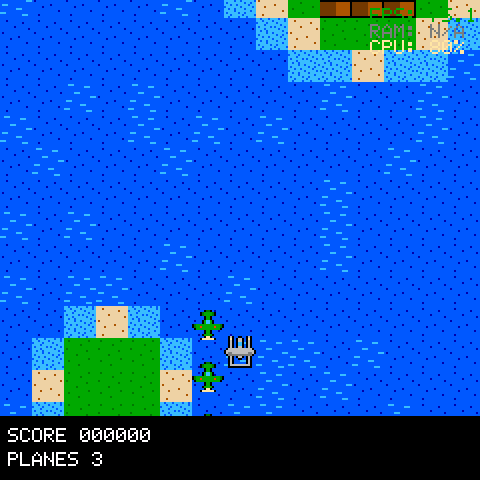
A vertically scrolling shooter over the Pacific. One stage, one aircraft, a sea that never stops moving.
The name is the honest label. This is a clone of Capcom's 1943: The Battle of Midway, built to exercise one engine behaviour the rest of the examples never touch: a camera that moves every single frame. All the art is original — no ripped sprites, no ripped maps, no Capcom assets anywhere in the tree.
It exists to answer a question the other tilemap examples cannot:
Every tilemap example in this repository keeps its camera still and lets
StaticTilemapLayerCachereplay the terrain with onememcpy. What happens when the camera never stops?
The answer is not the one the setup implies, and it is the most useful thing this example has to say. See The frame budget.
            world y = 0     ← north, end of stage
        +---------------+
        |   [carrier]   |   rows 5-12
        |               |
        |    islands    |
        |       ·       |
        |       ·       |
        |               |
        | ┌───────────┐ |   ← the 208 px viewport, climbing
        | │  ✈ player │ |
        | └───────────┘ |
        +---------------+
world y = 1600 ← south, camera starts hereRunning it
pio run -e native -t exec     # SDL2 desktop
pio run -e esp32dev -t upload # ESP32 + ST7789 240x240| Action | Desktop | ESP32 |
|---|---|---|
| Fly | Arrow keys | D-pad, GPIO 32/27/33/14 |
| Gun (hold) | SPACE | A, GPIO 13 |
| Restart, once the run has ended | RETURN | B, GPIO 12 |
Movement is eight-way and not normalised on the diagonal — the machine this imitates moves the same pixels per axis whether one direction is held or two, and correcting it to a true 1/√2 makes the aircraft feel sluggish diagonally.
What it demonstrates
| Engine capability | Where |
|---|---|
| A camera driven per frame, not pinned or following | MidwayScene::updateScroll() |
Camera2D bounds — and what happens without them | MidwayScene::init() |
ObjectPool<T, N> for bullets, enemies, explosions | MidwayScene members |
Pool iteration via nextLive() / kEnd | every MidwayScene::update*() |
StaticTilemapLayerCache missing every frame, measured | MidwayScene::draw() |
| Exported 4bpp tilemap and sprites, flash-resident | assets/OceanTileMap.cpp |
| Dual palette mode — sea and aircraft, 16 slots each | MidwayScene::init() |
| Offset bypass for a non-scrolling HUD strip | MidwayScene::drawHud() |
| Sprite-vs-sprite AABB with no physics engine | MidwayScene::resolveCollisions() |
Press-edge input (isButtonPressed) for restart | MidwayScene::update() |
The asset shapes follow metroidvania and legend_of_clone: tileset pools and map indices in flash behind PIXELROOT32_SCENE_FLASH_ATTR, drawn through StaticTilemapLayerCache, every header gated on PIXELROOT32_ENABLE_4BPP_SPRITES.
Screen layout
 0 ┌─────────────────────────┐
   │                         │
   │   playfield  240x208    │  ← the camera viewport
   │                         │
208├─────────────────────────┤
   │  SCORE 000000           │  ← HUD, 240x32, screen space
   │  PLANES 3               │
240└─────────────────────────┘The playfield is anchored at screen y = 0 with the HUD below it, so world y maps straight to screen y and the camera offset is the only transform in play. A HUD on top would push a constant offset into every world coordinate and every hit test in the example.
The frame budget
This is why the example exists.
The floor nobody can move
The ESP32 driver pushes the entire framebuffer on every present — sendBufferScaled(), called unconditionally from TFT_eSPI_Drawer.cpp:120. There is no dirty-rectangle path at the driver level; DirtyGrid marks cells for selective framebuffer clears, not for selective transmission.
So every frame, regardless of what changed:
240 × 240 px × 2 bytes (RGB565) = 115,200 bytes
115,200 × 8 bits ÷ 40 MHz = 23.0 ms23.0 ms of wire time, every frame, before the game has done anything. That is a hard ~43 FPS ceiling. 60 FPS is not slow here, it is arithmetically impossible: 16.6 ms is less than the push alone.
That is why SPI_FREQUENCY is 40 MHz and this example targets 30 FPS. Raising the clock to 80 MHz halves the floor — many ST7789 panels manage it, and the ones this was developed against do not.
The trap: lowering the logical resolution does not help the floor
RES_160x160 and friends shrink the logical framebuffer, so the clear and every blit get cheaper. They do not reduce the DMA bytes, because the push happens at physical resolution. The ~30% quoted in resolution-scaling.md is CPU-side work, not wire time. Worth doing; it will not buy you 60 FPS.
What the scroll actually costs
Here is the counter-intuitive part. A moving camera means StaticTilemapLayerCache misses 100% of frames — it replays its snapshot only while the sampled camera position is unchanged, and here it changes every frame.
That sounds expensive. It is not what dominates. The scroll costs CPU redraw time and zero wire time, and the wire is already 55% of the frame. The cache is left wired up in MidwayScene::draw() — the same three calls metroidvania makes — specifically so this can be measured rather than argued about.
Measuring it yourself
Uncomment the three profiling lines in the esp32dev environment of platformio.ini, then:
pio device monitor -e esp32devOnce a second, from TFT_eSPI_Drawer.cpp:520:
[TFT sendBufferScaled avg/N fr] total ... | setup ... | scale ... | dmaWait ... | pushDMA ... | endWrite ... | N FPSThat total splits the frame in two — transmit versus everything else — and tells you which half to attack.
They ship commented out on the device and enabled on native, because the instrumentation is not free: PIXELROOT32_ENABLE_PROFILING timestamps inside the DMA loop and the debug overlay renders text every frame. On a target whose budget is already 55% spent, measuring the frame changes the frame.
One measured data point
| Board | esp32dev + ST7789 240×240, SPI 40 MHz |
| Tiles | 8×8, 30×200 map |
| Instrumentation | overlay + profiler on |
| Result | ~24 FPS average (41.7 ms/frame) |
Of those 41.7 ms, 23.0 ms is the computed wire floor; the remaining ~18.7 ms is clear, terrain, sprites, logic — and the instrumentation measuring it.
The tiles have since been doubled to 16×16 (below) and the flags turned off. That combination has not been re-measured. When it is, this table gets a second row rather than an edited first one.
Why the tiles are 16×16
The map was 8×8 first, to match the machine being imitated, and 8×8 looked better — a finer grid draws a coastline that does not read as a staircase. It was given up for frame rate, and the reason is worth recording because it is not about pixels at all:
The renderer pays a per-tile cost on every tile — a call into
drawSpriteInternal, an index fetch, bounds arithmetic — and that cost does not shrink when the tile does.
| 8×8 | 16×16 | |
|---|---|---|
| Map | 30 × 200 | 15 × 100 |
| World | 240 × 1600 px | 240 × 1600 px |
| Blits per frame | 900 | 225 |
| Pixels per frame | 57,600 | 57,600 |
| Tileset + map in flash | 6,256 B | 2,524 B |
The world is deliberately identical. kCameraStartY, the stage length and all twelve wave triggers are in world pixels, so halving the grid while doubling the tile left every one of them untouched.
What it cost: an island is now a 5-tile blob rather than a 10-tile ellipse, and the foam shoreline ring went from 8 to 16 px.
Two things that turned out not to be the problem, checked before making the change: the 4bpp tilemap path already caches its palette LUT across tiles (Renderer.cpp:1005-1062, rebuilt only when the palette pointer changes), and packRgb565ToTftSprite8 is an inline bit-shuffle.
Scrolling, and the two coordinate spaces
The camera counts down from kCameraStartY (1392) to 0 at 32 px/s — 43.5 seconds of stage. Row 0 is north, so the player meets the highest row numbers first and the carrier last.
Camera2D silently pins to the origin without bounds
The single worst trap in this example, and it cost a debugging session:
camera_.setBounds(math::toScalar(0), math::toScalar(0));
camera_.setVerticalBounds(math::toScalar(0), math::toScalar(kCameraStartY));
camera_.setPosition(...); // ← clamped by the two lines aboveCamera2D constructs with minX/maxX/minY/maxY all zero (Camera2D.cpp:15-22) and setPosition() clamps against them with no diagnostic (Camera2D.cpp:34-41). A camera never given bounds is pinned to the origin no matter what it is told.
It fails with no error: the world renders row 0 forever while the game logic runs correctly somewhere off screen. The symptom reads as "every sprite in my game vanished", which points nowhere near the camera.
legend_of_clone and metroidvania never hit this because RoomGraph::enterRoom() sets the bounds for them, once per room. There is no room graph in a scrolling shooter.
The player lives in screen space
The world scrolls underneath a shmup's player; the player does not travel through it. So PlayerActor stores a screen position and converts to world only at draw and hit-test time.
Storing a world position would mean adding the scroll delta back every frame just to stand still — and any frame that missed the addition would drag the aircraft off the bottom of the screen. Screen space makes standing still the default and costs one addition at draw time.
Sub-pixel motion without floats
Speeds are px/s, frames arrive in ms, so a frame is worth a fraction of a pixel. Dropping that fraction every frame makes everything measurably slower than its stated speed — at 30 FPS the scroll would lose about 3% of its travel. advancePixels() carries the remainder in an integer, which stays exact on the non-FPU targets the engine also builds for.
It is correct for negative rates too: C++ integer division truncates toward zero, so the remainder keeps its sign and the climbing camera loses nothing.
Waves are keyed to the camera, not to a clock
const Wave kWaves[] = {
    { 1300, 3, 0,  6,   0, 26 },   // trigger camera y, count, weaves, col, xstep, gap
    { 1200, 3, 1, 14,   0, 26 },
...A wave fires when the camera has climbed past its trigger. That way a formation always arrives over the same stretch of water, which is what makes a stage learnable. A timer would decouple the two and the same wave would meet the player somewhere different every run.
An enemy's on-screen speed is its world speed plus the scroll: 60 + 32 = 92 px/s. Tuning that number while forgetting the scroll is added to it is the easiest way to end up with enemies that flash past unhittably.
Pools, not entities
The player is an Entity and goes through Scene::draw. Bullets, enemies and explosions do not — they live in ObjectPools the scene owns and draws directly.
Scene::draw sorts its entity list and viewport-culls each member every frame. That is worth paying for a handful of long-lived objects and not for thirty projectiles already known to be on screen.
Pools are reset from init() after Scene::init() has run, which is the ordering the ObjectPool header requires: resetState() must clear the entity list before any pooled object is destructed.
Sizes are derived, not guessed. A player bullet crosses the 208 px playfield in 208/300 s = 693 ms and one leaves every 170 ms, so at most 5 are ever in flight; the pool holds 8.
Collision without a physics engine
The example builds with PIXELROOT32_ENABLE_PHYSICS=0. Aircraft do not fall, do not push each other and never touch terrain — every collision is one AABB overlap between two sprites.
That uses a local integer Box, not core::Rect. Rect carries Scalar coordinates every test would have to convert through, and its intersects() compares with < rather than <=, so two boxes that merely touch along an edge are reported as overlapping.
The player's hitbox is inset 4 px per side from its sprite. 16×16 of P-38 is mostly wing, and a shmup that kills you for a wingtip graze feels broken rather than hard. Every arcade game of this kind cheats here.
The asset pipeline
Everything in src/assets/ is generated. The art source and the exporter live outside the repository, in docs/audits/_dev_tools/midway_clone/, which is gitignored — the same split legend_of_clone and metroidvania use, where the output is what the repo carries and what reviewers read.
python generate_assets.py             # after editing art_source.py
python generate_assets.py --check     # validate + round-trip, write nothing
python generate_assets.py --preview # print the art back as ASCIIA tool exists rather than hand-written headers because the 4bpp format puts the left pixel in the low nibble (Renderer.cpp:605-606) while sprite rows are declared uint16_t. On a little-endian target the hex digits of a literal run in the opposite order to the pixels they draw: 0x2220 is the pixel run 0,2,2,2. Hand-authoring that is not difficult, merely impossible to do reliably. Every grid is packed, unpacked again and diffed against its source before anything is written.
Two things the art had to work around
. means transparent, so sand is a. legend_of_clone spells sand . in its tilemap art; here . is the hole in every grid. A symbol meaning nothing in one file and beach in another is a trap worth avoiding.
The carrier deck is wood, not steel. It was gray #BCBCBC first — exactly the player's bare-aluminium airframe — and the aircraft vanished the moment it crossed one. Wartime flight decks really were planked, so the colour that reads is also the one that is correct.
Build flags
| Flag | Required | Why |
|---|---|---|
PIXELROOT32_ENABLE_4BPP_SPRITES=1 | Yes | The engine gates 4bpp draw paths with if constexpr. Without it this builds clean and renders nothing — Scenes.h #errors instead. |
PIXELROOT32_ENABLE_GAMEPLAY_OBJECT_POOL=1 | Yes | ObjectPool.h is wrapped in this and defaults to 0 (PlatformDefaults.h:101-103). Without it the whole pixelroot32::gameplay namespace is absent, and the error points at the namespace rather than at the missing flag. |
PIXELROOT32_ENABLE_GAMEPLAY_ROOM=0 | — | No rooms to enter. |
PIXELROOT32_ENABLE_PHYSICS=0 | — | No bodies to integrate. |
PIXELROOT32_ENABLE_PROFILING | No | See Measuring it yourself. |
Memory
| Flash | SRAM | |
|---|---|---|
| Tileset, 8 tiles × 16×16 4bpp | 1,024 B | 0 |
| Map indices, 15 × 100 | 1,500 B | 0 |
| Sprites, 11 frames | 1,216 B | 0 |
| Assets total | 3,740 B | 0 B |
| Object pools (bullets, enemies, explosions) | — | ~780 B |
StaticTilemapLayerCache snapshot | — | 57,600 B |
That last row deserves a hard look. allocateForRenderer() reserves a full logical framebuffer — 240 × 240 bytes — and in this example the cache never hits, because the camera moves every frame. It is 57.6 KB of SRAM buying one memcpy on the stage-complete freeze.
It is kept because measuring the miss is the point of the example. A shipping game with a continuously scrolling camera should call setFramebufferCacheEnabled(false) and skip the allocation entirely.
Not in this iteration
- No audio.
PIXELROOT32_ENABLE_AUDIO=1and a backend is wired up; nothing plays yet. - One stage, one enemy type. No boss, no POW power-ups, no loop-the-loop, no refuelling — all of which the original has.
- Enemies do not react to the player. They descend, they weave, they shoot on a timer.
- Terrain is decoration.
TILE_IS_LANDis exported for ground targets that do not exist yet; nothing collides with the map. - The stage ends by holding on the last frame. No score tally, no next stage.
Source code: https://github.com/PixelRoot32-Game-Engine/PixelRoot32-Demo-Projects/tree/main/games/midway_clone