
Tic Tac Toe
Demonstration project — provided as an example of what the PixelRoot32 Game Engine can do. It is not a product: parts may be incomplete, experimental, or deliberately simplified to keep one idea in focus.
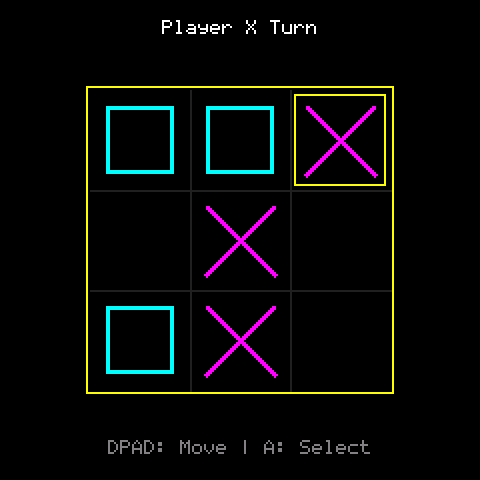
Three-in-a-row against a heuristic AI on a 3×3 board, drawn entirely with Renderer primitives — no sprites, no tilemap, no asset headers. The single idea it is about is the custom 16-colour palette: the whole neon look comes from one setCustomPalette() call remapping the engine's named colours, so the game code keeps saying Color::LightRed and gets neon pink.
Language: C++17
Engine: gperez88/PixelRoot32-Game-Engine@^1.9.0
Environments: native, esp32dev
Category: Games
Requirements (build flags)
Set in lib/platformio.ini's [base] template, so every environment inherits them:
PIXELROOT32_ENABLE_AUDIO=1— required. The background loop, the win jingle, and the fourAudioEventcues all go throughMusicPlayer/AudioEngine. Building without it is not a compile error — it is silence.PIXELROOT32_ENABLE_PHYSICS=0— the board is aPlayer[3][3]array and every rule is an array lookup. There is nothing to simulate.PIXELROOT32_ENABLE_PARTICLES=0— not used.PIXELROOT32_ENABLE_UI_SYSTEM=0— the status line and the instructions line areRenderer::drawTextCenteredcalls, not UI widgets.
Display size is 240×240 in the project platformio.ini (see PHYSICAL_DISPLAY_*). The board is BOARD_SIZE * CELL_SIZE = 150 px and is centred from DISPLAY_WIDTH / DISPLAY_HEIGHT at reset, so a different resolution re-centres it instead of clipping it.
Platforms
| Environment | Display | Audio backend |
|---|---|---|
native | SDL2, 240×240 | SDL2_AudioBackend in src/platforms/native.h |
esp32dev | ST7789 240×240 | ESP32_I2S_AudioBackend in src/platforms/esp32_dev.h |
Pin choices (ST7789 SPI, I2S audio, D-pad + two buttons) are in src/platforms/esp32_dev.h — edit there if your wiring differs.
Controls
| Action | native (keyboard) | esp32dev (GPIO) |
|---|---|---|
| Move cursor | Arrow keys | D-pad |
| Place mark | Space | Button A |
| Restart (from Game Over) | Space | Button A |
The cursor wraps at the board edges in both axes, so nine cells are always two presses apart at most. After a game ends the input is ignored for 500 ms so the press that ended the game cannot immediately restart it.
What it demonstrates
- Custom palette remapping.
CUSTOM_NEON_PALETTEis a plainuint16_t[16]of RGB565 values handed tographics::setCustomPalette()ininit(). Nothing else in the scene knows about it:drawXstill asks forColor::LightRed, and the palette decides that means neon pink. Swapping the look is one array, not a sweep through the draw code. - Two-layer audio. A looping
MusicTrackbuilt frommakeNote/makeRestwith theINSTR_TRIANGLE_PADpreset runs as background music, while placement, loss, and draw are one-shotAudioEvents played straight on theAudioEngine. Win stops the loop and plays a non-loopingMusicTrackinstead — the two paths never fight over the same voice. - Heuristic AI with a tunable error rate.
computeAIMove()is the classic four-step ladder: win if you can, block if you must, take the centre, take a corner.DEFAULT_AI_ERROR_CHANCE(0.25) then rerolls that choice a quarter of the time, which is what keeps a perfect-information 3×3 game losable. - Edge-detected input without an input queue. Cursor movement compares the current
isButtonDownagainst last frame's, so a held direction moves one cell rather than nine. TheinputReadylatch additionally swallows the button that was still down when the scene started. - Zero assets, zero allocation. Everything on screen is a line, a rectangle, or text. The two status strings are fixed
charbuffers filled withsnprintf; nothing inupdate()ordraw()allocates.
Project layout
src/
├── GameConstants.h      board size, cell size, button IDs, AI error chance
├── TicTacToeScene.h/.cpp  the whole game: state, AI, audio, drawing
├── main.cpp             platform selector
└── platforms/ native.h, esp32_dev.h — backend wiring per targetEngine documentation
Build
From games/tic_tac_toe:
pio run -e native
pio run -e esp32devUpload (ESP32)
pio run -e esp32dev --target uploadLicense
Source code: MIT.
| Asset | Author | License | Source |
|---|---|---|---|
| All audio cues | This repository | CC0 1.0 (public domain) | Original work, synthesised at runtime from AudioEvent / MusicTrack definitions in src/ |
This demo ships no art and no generated asset headers — the board, the marks, and the cursor are Renderer primitives resolved through the custom palette, so there is nothing else here to attribute.
Source code: https://github.com/PixelRoot32-Game-Engine/PixelRoot32-Demo-Projects/tree/main/games/tic_tac_toe