
Menu Navigation
Demonstration project — provided as an example of what the PixelRoot32 Game Engine can do. It is not a product: parts may be incomplete, experimental, or deliberately simplified to keep one idea in focus.
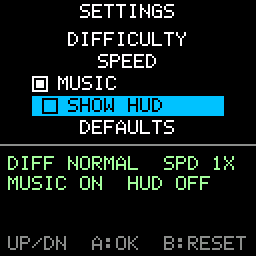
A settings menu built from the engine's own UI widgets and driven entirely by a D-pad: UIButton and UICheckBox rows stacked in a UIVerticalLayout, moved through with Up/Down, activated with A, and reset with B. There is no touch anywhere in this demo — no PIXELROOT32_ENABLE_TOUCH, no UITouchButton, and nothing registered with UIManager. That is the single idea here: the UI system is not touch-only, and the physical-input half of it is one layout call away.
Language: C++17
Engine: gperez88/PixelRoot32-Game-Engine@^1.9.0
Environments: native, esp32dev
Category: UI
Requirements (build flags)
Set in lib/platformio.ini (base template, inherited by every environment).
| Flag | Set to | Why |
|---|---|---|
PIXELROOT32_ENABLE_UI_SYSTEM | 1 | The topic. Every header under include/graphics/ui/ is wrapped in #if PIXELROOT32_ENABLE_UI_SYSTEM, so without it UIButton, UICheckBox and UIVerticalLayout do not exist as types at all. That is a compile error rather than a black screen, and src/MenuNavigationScene.h makes it a readable one with an #error naming the flag. Costs roughly 9 KB of RAM, most of it UIManager's widget and hit-test tables — which this demo never touches, but which the module brings along. |
PIXELROOT32_ENABLE_AUDIO | 0 | Off on purpose. Frees roughly 17 KB of RAM: mixer voices, the SPSC command queue, and the sequencer state. This demo makes no sound. |
PIXELROOT32_ENABLE_PHYSICS | 0 | Off on purpose. Frees roughly 9 KB: CollisionSystem's actor tables and the fixed-timestep PhysicsScheduler, both members of every Scene. Nothing here moves, let alone collides. |
PIXELROOT32_ENABLE_PARTICLES | 0 | Off on purpose. Frees roughly 2 KB of particle pool. Nothing on screen sparkles. |
PIXELROOT32_ENABLE_TOUCH is not set, and its absence is part of the point. A menu built from UIButton and UICheckBox needs no touch stack, no calibration, and no UIManager — only the InputManager that every demo already has. CONTRIBUTING.md's rule for the category folders is that a demo enables the minimum set of flags its topic needs; for a D-pad menu that set is one flag.
Platforms
| Environment | Display | Audio backend |
|---|---|---|
native | SDL2, 128×128 logical size | none — PIXELROOT32_ENABLE_AUDIO=0 |
esp32dev | ST7735 128×128 (GreenTab3 profile), SPI pins in platformio.ini: MOSI 23, SCLK 18, DC 2, RST 4, CS -1 | none — PIXELROOT32_ENABLE_AUDIO=0 |
Controls
| Button | native | esp32dev | Action |
|---|---|---|---|
| Up | Up arrow | GPIO 32 | Move the selection one row up. |
| Down | Down arrow | GPIO 27 | Move the selection one row down. |
| A | Space | GPIO 13 | Activate the selected row: a UIButton fires its callback, a UICheckBox toggles. |
| B | Enter | GPIO 12 | Restore every row to its default. |
Left and Right are declared in the platform headers because InputConfig takes six buttons, and are deliberately unbound — see the index trap below for why that matters more than it looks.
The five rows are DIFFICULTY (cycles EASY / NORMAL / HARD), SPEED (cycles 1X / 2X / 3X), MUSIC and SHOW HUD (checkboxes), and DEFAULTS (a button that does what B does). The band under the separator prints the current value of every setting plus the row that last fired, so an activation is always visible even when the new value looks like the old one.
What it demonstrates
The UI system is not touch-only
Read from the outside, pixelroot32::graphics::ui looks like a touch module: UIManager is the touch router, and most of what is written about the module is about UITouchButton, UITouchCheckbox and hit testing. That is half the module. The other half is physical-input widgets:
UIButtonandUICheckBoxeach take aconst InputManager&inhandleInput(). No touch, no hit test.UIVerticalLayoutstacks them, tracks the selected index, and already implements D-pad navigation: its ownhandleInput()moves the selection on the buttons given tosetNavigationButtons()and then forwards the sameInputManagerto the selected child.
So the whole menu is one call per frame:
menu_.handleInput(engine.getInputManager());Everything else in MenuNavigationScene.cpp is the settings the menu edits, not the menu.
The index parameter is a trap
UIButton's second constructor argument is documented as a navigation index, which reads like "this is row 2". It is not. Here is the whole of UIButton::handleInput:
void UIButton::handleInput(const InputManager& input) {
    if (!isEnabled || !isVisible) return;

    if (isSelected && input.isButtonPressed(index)) {
        this->press();
    }
}index is the physical button index that activates this widget. UICheckBox::handleInput is the same three lines with toggle() in place of press(). The row's position in the menu is UIVerticalLayout's business, not the widget's — setSelectedIndex() decides which row has isSelected.
Numbering the rows 0, 1, 2, 3, 4 in that argument therefore compiles, draws correctly, navigates correctly, and then binds row 0 to Up, row 1 to Down, row 2 to Left, row 3 to Right and row 4 to A. Two rows fire while you are still navigating, one row answers a button nothing else uses, and there is no warning of any kind.
Every row in this demo is constructed with the same value:
static constexpr uint8_t kButtonA = 4; // InputConfig order: Up, Down, Left, Right, A, BUIManager is deliberately unused
Nothing in this scene is registered with UIManager, and that is not an oversight. UIManager is the touch router — it owns hit testing and touch event dispatch for UITouchElements. Its lifecycle methods are deprecated no-ops; both bodies are, in full:
void UIManager::update(unsigned long deltaTime) { (void)deltaTime; }
void UIManager::draw(pixelroot32::graphics::Renderer& renderer) { (void)renderer; }Widgets are updated and drawn by the scene that owns them. Here the scene calls menu_.update(deltaTime) and menu_.draw(renderer), and the layout walks its children. Routing that through UIManager would draw nothing.
Layouts allocate — so build the tree in init()
UILayout keeps its children in a std::vector<UIElement*>, and addElement() push_backs into it. That is the documented exception to this repository's no-allocation-in-the-game-loop rule, and it survives only because it is bounded: the five addElement() calls happen once, in init(), and update() and draw() add nothing. Adding or removing a row per frame would turn a one-off allocation into a per-frame one.
The layout holds non-owning pointers, so the widgets are plain scene members that outlive it — never locals, never anything the scene can drop.
Callbacks are raw function pointers
UIElement uses void(*)() for buttons and void(*)(bool) for checkboxes rather than std::function, which keeps the widgets allocation-free and costs one pointer each. The consequence is that a lambda with a capture list does not convert. The callbacks in this demo are captureless free functions in an anonymous namespace that reach the scene through a file-scope pointer set in init().
Build
cd ui/menu_navigation

pio run -e native                 # build the PC/SDL2 simulator
pio run -e native --target exec   # build and run it
pio run -e esp32dev # build for ESP32The committed [env:native] build_flags are configured for Windows/MSYS2. On Linux/macOS remove the -IC:/msys64/..., -LC:/msys64/... and -mconsole lines; on macOS also uncomment the two Homebrew lines above them.
Upload (ESP32)
pio run -e esp32dev --target upload
pio device monitor -b 115200Engine documentation
- PixelRoot32 Game Engine
- UI API
- Input API
- Core API — Engine, Scene, Renderer
UIButton— theindexparameter and thehandleInput()quoted aboveUICheckbox.h— the file isUICheckbox.h, the class isUICheckBoxUIVerticalLayout— navigation, selection and scrollingUIElement— the callback types andTextAlignment- Engine configuration flags
- Memory system — flags and byte budgets
License
This demo ships no art assets: no sprites, no tilesets, no fonts, no audio. Everything on screen is drawn by Renderer primitives and the engine's own built-in font, so there is nothing here to attribute.
The demo source is MIT, like the rest of this repository — see LICENSE.
Source code: https://github.com/PixelRoot32-Game-Engine/PixelRoot32-Demo-Projects/tree/main/ui/menu_navigation