
SFX Bank
Demonstration project — provided as an example of what the PixelRoot32 Game Engine can do. It is not a product: parts may be incomplete, experimental, or deliberately simplified to keep one idea in focus.
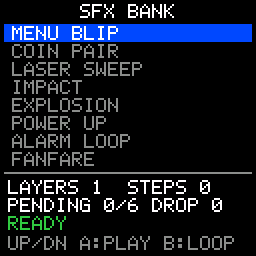
Eight sound effects in a bank shaped exactly the way playSfxBank expects: layers that fire together at t=0, plus sequence steps that fire later. Walk the list with Up / Down, press A to fire the selected effect. The one thing playSfxBank deliberately does not own is the delay — it hands every timed step to a SfxDelayScheduler the game supplies — so this demo writes the real one: a fixed six-slot scheduler driven by the scene's own update(), with no allocation anywhere. The pending count is on screen, and so is the number of steps it has had to drop.
Language: C++17
Engine: gperez88/PixelRoot32-Game-Engine@^1.9.0
Environments: native, esp32dev
Category: Audio
Requirements (build flags)
Set in lib/platformio.ini (base template, inherited by every environment).
| Flag | Set to | Why |
|---|---|---|
PIXELROOT32_ENABLE_AUDIO | 1 | The topic. Engine::getAudioEngine() and the AudioEngine member itself sit behind #if PIXELROOT32_ENABLE_AUDIO in core/Engine.h, so this is one of the few engine flags whose absence is a compile error rather than silence. src/SfxBankScene.h stops the build with an #error naming the flag anyway, so the message says what to do. It is also the most expensive subsystem in the engine: roughly 17 KB of RAM for the eight mixer voices, the SPSC command queue and the sequencer state. |
PIXELROOT32_ENABLE_PHYSICS | 0 | Off on purpose. Frees roughly 9 KB: CollisionSystem's actor tables and the fixed-timestep PhysicsScheduler, both members of every Scene. Nothing here moves. |
PIXELROOT32_ENABLE_UI_SYSTEM | 0 | Off on purpose. Frees roughly 9 KB: UIManager's widget and hit-test tables, again a per-Scene member. The list is Renderer::drawText and one filled rectangle. |
PIXELROOT32_ENABLE_PARTICLES | 0 | Off on purpose. Frees roughly 2 KB of particle pool. Nothing on screen sparkles. |
Those three zeros are the reason the one 1 is affordable. CONTRIBUTING.md's rule for the category folders is that a demo enables the minimum set of flags its topic needs, and audio at ~17 KB is the single largest thing a PixelRoot32 demo can switch on — leaving the other default-on subsystems enabled would add another ~20 KB that nothing on this screen uses.
Platforms
| Environment | Display | Audio backend |
|---|---|---|
native | SDL2, 128×128 logical size | SDL2_AudioBackend(22050, 1024) — 22.05 kHz, 1024-sample buffer. The buffer length is the floor on how late a scheduled step can be heard: the scheduler's resolution is the frame, the backend's is the block. |
esp32dev | ST7735 128×128 (GreenTab3 profile), SPI pins in platformio.ini: MOSI 23, SCLK 18, DC 2, RST 4, CS -1 | ESP32_I2S_AudioBackend(BCLK 26, LRCK 25, DOUT 22, 22050) — an external I2S DAC such as the MAX98357A. src/platforms/esp32_dev.h keeps the internal-DAC alternative (ESP32_DAC_AudioBackend on GPIO 25, 11.025 kHz) commented next to it. AudioConfig is built from audioBackend.getSampleRate() rather than a literal, so switching to the DAC option does not detune every effect. |
Controls
| Button | native | esp32dev | Action |
|---|---|---|---|
| Up | Up | GPIO 32 | Previous entry in the bank (wraps). |
| Down | Down | GPIO 27 | Next entry in the bank (wraps). |
| A | Space | GPIO 13 | playSfxBank(engine.getAudioEngine(), id, scheduler). On ALARM LOOP it refuses and says USE B FOR LOOP, because A does not track the loop and could not stop it. |
| B | Enter | GPIO 12 | On ALARM LOOP: start it looping. While a loop is running: stop it — see the caveat below. On any other entry with no loop running: nothing, and the status line says NOT A LOOP. |
Left and Right are declared in the platform headers because InputConfig takes six buttons, and are otherwise unused.
The caveat on B. AudioEngine::playEvent returns void. Nothing in the public API ever tells the game which voice an effect landed on, and AudioCommandType::STOP_CHANNEL needs a slot index. So B does not stop the looping voice — it cannot know which one that is. It stops the whole SFX sub-pool: slots ApuCore::SFX_VOICE_BASE (4) through 7, leaving 0–3 alone because those belong to the music sequencer. That is a real thing games do ("silence all effects"), it is spelled out in stopAllSfxVoices(), and it is the honest ceiling of what playSfxBank gives you back. A game that needs one-loop-at-a-time control has to place its looping voices by hand rather than through the bank helper.
What it demonstrates
The bank contract playSfxBank expects
playSfxBank is a template over the bank type, not a call on a bank object:
template <typename Bank, typename SfxId>
inline void playSfxBank(AudioEngine& engine, SfxId id, SfxDelayScheduler& scheduler);Bank needs four static functions and one nested struct:
static uint8_t layerCount(SfxId)static AudioEvent layerEvent(SfxId, uint8_t)static uint8_t sequenceStepCount(SfxId)static SequenceStep sequenceStep(SfxId, uint8_t), whereSequenceStephasfloat delaySecandAudioEvent event
That is the same API the PixelRoot32 Tool Suite's SFX editor exports — see games/bomberbot/src/assets/audio/SfxBank.h for a generated one. src/assets/DemoSfxBank.h is the same contract written by hand so the whole of it is readable. The body of the helper is eleven lines: every layer goes straight to playEvent, every step with delaySec <= 0 goes straight to playEvent, and every step with delaySec > 0 goes to the scheduler. Nothing else.
The eight entries each isolate one thing:
| Entry | Layers | Steps | What it is for |
|---|---|---|---|
MENU BLIP | 1 | 0 | The smallest entry a bank can have. |
COIN PAIR | 1 | 1 | The scheduler's hello world: one note now, one 70 ms later. |
LASER SWEEP | 1 | 0 | sweepEndHz + sweepDurationSec, exponential curve. |
IMPACT | 3 | 0 | Three voices at t=0 — three of the four SFX slots at once. |
EXPLOSION | 1 | 2 | NOISE with a downward clock sweep, plus two delayed tail steps. |
POWER UP | 1 | 0 | A four-point pitchEnvelope arpeggiating inside one voice. |
ALARM LOOP | 1 | 0 | loop = true with a four-entry dutySteps table. |
FANFARE | 1 | 3 | Three delayed notes — two presses fill the six-slot scheduler. |
Why the delay scheduler is the game's job
The engine ships two SfxDelayScheduler implementations and neither is what a game wants. NullSfxDelayScheduler drops every delayed step on the floor, so FANFARE becomes one note. ImmediateSfxDelayScheduler plays them all at t=0, so FANFARE becomes one chord. Both are honest about being stubs.
Timing belongs to whatever already has a clock, and in a game that is the scene. TimedSfxDelayScheduler in src/SfxBankScene.h is a fixed PendingStep slots_[6] array with a live count:
schedule()convertsdelaySecto milliseconds and copies the event into the next free slot. The event is stored by value — theSequenceStepplaySfxBankhanded over is a temporary. Itspreset,dutyStepsandpitchEnvelopepointers survive that copy because they point at the bank'sinline constexprtables, which is the whole reason those tables must have static storage duration.update(deltaTime)is called fromScene::updatewith the frame time in milliseconds, counts every slot down, and callsplayEventon the ones that reach zero. A fired slot is reclaimed by swapping the last live entry into its place, so nothing shifts and nothing moves; the loop index deliberately does not advance after a swap, because the entry that just arrived has not been stepped yet this frame.- The step is clamped to 100 ms, so a long stall — a breakpoint, the first frame after
init()— cannot fire the entire queue at once. - No
new, nomalloc, no container, anywhere. The six slots are part of the scene's ownsizeof.
When it is full, it drops the newest step and counts it. The HUD prints PENDING n/6 DROP n and turns the line orange at the ceiling, red once anything has been dropped. Evicting an already-scheduled step instead would cut short a sound the player has already begun hearing; refusing the new one is the smaller lie, and either way the number is on screen rather than swallowed. Hold A on FANFARE to watch it happen.
The four-voice SFX sub-pool
ApuCore owns eight voices and partitions them: MUSIC_VOICE_BASE 0 through 3 are the music sequencer's, SFX_VOICE_BASE 4 through 7 are effects. SFX steal only within their own four, so an effect can never cut off the music — and looped voices are reclaimed first when a steal is needed.
Four simultaneous non-looping effects means the fifth steals one of them. This is easy to hear here: IMPACT alone takes three slots, so firing IMPACT and then anything else immediately is already at the edge. That is not a bug in the mixer, it is the budget; a game with more than four concurrent effects needs a priority or cooldown policy of its own — the generated Tool Suite banks carry a cooldownMs(SfxId) for exactly that, and playSfxBank does not look at it.
The two AudioEvent field-order traps
AudioEvent is declared in <pixelroot32/apu/AudioTypes.h> in this order:
1 type   2 frequency   3 duration   4 volume   5 duty   6 noisePeriod
7 preset 8 sweepEndHz  9 sweepDurationSec  10 loop  11 sweepCurve
12 dutySteps 13 dutyStepCount 14 pitchEnvelope 15 pitchEnvelopeCountTrap 1 — it is frequency, duration, volume, not frequency, volume, duration. All three are float, so swapping them is not a build error. It is a 0.4-second note played at 30% of the volume you asked for, and you will look at the mixer before you look at the literal.
Trap 2 — preset is field 7, not the last field. Writing {type, freq, dur, vol, duty, &INSTR_X} aims the preset pointer at noisePeriod's slot, which is a uint8_t.
C++17 has no designated initialisers, so src/assets/DemoSfxBank.h sets the five positional fields through a makeEvent() helper and assigns everything past duty by name:
AudioEvent event = detail::makeEvent(WaveType::PULSE, 1200.0f, 0.28f, 0.45f, 0.25f);
event.preset = &presets::kPulseSweep;
event.sweepEndHz = 140.0f;
event.sweepDurationSec = 0.26f;
event.sweepCurve = SweepCurve::Exponential;The one place positional initialisation is still used is InstrumentPreset, whose field order AudioMusicTypes.h documents as frozen — the deprecated noiseShortMode alias is kept as the last member precisely so existing positional literals keep meaning what they meant.
The rest of the mixer's small print, respected
- Sweep is active only when
sweepDurationSec > 0andsweepEndHz > 0. Leave either at zero and the voice just holdsfrequency, with no warning. - On
NOISE,frequencyis the LFSR clock rate, not a pitch.EXPLOSIONsweeps 9000 Hz down to 500 Hz of clock, which is what turns a hiss into a boom. - A
pitchEnvelopewith ≥ 2 points replaces the single-segment sweep. SoPOWER UPleavessweepEndHz/sweepDurationSecat zero rather than setting dead data. Maximum 4 duty steps, maximum 4 pitch points,timeSecnon-decreasing. preset,dutyStepsandpitchEnvelopeare raw pointers the mixer dereferences on the audio side. Every one of them here is aninline constexprat namespace scope, so it outlives any event that names it.loop = truenever auto-stops.durationis meaningless while it is set; the voice stays enabled untilSTOP_CHANNELnames its slot, or until another effect steals it.
Ordering the engine cares about
init() and update() call their Scene:: base first. draw() does not: it paints the background, then calls Scene::draw(renderer), because the base draws the scene's entities and filling after it would overpaint them.
Build
From audio/sfx_bank:
pio run -e native
pio run -e native --target exec
pio run -e esp32devThe committed [env:native] flags target Windows/MSYS2. On Linux drop the -IC:/msys64/..., -LC:/msys64/... and -mconsole lines; on macOS drop them and uncomment the two Homebrew lines above them. CI does this itself.
Upload (ESP32)
pio run -e esp32dev --target uploadEngine documentation
- Audio API
- Core API
- Graphics / Renderer
- Input API
include/audio/SfxBankPlayback.h—playSfxBank,SfxDelaySchedulerand the two stub schedulersinclude/audio/AudioEngine.h—playEvent,submitCommandAudioTypes.h(PixelRoot32-APU) —AudioEvent,SfxBreakpoint,AudioCommand,WaveType,SweepCurveAudioMusicTypes.h(PixelRoot32-APU) —InstrumentPresetand its frozen field order
License
Source code: MIT.
This demo ships no art and no audio samples. Every sound is synthesised at run time by the engine's APU from the AudioEvent literals in src/assets/DemoSfxBank.h, and everything on screen is drawn with Renderer primitives and the engine's built-in 5×7 font against the built-in PR32 palette. There is nothing here to attribute.
Source code: https://github.com/PixelRoot32-Game-Engine/PixelRoot32-Demo-Projects/tree/main/audio/sfx_bank