
The Legend of Clone — screen transitions
Demonstration project — provided as an example of what the PixelRoot32 Game Engine can do. It is not a product: parts may be incomplete, experimental, or deliberately simplified to keep one idea in focus.
Language: C++17
Engine: gperez88/PixelRoot32-Game-Engine@^1.9.0
Environments: native, esp32dev
Category: Games
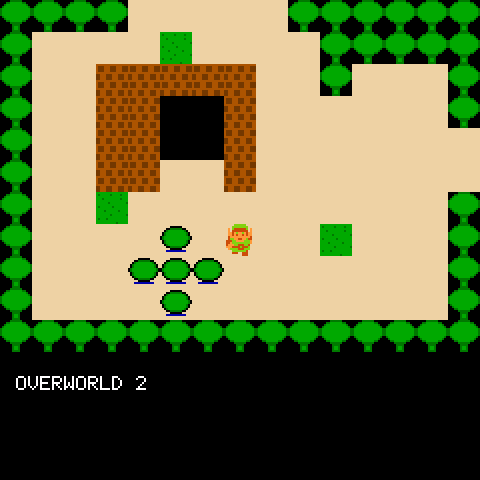
An 8-bit-style overworld and the dungeon under it. Two scenes, four rooms each, and one player who walks between them.
The name is the honest label. This is a clone of The Legend of Zelda, built to exercise engine features — room graphs, scrolling screen transitions, scene fades, 4bpp tilemaps — against a layout everyone already knows, so the machinery is the thing under review and not the level design. It is not a reproduction: the maps are hand-authored rather than ripped, the hero carries nothing and is nobody in particular, and there are no enemies, items or combat.
It started as an answer to one question — does a player walking off the edge of one screen land correctly on the next? — and the dungeon is the same question asked again somewhere the answer had better not be different.
        OVERWORLD                        DUNGEON
+----------------+----------------+   +----------------+----------------+
| 0  north-west  | 1  north-east  |   | 0  north-west  | 1  north-east  |
+----------------+----------------+   +----------------+----------------+
| 2  START  [C]  | 3  south-east  |   | 2  ENTRANCE [S]| 3  south-east  |
+----------------+----------------+   +----------------+----------------+

[C] cave mouth <-----------------> [S] stairsRunning it
pio run -e native -t exec     # SDL2 desktop
pio run -e esp32dev -t upload # ESP32 + ST7789 240x240Arrow keys walk. Walk into a gap in the border and the screen scrolls. Walk into the black cave mouth on the start screen and the picture fades into the dungeon; walk onto the staircase you arrive beside and it fades back out, putting you below the cave rather than at the start of the game.
What it demonstrates
| Engine capability | Where |
|---|---|
RoomGraph<N> + buildRoomGraph() | TopDownScene::init() |
| Exported room-layer data contract | assets/OverworldRooms.h |
| Camera pinned per room, not following | TopDownScene::snapCameraToRoom() |
onEnter hook bridged to Scene::onRoomEnter | TopDownScene::onRoomEnterCallback() |
Engine::triggerTransition() fade between scenes | OverworldScene::onPlayerSettled() |
| Exported 4bpp tilemaps and sprites, flash-resident | assets/OverworldTileMap.cpp |
| Dual palette mode — world and player, 16 slots each | TopDownScene::init() |
StaticTilemapLayerCache on a pinned camera | TopDownScene::draw() |
| Sprite flipping as animation, NES-style | PlayerActor::draw() |
| Offset bypass for a non-scrolling HUD strip | drawStatusBar() |
Per-pixel tile collision via isTilePixelSolid | TileWorld::isSolidAtPixel() |
The asset shapes here follow metroidvania, which is the reference for how this engine expects tilemaps and sprites to be fed to it: tileset pools and map indices in flash behind PIXELROOT32_SCENE_FLASH_ATTR, read through PIXELROOT32_READ_BYTE_P, drawn through StaticTilemapLayerCache, with every header gated on PIXELROOT32_ENABLE_4BPP_SPRITES.
Screen layout
The NES splits its 256x240 output into a 256x176 playfield and a 64 px status bar. This example keeps that split on the engine's reference 240x240 panel: a 240x176 playfield (15x11 tiles at 16 px) with the status bar below it.
The bar sits at the bottom rather than the top on purpose. With the playfield anchored at screen y = 0, world y maps straight to screen y and the camera offset is the only transform in play. A top bar would push a constant +64 into every world coordinate, tilemap origin and hit test in the example.
The camera viewport is the playfield (240x176), not the panel. Because the renderer's logical surface is still 240 px tall, world rows below the current room would bleed into the strip — so the bar is drawn last, and opaque.
Two scenes, one set of machinery
The overworld and the dungeon are separate Scenes. What they have in common — a room grid, a camera pinned per room, the scrolling change between rooms, collision, the player — lives in TopDownScene, and each concrete scene is about eighty lines: its map, its status readout, and the one tile that changes scene.
That split is not tidiness. The room transition below contains one step that is easy to leave out and impossible to spot afterwards, and a second copy of it in the dungeon would have been a second chance to get it wrong.
TopDownScene::Setup is what a scene hands over: two palettes (world and player), a room layer, a TileWorld already attached to its export, and where to put the player. Two hooks are optional — drawStatusBar() and onPlayerSettled(), the latter being where a scene reacts to the tile the player is standing on.
onPlayerSettled() is deliberately not called mid-slide. During a room change the player is being interpolated across a seam and passes over tiles they never stepped on; firing a cave entrance from one of those would be a teleport nobody asked for.
init() runs again every time
SceneManager::setCurrentScene() calls init() on the scene it swaps to. Every time. A scene you have already visited is re-initialised from scratch when you come back to it, and two things in this example exist only because of that:
The spawn is remembered. OverworldScene records where the player should reappear before it starts the fade into the dungeon. Without it, climbing the stairs back out would drop you at the start of the game.
The room graph is reset. buildRoomGraph() appends — that is how several exported layers are stitched into one graph — so a second call on a graph that is already full adds nothing and returns 0. The scene therefore does rooms_ = RoomGraph<kMaxRooms>{} before every build.
The tilemap snapshot is dropped. A framebuffer cached under the previous scene's palette and tiles is worthless to this one, so init() calls clear() and invalidate() before taking the buffer back with allocateForRenderer(). Allocating at init rather than in draw() is what keeps the game loop off the heap.
That second one shipped broken: leaving the dungeon rebuilt no rooms, worldReady_ went false, and the scene stopped drawing. It presented as a black screen rather than as the "MAP DATA REJECTED" message that was supposed to catch exactly this, because the message was being drawn in world space — with the dungeon camera's leftover offset still in the renderer, it landed sixty pixels above the top of the screen. The check was right and its output was invisible. Failure paths draw in screen space now.
How a screen change works
The camera never follows the player. It sits pinned at the current room's origin, which is what makes the overworld read as a grid of fixed screens rather than a scrolling field.
When the player's box crosses a room edge and that edge has a connection:
- Camera bounds widen to the union of both rooms.
Camera2D::setPositionclamps to its bounds, and those bounds are still the room being left. Skip this and the slide pins to the old room's edge — the transition runs, the timer expires, and nothing appears to move. - The player is disabled.
Scene::updateskips disabled entities, so this is the whole of the input lockout. - Camera and player interpolate together over
kTransitionDurationMs. The player slides rather than teleports because an 8-bit top-down walks you the last few pixels across the seam while the screen scrolls. Teleporting looks like a cut. RoomGraph::enterRoom()on arrival resets the bounds to the new room and fires theonEnterhook.
The crossing test fires on the leading edge — the frame any pixel of the player enters the neighbouring screen, not once they are halfway across.
Why not CameraTween
CameraTween interpolates a camera and nothing else. This transition has to move the player in lockstep with it, which needs a timer the scene owns anyway — at which point the camera lerp is two lines and a second timer inside CameraTween would only be state to keep in sync. If a later iteration adds a transition that moves the camera alone, CameraTween is the right tool for it.
The asset pipeline
src/assets/ is generated code, in the shape the PixelRoot32 Tilemap Editor and Sprite Compiler produce. The runtime is written against that shape rather than against anything this example invented — which is the point of the whole folder.
character art  ──exporter──►  src/assets/*.h|.cpp   packed 4bpp in flash
(not versioned) (versioned, what builds)Only the right-hand side is in the repository. The exporter and its character-art source are development tooling and live outside the tree, under the gitignored docs/audits/_dev_tools/legend_of_clone/, next to the other asset scripts. That is the same arrangement metroidvania has: its files say // Generated by PixelRoot32 Sprite Compiler and the compiler is not in the repository either. Cloning this repo gets you an example that builds; it does not get you the art pipeline, and it does not need to.
So treat src/assets/* as build output. The header on every file says as much, and a hand edit there is lost on the next export.
What the exporter is, for the record
Art is authored as characters, one per pixel — art_source.py — rather than as hex. A bush you can see in a diff is worth more during review than 128 bytes of hex, and eight rooms of level design are only reviewable as a grid. But the authoring format stops at the exporter: what ships is packed bytes in flash, identical to an editor export, with no packer, no .bss and no startup cost.
That distinction is the correction this example needed. An earlier version shipped the character art as the runtime format and unpacked it into RAM at init(). Readable, and wrong: it spent 4,864 bytes of RAM on a convenience that belongs at build time.
A second script, check_maps.py, validates both maps against their room tables and the doorway constants — a border declaring a connection the tiles wall off, an edge opening the room graph knows nothing about, a spawn cell sitting on the very tile that triggers a scene change. Each of those produces a game that runs and misbehaves, which no compiler will catch.
Tile collision
Collision is a property of the tile id, exported next to the art as TILE_SOLID[] so it cannot drift away from it. How that flag is applied is selectable at compile time with kCollisionMode in GameConstants.h:
| Mode | What it tests |
|---|---|
WholeTile | A solid tile blocks its whole 16×16 cell; the bitmap is ignored. |
PerPixel | The cell must be solid and the tile's 4bpp bitmap opaque at that pixel (palette index 0 is walkable). |
PerPixelEroded | Per-pixel, with the tile's silhouette eroded by kTileSolidErosionPx first. Default. |
canOccupy() branches with if constexpr, so the unselected modes are discarded at compile time and the unused engine helper is stripped by --gc-sections on ESP32.
Both bounds are checked in isSolidAtPixel itself, and that is deliberate: isSolid() returning true for an out-of-range cell is not enough to stand in for the bounds check here. A true from it only means "do not return false yet", so control would fall through to the bitmap test, where tileAt() answers 0 for that same out-of-range cell and the empty tile's fully transparent bitmap reports "not solid" -- and the player walks off the right or bottom edge. The negative and the far edge need their own explicit returns.
Erosion shrinks the object, not the player. A shrunken hitbox lets the body penetrate a concavity and snag inside it; shrinking the thing being walked into cannot. The cell flag is checked before any pixel read, so walkable ground never touches bitmap data.
Worth knowing on this map: PerPixel and WholeTile behave identically, because these terrain tiles are fully opaque — a bush is drawn over its own background, not on transparency. Sweeping the overworld one pixel at a time, both allow 70,299 of 156,705 body positions. Only PerPixelEroded differs, at 75,187 — about 7% more room, which is the fringe of tree crowns and bush edges no longer catching the player. Per-pixel collision pays off against art with real transparency; erosion pays off against art with ragged edges.
Reproducing those numbers
They come from tools/collision_survey.cpp, which links this example's own TileWorld and exported maps against the engine's isTilePixelSolid. It prints the three counts and asserts the properties they depend on — all four map edges blocked in every mode, spawn and both doorway cells reachable, and each mode a superset of the one before it. It exits non-zero if any of that stops holding.
cd examples/legend_of_clone
g++ -O2 -std=gnu++17 -fno-exceptions -DPLATFORM_NATIVE -DSDL_MAIN_HANDLED \
    -DPIXELROOT32_ENABLE_4BPP_SPRITES=1 -DPIXELROOT32_ENABLE_2BPP_SPRITES=0 \
    -DPIXELROOT32_ENABLE_GAMEPLAY_ROOM=1 -DPIXELROOT32_ENABLE_AUDIO=0 \
    -DPIXELROOT32_ENABLE_PHYSICS=0 -DPIXELROOT32_ENABLE_UI_SYSTEM=0 \
    -DPIXELROOT32_ENABLE_PARTICLES=0 \
    -DPHYSICAL_DISPLAY_WIDTH=240 -DPHYSICAL_DISPLAY_HEIGHT=240 \
    -I../../include -I../../src -Isrc \
    -o collision_survey tools/collision_survey.cpp src/TileWorld.cpp \
    src/assets/OverworldTileMap.cpp src/assets/DungeonTileMap.cpp \
    ../../src/physics/TilePixelCollision.cpp
./collision_surveyThe tool mirrors PlayerActor::canOccupy rather than including it, so it needs no Entity/Engine graph and builds as a plain host binary. That mirroring is the one thing to keep in step: change canOccupy's shape and the tool's two helpers have to change with it.
Map data
Both maps are authored as 22 rows of 30 characters, one per tile, and exported to a TERRAIN_INDICES array. The legend:
OVERWORLD                        DUNGEON
'.'  sand         walkable       '.'  floor    walkable
','  grass patch  walkable       '#'  wall     blocking
'B'  bush         blocking       'S'  stairs   walkable, leaves the dungeon
'T'  forest       blocking
'#'  mountain     blocking
'C' cave mouth walkable, enters the dungeonAlongside the indices, each tileset exports a TILE_SOLID table. Collision is a property of the tile, not of a second layer — a bush blocks wherever it is — so the two come out of one source and cannot drift apart. TileWorld is what pairs them at runtime: three pointers, no data of its own.
This is where this example diverges from metroidvania, which derives collision from a separate
platformslayer. That is the right answer there, because a platform tile and a background tile can share art. Here tile type is collision, so a 7-byte table beats a 660-byte layer.
The cave mouth and the stairs are walkable. They have to be — you enter a cave in a game like this by walking into it, not by bumping into it — which is why both are placed inside a room rather than in its border. A walkable cell in a border would be an opening the room graph knows nothing about.
The overworld screens are hand-authored to read like the start area of the NES first quest — mountains along the north, forest walling in the south, the cave in a rock face. They are not tile-exact rips of the original ROM. Dungeon rooms are a 2-tile-thick wall around an 11x7 interior, which is the NES dungeon room proportioned to a 15-wide screen. Doorways are two tiles wide so the 16-pixel player walks through without being tile-aligned; the original gets away with one-tile doors only because it nudges you onto the grid as you pass.
Room seams have to line up by hand: the open cells on one side of a border must face open cells on the other, or the connection is decorative and the player walks into a wall. The seams are marked in each map's comments.
Colors
A Color in this engine is a palette slot, not an RGB value — the same enumerator resolves differently under each palette. So the NES look is not a set of tinted draws; it is a custom 16-entry RGB565 table installed at init(), after which Color::Yellow is sand.
The scene runs in dual palette mode, which is the metroidvania arrangement:
enableDualPaletteMode(true);
setBackgroundCustomPalette(TILEMAP_PALETTE_DATA);      // the world
setSpriteCustomPalette(PLAYER_SPRITE_PALETTE_RGB565); // the heroTwo tables of sixteen instead of one. The previous version shared a single table, which meant three of the world's slots were spent on the hero's skin, tunic and brown. They are no longer competing.
The dungeon shares the world's table. Not a compromise — it already carried a navy, a blue and a grey, so blue walls and stone stairs needed no new entries. A dungeon that did want its own would pass a different pointer; TopDownScene::Setup takes one per scene precisely so that stays a one-line change.
Two indices, and why they are not the same
Each palette is exported as two arrays, and conflating them is the mistake the split exists to prevent:
| Indexed by | What it holds | |
|---|---|---|
..._PALETTE_MAPPING | 4bpp pixel value | a Color slot |
..._PALETTE_DATA | Color slot | RGB565 |
The blitter treats pixel value 0 as transparent and never reads entry 0, so black — which every outline, the cave mouth and the whole dungeon floor need — cannot live at pixel value 0. It lives at 1 and maps to Color::Black.
The mapping is therefore not the identity, and it must not be forced to be. Metroidvania's happens to be identity because nothing in its art collides with that rule; compacting this one the same way put Color::White at black and would have drawn the status bar text invisibly. Colors keep their conventional slots, so anything that names a color instead of indexing art — status text, the MAP DATA REJECTED message — still means what it says.
Art
Every 16x16 image is authored as 16 strings of 16 characters and exported to packed 4bpp. The characters mean:
'k' black   'g' green        'o' rock, lit
'w' white   'l' tunic green  'r' rock, shaded
'n' shadow  '.' sand         's' skin
'd' dark green               'h' hero brown
' ' transparentNibble order matters and is easy to get wrong: within a byte the low nibble is the left pixel of the pair. Reversing it mirrors every pair of pixels, which looks almost right — harder to spot than art that looks broken. The exporter owns that detail now, so it is decided once rather than per asset.
Adding a color costs nothing until art references it: the exporter builds each palette from the characters that group actually uses.
The player
The hero is three colors and a hole — tunic green, skin, and one brown doing outline, hair, boots and belt at once. That is one NES sprite palette exactly, which was the whole budget an 8-bit cartridge had for a protagonist.
He has no black in him. Outlining a sprite in black is the fastest way to make it stop reading as an 8-bit character; it flattens into a sticker.
He carries nothing in either hand, and that is a design constraint rather than an omission. It keeps clear daylight between this hero and the obvious inspiration — and it pays for itself a second time in the walk cycle below.
The walk cycle
Two frames, always — a toggle, not a sequence. PlayerActor::walkFrame_ is one bit for that reason.
A frame lasts 100 ms, which is 6 frames at ~60 Hz — the cadence 8-bit top-down walks are built on. kWalkFrameMs.
The cycle is keyed on input, not on movement. Pressed against a wall the hero keeps walking on the spot, and releasing the D-pad freezes him on whatever frame he was on rather than snapping to a neutral pose. Gating on movement instead would make him stutter to a halt against every bush.
Which frames mirror, measured rather than assumed:
| Direction | Frame 0 | Frame 1 |
|---|---|---|
| South | PLAYER_DOWN | PLAYER_DOWN mirrored |
| North | PLAYER_UP | PLAYER_UP mirrored |
| East | PLAYER_SIDE_A | PLAYER_SIDE_B — a real bitmap |
| West | east, mirrored |
Four bitmaps, not five, and the empty hands are why. A held object cannot be mirrored — flipping the sprite would teleport it to the other hand — so a character carrying a shield needs a second front-facing bitmap. This one does not: the head and torso are left-right symmetric while the arms and legs are not, so the mirror swings the far arm forward and the near one back, which is the animation. The second front-facing bitmap measured 0 differing pixels against mirror(PLAYER_DOWN); dropping it saved 168 bytes of flash.
The side pair cannot play the same trick, because there the flip bit is already spending itself on the facing. Mirroring a side-on pose turns him around instead of animating him — 146 differing pixels, against the front pair's 0.
One trap worth knowing, because it has already cost an afternoon here: a sprite that is perfectly symmetric makes its own mirrored walk frame invisible, and that reads as a broken timer rather than as broken art. check_sprites.py measures every bitmap against its own mirror and fails below a floor:
| Bitmap | Differing pixels vs its own mirror |
|---|---|
PLAYER_DOWN | 44 |
PLAYER_UP | 26 |
PLAYER_SIDE_A | 146 |
PLAYER_SIDE_B | 142 |
The two vertical numbers are the ones that matter, because those are the only frames whose animation is the mirror. An earlier PLAYER_UP sat at four pixels — enough to pass, not enough to see.
Note that the flip bit ends up doing two different jobs: facing north it carries the animation frame, facing east or west it carries the facing. PlayerActor::draw() has that same split.
Five bitmaps cover four directions and a two-frame cycle.
Drawing the terrain
The terrain goes through StaticTilemapLayerCache, the same path metroidvania uses. A pinned camera is the case that cache exists for:
const TileMap4bppDrawSpec staticLayers[] = { terrainLayer() };
tilemapLayerCache_.draw(renderer, camX, camY, staticLayers, 1, nullptr, 0);While the player walks around a room the camera does not move, so the terrain is byte-identical frame after frame and the cache replays it with one memcpy instead of blitting 165 tiles. During a slide the camera sample changes every frame and it rebuilds — which is exactly when a rebuild is correct. Nothing had to be told when to invalidate.
One detail is not obvious and is worth copying. The cache keys its snapshot on a camera sample, and its documentation suggests -renderer.getXOffset(). That does not work here: the offset is only set inside draw(), so adviseFramebufferBeforeBeginFrame — which the engine runs beforebeginFrame — would read the previous frame's value and disagree with draw() on the exact frame the camera moves. Both callers read Camera2D directly instead, so they always agree.
The build flag
-D PIXELROOT32_ENABLE_4BPP_SPRITES=1The engine gates its 4bpp paths with if constexpr, so building without this is not a compile error — it is a black screen with no diagnostic. Every header here is gated on it the way metroidvania's are, and Scenes.h turns the missing flag into an #error that says so. Failing at build time is the whole point: this example cannot function without it, so it should not pretend to build.
Memory
Almost everything is const in the scene flash section (PIXELROOT32_SCENE_FLASH_ATTR) and read through PIXELROOT32_READ_BYTE_P, so it costs flash rather than RAM:
| Item | Bytes | Where |
|---|---|---|
| Tileset pixel data | 1,408 | flash — 11 tiles x 128 B across both maps |
| Player pixel data | 640 | flash — 5 sprites x 128 B |
| Map indices | 1,320 | flash — 660 per map |
| Collision tables | 11 | flash — one bool per tile, not per cell |
TileWorld x2 | ~40 | RAM — three pointers each, no data |
RoomGraph<4> x2 | ~240 | RAM — fixed capacity, no allocation |
| Framebuffer snapshot | 57,600 | heap, allocateForRenderer() at init, ESP32 only |
Measured on esp32dev, whole example: 24,800 B RAM (7.6%) and 351,073 B flash (26.8%).
The previous version of this example expanded character maps into .bss at startup and packed art into RAM buffers. Moving to the exported format took RAM from 29,664 B to 24,800 B — 4,864 bytes returned — while flash stayed flat, because the art that arrived was offset by the packer and character maps that left.
TileMapGeneric::indices is a non-const uint8_t*, so the exporter casts the const array on assignment, exactly as the editor's own output does. Nothing writes through it.
Not in this iteration
- The dungeon has no keys, no locked doors, no enemies and nothing to find. Four rooms and a way out.
- The status bar is a placeholder.
UISpriteRowis what the heart row is for, once the player has something to lose. - No enemies, items, sword or combat anywhere.
- No persistence — leaving the dungeon forgets everything about it.
Source code: https://github.com/PixelRoot32-Game-Engine/PixelRoot32-Demo-Projects/tree/main/games/legend_of_clone