
Bomberbot
Demonstration project — provided as an example of what the PixelRoot32 Game Engine can do. It is not a product: parts may be incomplete, experimental, or deliberately simplified to keep one idea in focus.
✅ ORIGINAL CC0 ARTWORK
All sprite art in this example (player, enemies, bomb, explosion, tiles, power-ups) is original pixel art designed from scratch for this demo. It is not derived from any copyrighted game artwork and carries no third-party restriction. Regeneration details:
src/assets/README.md.
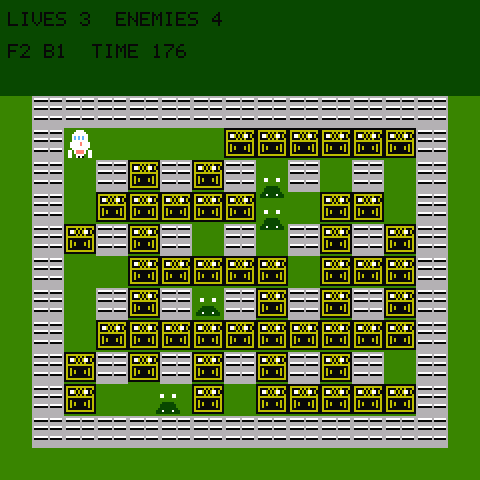
A classic Bomberbot-style game on a 13×11 grid: place bombs, chain explosions, destroy soft walls, dodge four PRNG-driven enemies, collect power-ups, and reach the exit once every enemy is dead. Movement is interpolated between cells (not a teleport-per-cell like some of the other grid examples), and every timed rule — movement, bomb fuses, explosions, the level clock — runs on a fixed 20 ms logic step, decoupled from the rendered frame rate.
A NES-style title screen (src/TitleScreenScene.cpp) runs first; pressing Start (Space / Enter on native, A / B on ESP32) swaps in the gameplay scene.
Language: C++17
Engine: gperez88/PixelRoot32-Game-Engine@^1.9.0
Environments: native, esp32dev
Category: Games
Requirements (build flags)
Set in lib/platformio.ini's [base] template, so every environment inherits them:
PIXELROOT32_ENABLE_GAMEPLAY_GRID_SPACE=1— required, not optional.BomberbotConstants.hdeclareskBoardGridas agameplay::GridSpec, and the wholeGridSpace.hheader lives behind this flag (default0), so the example does not compile without it.PIXELROOT32_ENABLE_AUDIO=1— needed for the four sound events below.PIXELROOT32_ENABLE_DEPTH_SORT=1— Y-axis ordering between the player and the enemies, so whoever stands lower on the board is drawn in front. Two details make it work: the comparator is consulted only between entities on the same render layer, soBoardRenderer(layer 0) stays behind every actor (layer 1) regardless of its Y; anddepthSortEnabledis set because actors move every frame, whereas the default only re-sorts when an entity is added or removed. The comparator keys on the sprite's bottom edge, not its top, because the feet are what read as the contact point with the floor.PIXELROOT32_ENABLE_PHYSICS=0— the physics system is never used; every blocking/collision check here is a board lookup, not a physics query.PIXELROOT32_ENABLE_PARTICLES=0— not used.PIXELROOT32_ENABLE_UI_SYSTEM=0— HUD and overlays are drawn directly withRenderer::drawText/drawTextCentered, not the UI widget system.
Display size is 240×240 in the project platformio.ini (see PHYSICAL_DISPLAY_*).
Platforms
| Environment | Display | Audio backend |
|---|---|---|
native | SDL2, 240×240 | SDL2_AudioBackend in src/platforms/native.h |
esp32dev | ST7789 240×240 | ESP32_I2S_AudioBackend in src/platforms/esp32_dev.h |
Pin choices (ST7789 SPI, I2S audio, D-pad + two buttons) are in src/platforms/esp32_dev.h — edit there if your wiring differs.
Controls
| Action | native (keyboard) | esp32dev (GPIO) |
|---|---|---|
| Move | Arrow keys | D-pad |
| Place bomb | Space | Button A |
| Restart (from Game Over / Stage Clear) | Enter | Button B |
| Start (title screen) | Space or Enter | A or B |
Movement has a fixed priority — Up > Down > Left > Right — when more than one direction is held at once, so input is never ambiguous and never diagonal. Holding a direction into a wall, a bomb, or the board edge simply leaves the player in place; it is never a death.
How audio is triggered
Audio goes through bomberbot::AudioDirector (a game-side singleton in src/audio/AudioDirector.h), which owns the SfxId enum and dispatches every sound from the Tool Suite–generated SFX bank in src/assets/audio/SfxBank.h. This is the same structure the Pixel Leap sample uses: a game-owned SfxId, a generated bank header + .pr32sfx.json sidecar, and a director that applies cooldowns, a global SFX volume, and an ESP32 DAC frequency clamp while playing layers at t=0 and scheduling sequence steps. BomberbotScene calls AudioDirector::instance().playSfx(SfxId::…) — never a raw AudioEvent — and feeds update(dtMs) each frame so delayed steps fire on time. Events tied to exact pipeline moments:
- Bomb placed —
SfxId::PlaceBomb, the step a bomb placement actually succeeds (not every press; a press rejected by the bomb limit or an already-bombed cell stays silent). - Player footsteps —
SfxId::Footstep(horizontal, Left/Right) orSfxId::FootstepSoft(vertical, Up/Down), fired exactly once per new step started viaPlayerActor::stepStarted(). - Explosion —
SfxId::BombExplosionTiny, the step any bomb(s) actually detonate, whether from a timer or a chain reaction. - Enemy death —
SfxId::EnemyDeath, the step an enemy is removed by a blast. - Power-up pickup —
SfxId::PickupPowerSoft, when a Fire/Bomb power-up is consumed. - Player death —
SfxId::Death, one shared fanfare for every death cause: explosion contact, enemy contact, or the countdown reaching zero. - Stage clear —
SfxId::StageClear, the step victory is reached (last enemy already dead, player steps onto the revealed exit).
The bank also ships SfxId::CoinBlip and SfxId::MenuBlip for future UI / pickup use; they are not currently triggered by the scene.
What it demonstrates
- Deterministic board generation.
BomberbotBoard.cppbuilds the board from a seed using the engine's seeded PRNG (math::set_seed/math::rand_int) — neverstd::rand. Hard walls sit on the border and at every even-x/even-y interior cell; every other cell is on a connected corridor lattice by construction (no reachability check needed, since soft walls are all destructible and never permanently block a corridor cell). The player's start cell and its two adjacent cells are guaranteed free of soft walls. - Interpolated grid movement. The player moves at 12 logic steps per cell, enemies at 20. Both drive the engine's
gameplay::GridMotion(include/gameplay/GridMotion.h), which owns the logical cell, the in-flight target, the arrival edge and the cell-to-pixel lerp. Movement policy stays per-actor and is deliberately not shared: the player stays put when blocked and reads held input; an enemy re-picks a direction and reads the seeded PRNG. Those decisions, plus the pass-through rule below, disagree between the two actors, soGridMotiondoes not model them. - Own-bomb pass-through. A player can always leave the cell they just bombed; that bomb becomes solid again the instant they arrive in a new cell. Enemies have no such exemption — every bomb is solid to them.
- Chain reactions. An explosion reaching another bomb detonates it immediately, in the same logic step, via a small bounded queue (at most 8 entries — the size of the bomb pool) instead of recursion, so a ring of mutually-adjacent bombs still resolves in a fixed number of iterations.
- Hidden content lives in the tile type, not a side table. The three soft-wall variants (plain, hiding the exit, hiding a power-up) render and block identically until destroyed — there is only one array that could disagree with what is drawn.
- Cell/world conversion via
gameplay::GridSpace. The board'sconstexpr GridSpecplaces the playfield below a reserved status band (containsCellrejects that band automatically, so no gameplay rule needs to know the HUD exists) — no hand-rolled* 16// 16arithmetic anywhere in the game logic. - Plain-enum state, not the engine's generic state-machine primitive. The level's five states (Loading, Playing, ExitUnlocked, StageClear, GameOver) are one plain
enum class, driven by a fixed nine-stage update pipeline that runs the same conditions in the same order every logic step. Player, bomb, and tile "state" are likewise derived from a couple of existing fields rather than stored as separate enums. - Entity budget guardrail. A
static_assert(compile-time) plus a post-initassert(development builds only — it compiles out underNDEBUGonesp32devrelease builds) both guard against the entity pool silently dropping an actor once its fixed array is full. - HUD and overlays. Lives, enemies remaining, current fire power / max bombs (
F n B n), and the countdown are drawn every frame straight from the live game state — there is no cached copy that could go stale. Game Over and Stage Clear are a text overlay drawn on top of the board, not a separate screen orScene. - Level countdown. A
TIMEvalue counts down once per logic step (never per rendered frame); reaching zero costs one life through the exact same path as an explosion or an enemy contact. The 180-second starting value is a first estimate, not a value tuned against a timed play session.
Engine documentation
- Audio API
- Core API
- Input API
- Memory system — gameplay flags and byte budgets
- Grid cell occupancy pattern — the status-band-above-the-grid layout this example uses
gameplay/GridSpace.h— the full grid conversion API
Build
From games/bomberbot:
pio run -e native
pio run -e esp32devUpload (ESP32)
pio run -e esp32dev --target uploadLicense
Source code: MIT.
| Asset | Author | License | Source |
|---|---|---|---|
| All sprite art — player, enemies, bomb, explosion, tiles, power-ups | This repository | CC0 1.0 (public domain) | Original work, generated by tools/generate_cc0_assets.py; see src/assets/README.md |
| All audio cues | This repository | CC0 1.0 (public domain) | Original work, synthesised at runtime from AudioEvent definitions in src/ |
Nothing here is derived from third-party game artwork, so the demo carries no attribution requirement of its own.
Source code: https://github.com/PixelRoot32-Game-Engine/PixelRoot32-Demo-Projects/tree/main/games/bomberbot