
Isometric Tilemap Export
Demonstration project — provided as an example of what the PixelRoot32 Game Engine can do. It is not a product: parts may be incomplete, experimental, or deliberately simplified to keep one idea in focus.
Requires engine 1.10.0 or newer. This demo uses the projection API (
ProjectionSpec, the projecteddrawTileMapoverload,expandProjectedMapBounds,cameraRangeFor,computeSpanTable), which first ships in1.10.0.
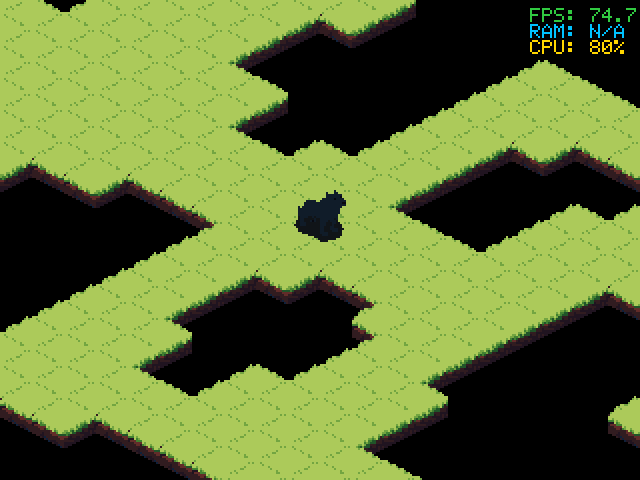
A minimal PixelRoot32 game whose entire scene comes out of the Tilemap Editor's exporter: isometric projection, 36x29 cells, a 32x16 cell stride, one ground layer, one palette slot. Nothing in src/assets/ is hand-written, and nothing in src/ corrects it.
The project exists to answer one question — does the engine paint what the editor showed? — and it is also the check that keeps the answer true.
Two isometric demos, two questions. This is the pipeline demo — an editor export reaching the screen unaltered. For what happens after the tiles are drawn — actors moving tile by tile, projection-aware depth sorting, rooms connected by a
RoomGraph— seeiso_dungeon. It carries the same temporary branch pin as this demo, and the two should be switched to@^1.10.0together.
Language: C++17
Engine: gperez88/PixelRoot32-Game-Engine@^1.10.0
Environments: native, esp32dev
Category: Graphics
Requirements (build flags)
Set in lib/platformio.ini's [base] template, so both environments inherit them:
| Flag | Value | Why |
|---|---|---|
PIXELROOT32_ENABLE_PROJECTION | 1 | The cell-to-screen basis ISO_PROJECTION is expressed in. Without it math/Projection.h compiles to nothing. |
PIXELROOT32_ENABLE_TILEMAP_PROJECTION | 1 | The projected drawTileMap overload — the whole point of the demo. Without it the only overload left is the orthogonal one, which steps by tileWidth/tileHeight and cannot place a diamond. |
PIXELROOT32_ENABLE_GAMEPLAY_GRID_SPACE | 1 | gameplay/GridMotion.h, which the player uses to walk cell to cell. It shares this flag with GridSpace, so an isometric game that never declares a GridSpec still has to enable it. |
PIXELROOT32_ENABLE_GAMEPLAY_ROOM | 1 | The export references gameplay::RoomData behind this flag. |
PIXELROOT32_ENABLE_4BPP_SPRITES | 1 | The exported tileset and the player sheets are 4bpp. Building without it is not an error — it is a black screen. |
PIXELROOT32_ENABLE_DIRTY_REGIONS | 1 | Per-tile dirty-skip on the ground layer (see Performance optimisations). ESP32 only; the native SDL2 driver ignores the dirty grid. |
PIXELROOT32_ENABLE_AUDIO | 0 | Not used. |
PIXELROOT32_ENABLE_PHYSICS | 0 | Not used — movement is grid motion, not a physics query. |
PIXELROOT32_ENABLE_PARTICLES | 0 | Not used. |
PIXELROOT32_ENABLE_UI_SYSTEM | 0 | Not used — the debug overlay draws through the renderer directly. |
PIXELROOT32_ENABLE_2BPP_SPRITES | 0 | No 2bpp art in this scene. |
Platforms
| Environment | Display | Audio |
|---|---|---|
native | SDL2 window, 320x240 | none — PIXELROOT32_ENABLE_AUDIO=0 |
esp32dev | ST7789 240x240 over SPI — MOSI 23, SCLK 18, DC 2, RST 4, CS -1 | none |
The two window sizes differ on purpose: the map is larger than either, so the view scrolls (see Scrolling) rather than showing the whole scene at once.
What it verifies
Painting the scene is one call:
renderer.drawTileMap(ground, 0, 0, LayerType::Dynamic, ISO_PROJECTION);Everything else — geometry, tile indices, tileset, tile count, per-tile foot anchor — is set by the export's own init(). If any of that stops arriving, this project stops building or starts drawing wrong, which is the point of keeping it around.
Scrolling: the engine's camera, not a local one
The map is larger than the window, so the view follows the player as it walks the cells. None of that is hand-rolled any more, and none of it touches the export:
// once, in init()
expandProjectedMapBounds(world_, ground, ISO_PROJECTION);

// every frame, in this order
camera_.setViewportSize(viewW, viewH);
const auto range = cameraRangeFor(world_, viewW, viewH);
camera_.setBounds(...); camera_.setVerticalBounds(...);   // before the position
camera_.setPosition(...);                                  // setPosition clamps
camera_.apply(renderer); // → display offsetThree things in that flow are easy to get wrong and worth naming:
expandProjectedMapBoundsis what knows how big the drawn map is. It is notMAP_WIDTH * TILE_WIDTH: under an isometric basis a step along either cell axis moves both screen axes, and 32×32 art anchored at foot row 24 overhangs its 32×16 cell. For this export the answer is 1040×536 px, derived rather than written down.- Bounds before position.
Camera2D::setPositionclamps against the bounds the camera already holds, so setting the position first clamps it against the previous frame's range — or, on frame one, against{0, 0}. apply()makes the origin zero. It writes the negated camera position into the renderer's display offset, which every later primitive honours — the tilemap above and the player's sprite alike. That is why thedrawTileMapcall passes0, 0, and why the player takes no camera argument. Passing the camera at a call site as well would count it twice.
What the export carries
inline constexpr uint8_t TILE_WIDTH  = 32;   // the CELL stride
inline constexpr uint8_t TILE_HEIGHT = 16;   // not the bitmap size
inline constexpr uint8_t MAP_WIDTH   = 36;
inline constexpr uint8_t MAP_HEIGHT  = 29;

inline constexpr pixelroot32::math::ProjectionSpec ISO_PROJECTION{
    464, 24,
     16,  8,
    -16,  8};

inline constexpr uint16_t TILESET_TILE_COUNT = 2;
extern const uint8_t TILESET_FOOT_Y[TILESET_TILE_COUNT];Both origin components are derived rather than guessed. originX = 464 is the map's own western inset, rows * cellW / 2 = 29 * 32 / 2. originY = 24 is max(foot), which is what keeps the tallest sprite's top edge from crossing y = 0 — and 24 is derivedFootY(32, 16, Isometric), i.e. tileHeight - cellHeight / 2.
The foot table is parallel to the layer's tiles[] — tileFootY is indexed by the same tile slot tiles[] uses, so the export emits it right alongside the tileset. Two tiles here: index 0 is the exporter's empty sentinel (foot 0), index 1 the 32×32 ground tile anchored at foot row 24.
The defect this project found
Built against the first export of this scene, it did not link:
undefined reference to `isometric_scene::main_scene::TILESET_FOOT_Y'Three separate gaps in the Tool Suite's cpp_code_generator.cpp, since fixed:
init()never assignedtileFootY— on either palette path. That one was silent: it compiled, it linked, it rendered, and every tile anchored at its top-left corner instead of its foot, so the whole map drew a foot-height too low.- Multi-palette exports never defined the table. The definition was emitted from the single-palette tileset helper, while the header declared the
externunconditionally. - The table was sized from the raw tilesheet, not the deduped pool. Dedup collapses identical tiles, so the two arrays have different lengths and a different order, and
footYFor()bounds-checks against the pool'stileCount.
A fourth is latent rather than fixed: both sprite emitters hardcode ctx.tileSize for width and height, so a 32x40 wall sheet would export as 32x32. This project's art is 32x32, so it does not bite — but the reference contract at iso_dungeon mixes 32x16 floors with 32x40 walls, which is the normal isometric case.
Performance optimisations
Two opt-in engine optimisations for isometric ground layers are enabled here (see platformio.ini and IsoTilemapExportScene::init):
- Per-tile dirty-skip (
PIXELROOT32_ENABLE_DIRTY_REGIONS=1). When the camera is stationary and the layer isDynamic, the projected tilemap loop blits only the tiles whose screen rect intersects a dirty cell — a few tiles instead of the ~200 the camera window covers. It takes effect only on an 8bpp framebuffer (ESP32/TFT_eSPI); the native SDL2 driver skips the dirty grid entirely, so the effect is invisible underpio run -e native. - Span-limited blit (
computeSpanTable). The 32×32 ground tile is a diamond with transparent padding top and bottom, yet the blit decodes all 1024 nibbles.init()copies the twoSprite4bppdescriptors into RAM, computes the per-row opaque span, and repointsground.tilesat the copies. The pixel data stays in flash; only the 16-byte descriptors move. Copying to RAM rather thanconst_cast-writing the exportedstatic constdescriptors matters on ESP32, where they may live in flash and a write would be a LoadStoreError.
computeSpanTable reads pixel data through PIXELROOT32_READ_BYTE_P (pgm_read_byte on ESP32, a plain dereference on native), so flash-resident art is read safely on every target.
Build
pio run -e native
.pio/build/native/program.exeThe window is 320x240 on native and 240x240 on esp32dev (platformio.ini). The map is wider and taller than that — see the camera section above — which is the reason the view scrolls instead of showing the whole scene at once.
PlatformIO fetches the engine itself from the branch pinned in platformio.ini; no local engine checkout is needed. Native builds also need SDL2 — from MSYS2/MinGW on Windows, libsdl2-dev on Linux, brew install sdl2 on macOS. The platformio.ini here ships with the Windows/MSYS2 include and library paths; remove the -IC:/msys64/..., -LC:/msys64/... and -mconsole flags on the other two.
Upload (ESP32)
pio run -e esp32dev --target uploadProject layout
platformio.ini                 native and esp32dev environments
lib/platformio.ini             shared build templates
src/main.cpp
src/platforms/                 native (SDL2) and esp32dev entry points
src/IsoTilemapExportScene.*    the projected drawTileMap call and the camera
src/actors/PlayerActor.*       the player actor that walks the exported cells
src/assets/ exporter output, untouchedRe-exporting
Overwrite src/assets/ from the editor and rebuild. If it still links and the tiles still sit in their diamonds, the export contract held.
License
Source code: MIT.
| Asset | Author | License | Source |
|---|---|---|---|
Isometric ground tileset, baked into src/assets/tilemap/ by the Tilemap Editor exporter | scrabling | CC BY 4.0 | Pixel Isometric Tiles |
Player idle and run sheets, 64x64, in src/assets/sprites/ | scrabling | CC BY 4.0 | same pack |
Art by scrabling, used under CC BY 4.0 and re-encoded to the engine's 4bpp nibble-packed format. The pack ships here as generated content files of this demo, not as a redistributable copy of the pack: the author's own terms permit exactly that use and prohibit redistributing the assets on their own or as part of a collection. If you want the tiles themselves, get them from the link above.
Source code: https://github.com/PixelRoot32-Game-Engine/PixelRoot32-Demo-Projects/tree/main/graphics/iso_tilemap_export