
Palette Swap
Demonstration project — provided as an example of what the PixelRoot32 Game Engine can do. It is not a product: parts may be incomplete, experimental, or deliberately simplified to keep one idea in focus.
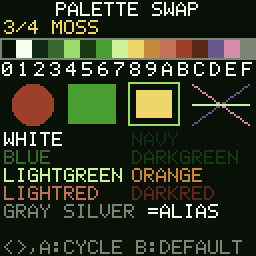
One scene, drawn exactly once, repainted four different ways. Every primitive in draw() names a Color enumerator, and a Color enumerator is a palette index rather than an RGB value — so a single setCustomPalette() call changes all sixteen colours on screen without the drawing code changing at all.
Language: C++17
Engine: gperez88/PixelRoot32-Game-Engine@^1.9.0
Environments: native, esp32dev
Category: Graphics
Requirements (build flags)
Nothing needs enabling. Palette handling is core renderer behaviour, not an opt-in subsystem: setPalette(), setCustomPalette() and resolveColor() are always compiled in, and the Color enum is part of graphics/Color.h with no feature guard around it. There is no PIXELROOT32_ENABLE_PALETTE, and the absence is the point — you do not pay to adopt this, and you cannot turn it off.
What the demo does set are four disables, so the flag list stays honest about what a palette-only demo costs:
| Flag | Value | Why | Cost if left on |
|---|---|---|---|
PIXELROOT32_ENABLE_AUDIO | 0 | The demo is silent. | ~17 KB RAM: mixer voices + command queue |
PIXELROOT32_ENABLE_PHYSICS | 0 | Nothing moves, so nothing collides. | ~9 KB RAM: CollisionSystem + scheduler |
PIXELROOT32_ENABLE_UI_SYSTEM | 0 | The HUD is four drawText() calls. | ~9 KB RAM: UIManager widget/hit-test tables |
PIXELROOT32_ENABLE_PARTICLES | 0 | No emitters. | ~2 KB RAM: particle pool |
Together those four release roughly 37 KB of RAM on ESP32. They live in lib/platformio.ini under [base], alongside the language flags (-std=gnu++17, -fno-exceptions, and -fno-rtti on ESP32).
Turning any of them back on is not an error — it is silent RAM you are not using.
Platforms
| Environment | Display | Driver | Audio backend |
|---|---|---|---|
native | 128x128 logical, SDL2 window | DisplayType::NONE (SDL2_Drawer) | none — PIXELROOT32_ENABLE_AUDIO=0 |
esp32dev | 128x128 ST7735 (GREENTAB3), SPI @ 40 MHz | DisplayType::ST7735 (TFT_eSPI_Drawer) | none — PIXELROOT32_ENABLE_AUDIO=0 |
Both targets render the same 128x128 logical frame. Pin assignments for esp32dev are in platformio.ini; the display and input wiring lives in src/platforms/.
Controls
| Button | Native key | ESP32 pin | Action |
|---|---|---|---|
| Left | Left arrow | GPIO 33 | Previous palette |
| Right | Right arrow | GPIO 14 | Next palette |
| A | Space | GPIO 13 | Next palette (cycles, wraps 4 → 1) |
| B | Enter | GPIO 12 | Return to the engine's built-in PR32 palette |
Pressing A, Left or Right after B resumes the cycle from where it left off — B changes the palette, not the position in the list.
What it demonstrates
The Color enum is an index, not a colour
pixelroot32::graphics::Color enumerators are the palette indices 0-15. Entry n of a custom palette is what Color::<name> resolves to:
| Index | Enumerator | Index | Enumerator |
|---|---|---|---|
| 0 | Black | 8 | Yellow |
| 1 | White | 9 | Orange |
| 2 | Navy | 10 | LightRed |
| 3 | Blue | 11 | Red |
| 4 | Cyan | 12 | DarkRed |
| 5 | DarkGreen | 13 | Purple |
| 6 | Green | 14 | Magenta |
| 7 | LightGreen | 15 | Gray |
The names are historical labels for the default PR32 table. Under this demo's EMBER palette, Color::Blue is a brown; under MONO it is a dark grey. Nothing in draw() knows or cares — the swatch strip on screen is drawn by casting a loop counter straight to Color, which is legal precisely because the enumerator is the index.
Several names are aliases of the same slot
Editing one entry moves every name that collapses onto it. These are the aliases the engine header declares:
| Slot | Canonical | Aliases |
|---|---|---|
| 2 | Navy | DarkBlue |
| 3 | Blue | LightBlue, DebugBlue |
| 4 | Cyan | Teal |
| 5 | DarkGreen | Olive |
| 6 | Green | DebugGreen |
| 8 | Yellow | Gold |
| 11 | Red | DebugRed |
| 12 | DarkRed | Brown, Maroon |
| 14 | Magenta | Pink, LightPurple |
| 15 | Gray | MidGray, LightGray, DarkGray, Silver |
Color::Silver == Color::Gray compares true. There is no separate silver to tune: a palette author who "fixes" Silver has just moved DarkGray, LightGray, MidGray and Gray too. The demo draws the words GRAY and SILVER side by side, in Color::Gray and Color::Silver, so the collapse is visible rather than merely documented.
Color::Transparent (255) is the odd one out: it is a sentinel intercepted by the renderer, never resolved against a palette, and passing it to a drawing primitive is a no-op.
Single Palette Mode is what this demo runs in
graphics/Color.h documents two modes:
- Single Palette Mode (default) — one global palette resolves every draw, background and sprite alike.
- Dual Palette Mode — enabled by
enableDualPaletteMode(true); backgrounds resolve againstbackgroundPaletteand sprites againstspritePalette, andresolveColor(color, context)picks between them.
This demo stays in Single Palette Mode and never calls enableDualPaletteMode(). setCustomPalette() and setPalette() are documented as the legacy (single) entry points, and reading their implementations shows what that means in practice: each one assigns the same pointer to currentPalette, backgroundPalette, spritePalette, and to slot 0 of both the 8-entry background and sprite slot banks, while deliberately leaving dualPaletteMode false. So one call really does repaint everything — that breadth is a property of the single-palette entry point, not of palettes in general.
The practical implication: because slot 0 of each bank is also rewritten, a demo that later adopts multi-palette tilemaps or sprites (setBackgroundPaletteSlot, setSpritePaletteSlot, slots 0-7) will find its slot 0 already pointing at whatever setCustomPalette() last handed over. Slots 1-7 are untouched.
The engine keeps your pointer — it does not copy the entries
setCustomPalette(const uint16_t*) stores the pointer and nothing else. This is stated in the header and confirmed in the engine's src/graphics/Color.cpp, where the function assigns the argument to currentPalette (and the bank slots) with no copy loop, and resolveColor() dereferences that same pointer on every single draw call for the rest of the run.
So a palette handed to the engine must outlive every frame that uses it. The four tables in src/assets/Palettes.h are inline constexpr at namespace scope, which gives them static storage duration and puts them in flash/rodata. A palette built as a local in init() would compile and run, and then resolve colours out of a dead stack frame.
The header also nullptr-guards: setCustomPalette(nullptr) is a no-op that leaves the previous palette active, rather than crashing on the next draw.
The greyscale palette is the proof
Cycle to 4/4 MONO. Every shape keeps its shape, its size and its position, and loses its hue. That is only possible because the draw code stored slot numbers the whole time.
Project layout
graphics/palette_swap/
├── platformio.ini            # envs, board, display size, TFT pins
├── lib/platformio.ini        # [base] language flags + the four disables
└── src/
    ├── main.cpp              # platform selector, nothing else
    ├── PaletteSwapScene.h    # layout constants, button indices, state
    ├── PaletteSwapScene.cpp  # one draw path; the swap is one line
    ├── assets/Palettes.h     # the four palettes + the index/alias tables
    └── platforms/
        ├── native.h          # SDL2 DisplayConfig, InputConfig, Engine, main()
└── esp32_dev.h # ST7735 DisplayConfig, GPIO InputConfig, setup/loopupdate() and draw() allocate nothing: the HUD line is snprintf'd into a fixed member buffer, and only on the frames where the palette actually changed.
Build
cd graphics/palette_swap

pio run -e native                # build the SDL2 simulator
pio run -e native --target exec  # build and run it
pio run -e esp32dev              # build the ESP32 firmware
pio run -t clean -e nativeThe committed [env:native] build_flags target Windows/MSYS2. On Linux or macOS remove the -IC:/msys64/..., -LC:/msys64/... and -mconsole lines; on macOS also uncomment the two Homebrew lines above them.
Upload (ESP32)
cd graphics/palette_swap

pio run -e esp32dev --target upload
pio device monitor -b 115200Engine documentation
- PixelRoot32 Game Engine
include/graphics/Color.h— theColorenum, the alias list, and both palette modesinclude/graphics/PaletteDefs.h— the built-in NES / GB / GBC / PICO8 / PR32 tablesinclude/graphics/Renderer.h— the drawing primitives used hereinclude/core/Scene.h— theinit/update/drawcontract
License
This demo ships no art assets — no sprites, no tilesets, no fonts, no audio. Everything on screen is drawn from renderer primitives and the engine's built-in 5x7 font.
The four palettes in src/assets/Palettes.h (EMBER, SIGNAL, MOSS, MONO) are original work created for this demo, released under the same MIT license as the rest of the repository. They are hand-authored RGB565 constants, not derived from any existing palette collection.
The source code is licensed under the MIT License.
Source code: https://github.com/PixelRoot32-Game-Engine/PixelRoot32-Demo-Projects/tree/main/graphics/palette_swap