
Touch Controls
Demonstration project — provided as an example of what the PixelRoot32 Game Engine can do. It is not a product: parts may be incomplete, experimental, or deliberately simplified to keep one idea in focus.
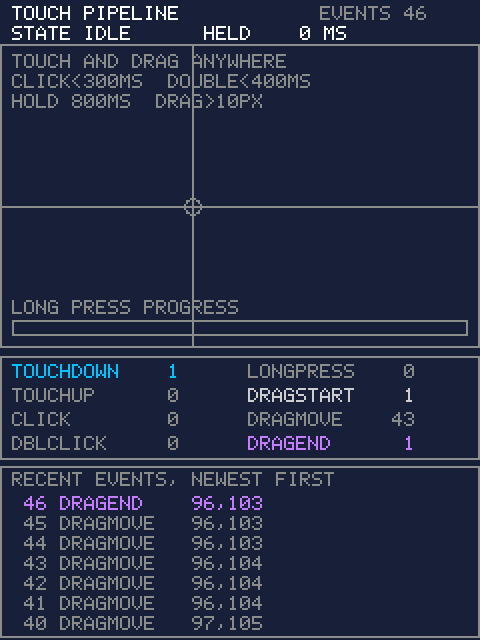
One screen that reports every gesture the engine's touch pipeline produces, at the moment it produces it. A crosshair follows the live touch point, the current TouchState is printed at the top, a counter per gesture type proves the rare ones are reachable, and a rolling log shows the last seven events with their type and coordinates. The single idea is that the game never sees a raw touch: hardware goes through an adapter, into a state machine, into a queue, and only then into one virtual method — and this demo makes each of those stages' output visible instead of describing it.
Language: C++17
Engine: gperez88/PixelRoot32-Game-Engine@^1.9.0
Environments: native, esp32cyd
Category: Input
Requirements (build flags)
Set in lib/platformio.ini (base template, inherited by every environment).
| Flag | Set to | Why |
|---|---|---|
PIXELROOT32_ENABLE_TOUCH | 1 | The topic — and it defaults to 0, so a demo about touch that forgets it is a demo about nothing. It gates Engine and only Engine: at 0 the Engine's touchDispatcher and touchManager members, its getTouchDispatcher() / hasTouchEvents() / setTouchManager() accessors, and the per-frame block in Engine::update() that drains the queue into Scene::processTouchEvents() are all compiled out. Building at 0 is not an error. Everything still compiles and links, the window still opens, the readout still draws — the queue is simply never filled and never drained, so the log stays empty forever. The failure mode is silence, not a diagnostic. |
PIXELROOT32_ENABLE_AUDIO | 0 | Defaults to 1. This demo is silent, and audio is the engine's most expensive default: roughly 17 KB of RAM for voice state and mixing buffers nothing here would write to. |
PIXELROOT32_ENABLE_PHYSICS | 0 | Defaults to 1. The scene owns no Actor and in fact no entity at all; it draws Renderer primitives. Roughly 9 KB of RAM for CollisionSystem and SpatialGrid that would sit reserved and unused. |
PIXELROOT32_ENABLE_PARTICLES | 0 | Defaults to 1. No effects. Roughly 2 KB of RAM for the emitter pool. |
PIXELROOT32_ENABLE_UI_SYSTEM | 0 | Defaults to 1, and turning it off here is the point rather than a saving. Scene::processTouchEvents() runs UIManager::processEvents() first and lets it mark events consumed; only what survives reaches onUnconsumedTouchEvent(). This demo is about the layer below the UI, so it registers no widgets and draws its readout with Renderer primitives — which is what guarantees every gesture the state machine emits reaches the scene unconsumed and gets logged. |
What the flag does not gate is worth as much as what it does:
InputManagerembeds aTouchEventDispatcherunconditionally and exposesgetTouchEvents()/hasTouchEvents()/getTouchState()at every setting.TouchEventDispatcher.hcontains no#ifat all, and neither doTouchEvent.h,TouchEventTypes.horTouchStateMachine.h.TouchManager's conditionals select a driver —PLATFORM_NATIVE,TOUCH_DRIVER_XPT2046,TOUCH_DRIVER_GT911— and never test this flag.
So the only #if PIXELROOT32_ENABLE_TOUCH in this demo's own source guards Engine::getTouchDispatcher() in TouchControlsScene::update() and Engine::setTouchManager() in the ESP32 platform header. Wrapping the dispatcher, the manager or InputManager::getTouchEvents() in that flag would be guarding code the flag has no opinion about.
And setting the flag is not sufficient on hardware: without a TOUCH_DRIVER_* define, TouchManager selects no adapter and the panel is never read. Driver choice is a separate axis — see esp32cyd's -D TOUCH_DRIVER_XPT2046 in platformio.ini.
Platforms
| Environment | Display | Driver | Touch | Audio backend |
|---|---|---|---|---|
native | 240x320 logical, SDL2 window | SDL2_Drawer (DisplayType::NONE) | Mouse, forwarded into the dispatcher by the drawer | none (PIXELROOT32_ENABLE_AUDIO=0) |
esp32cyd | 240x320 ILI9341 | TFT_eSPI_Drawer (DisplayType::ILI9341_2) | XPT2046 resistive panel via TouchManager, TOUCH_CS=33 on its own GPIO bus | none (PIXELROOT32_ENABLE_AUDIO=0) |
Why esp32cyd and not esp32dev. CONTRIBUTING.md makes esp32dev the default hardware target unless the demo needs something that board does not have, and names games/chess as the exception that shows the rule: touch is its whole interaction model and the generic ST7789 board has no panel. This demo is exactly that case, only more so — a build of it on a panel-less board would draw a permanently empty log. So it ships the ESP32-2432S028 "Cheap Yellow Display" instead, whose XPT2046 panel is the hardware the demo is about. CI reads the build matrix from each demo's own [env:*] sections, so shipping a non-default board needs no workflow change.
The touch wiring and calibration in the esp32cyd environment are copied from games/chess, which follows the engine's own 2048 example. Resistive panels vary: retune XPT2046_RAW_*_LO / _HI by touching the corners if the crosshair does not reach the edges.
Controls
| Input | Native | esp32cyd |
|---|---|---|
| Touch down / up | Left mouse button | Finger on the panel |
| Move | Mouse motion with the button held | Finger drag |
There are no buttons. On native the mouse is the finger: SDL2_Drawer::processEvents() converts SDL_MOUSEBUTTONDOWN, SDL_MOUSEBUTTONUP and SDL_MOUSEMOTION into TouchEventDispatcher::processTouch(0, pressed, x, y, SDL_GetTicks()) — the same call the XPT2046 path reaches through TouchManager. Window coordinates are scaled and offset into framebuffer coordinates and clamped to the logical bounds before they enter the pipeline, so the two targets behave identically.
To provoke each gesture:
| Gesture | How |
|---|---|
TouchDown | Press. Always the first event. |
TouchUp | Release any press that did not become a drag. It fires on its own if the press lasted longer than 300 ms. |
Click | Press and release within 300 ms, without leaving the 10 px ring. Arrives right after that release's TouchUp, never instead of it. |
DoubleClick | A second click within 400 ms of the first. The second release emits TouchUp + DoubleClick — the Click is replaced, not added to. |
LongPress | Hold still for 800 ms — the progress bar fills as you wait. It fires while your finger is still down; the later release still emits TouchUp. |
DragStart | Move more than 10 px from where you pressed, while still held. |
DragMove | Keep moving. |
DragEnd | Release while dragging. A drag release emits DragEnd only — no TouchUp and no Click, which is what stops a piece dropped on a button from also pressing it. |
The log makes those orderings visible: a quick tap logs two lines, a double-click's second tap logs DoubleClick above TouchUp, and a drag release logs exactly one.
The cyan ring drawn around the press point is the DRAG_THRESHOLD radius: leaving it is the exact frame the state machine stops calling the gesture a press and starts calling it a drag.
What it demonstrates
The four stages, and where each one's output shows up on screen.
- Adapter. Hardware becomes a normalized
TouchPoint. Onesp32cyd,TouchManagerowns the XPT2046 adapter selected by-D TOUCH_DRIVER_XPT2046and applies theTouchCalibrationpreset set insrc/platforms/esp32_cyd.h. Onnative,SDL2_Drawerplays the same role for the mouse. Output: the coordinates the crosshair sits at. - State machine.
TouchStateMachineconsumes points and tracks oneTouchStateper touch id —Idle,Pressed,LongPress,Dragging— emitting a semanticTouchEventon each transition. Output: theSTATEline in the header, read every frame fromEngine::getTouchDispatcher().getTouchState(0). - Queue.
TouchEventQueueholds up toTOUCH_EVENT_QUEUE_SIZE(16) events of 12 bytes each — 192 bytes total — andEngine::update()drains it once per frame withgetEvents(). It is a pull model: nothing calls the game back. Output: several events can land in one frame, which the log shows as a burst of consecutive sequence numbers. - Scene.
Scene::processTouchEvents()offers the drained buffer toUIManagerfirst (compiled out here), then hands each still-unconsumed event toonUnconsumedTouchEvent(). Output: everything in the log and the counters. That one virtual method is the entire touch API a scene needs.
The gesture timing constants, from input/TouchEventTypes.h. The demo prints them from the constants themselves rather than from literals, so the screen cannot drift from the state machine that enforces them:
| Constant | Value | Meaning |
|---|---|---|
TouchTiming::CLICK_MAX_DURATION | 300 ms | Press-to-release longer than this is a TouchUp, not a Click. |
TouchTiming::DOUBLE_CLICK_INTERVAL | 400 ms | Two clicks closer together than this become a DoubleClick. |
TouchTiming::LONG_PRESS_THRESHOLD | 800 ms | Held longer than this without moving fires LongPress. |
TouchTiming::DRAG_THRESHOLD | 10 px | Movement past this promotes a press to a drag. |
The consumed flag. Every touch handler starts with
if (event.isConsumed()) return;TouchEvent carries TouchEventFlags::Consumed in a byte of its 12, and Scene::processTouchEvents() passes a mutable buffer so earlier consumers can set it in place. Nothing marks events in this demo — the UI system is off — but the check is not decoration: the moment a UIManager is added, a button press that also reached the scene behind it would fire twice.
Zero allocation. The log is a fixed seven-slot ring buffer of 8-byte members (56 bytes), the counters are eight uint16_t, and every string is formatted with snprintf into one 40-byte member buffer at draw time. Nothing in update() or draw() touches the heap.
Project layout
input/touch_controls/
├── .gitignore
├── README.md
├── platformio.ini          # native + esp32cyd environments
├── lib/platformio.ini      # [base] / [base_native] / [base_esp32] templates
└── src/
    ├── main.cpp            # platform selector, nothing else
    ├── TouchControlsScene.h
    ├── TouchControlsScene.cpp
    └── platforms/
        ├── native.h        # DisplayConfig, InputConfig, Engine, main()
└── esp32_cyd.h # DisplayConfig, InputConfig, Engine, TouchManager, setup()/loop()Build
cd input/touch_controls

pio run -e native                # build the SDL2 simulator
pio run -e native --target exec  # build and run it
pio run -e esp32cyd              # build for the Cheap Yellow Display
pio run -t clean -e nativeOn Linux and macOS, remove the -IC:/msys64/..., -LC:/msys64/... and -mconsole lines from [env:native]; on macOS also uncomment the two Homebrew lines above them. CI does the same with sed -i -e '/msys64/d' -e '/-mconsole/d'.
Upload (ESP32)
cd input/touch_controls

pio run -e esp32cyd --target upload
pio device monitor -e esp32cyd # 115200 baudEngine documentation
License
This demo ships no art and no audio assets. Every pixel on screen is a Renderer primitive or a glyph from the engine's built-in 5x7 font, so there is nothing to attribute.
The demo source is licensed under the same terms as this repository — see LICENSE.
Source code: https://github.com/PixelRoot32-Game-Engine/PixelRoot32-Demo-Projects/tree/main/input/touch_controls