
DOOM (PixelRoot32 port)
Shareware DOOM (1993), episode 1, running on an ESP32 DevKit — a classic ESP32 (the esp32dev PlatformIO board: 240 MHz dual core, 4 MB flash, 327,680 B of DRAM, no PSRAM) with a 240x320 ILI9341 panel wired to it, mounted in portrait and rotated a quarter turn to a 320x240 frame. All nine levels of E1 play with the status bar, the weapon, the menu, the automap, sound effects, music, level transitions and six save slots.
The engine supplies what a 1993 renderer does not need to own again: an 8bpp surface, the 8bpp-to-panel present path, input, persistence and the APU audio backend. Everything above that line — the BSP renderer, the game loop, the fixed-point math, the WAD reader — is DOOM's own code in lib/doom/, kept at arm's length from the engine.
Language: C++17 (+ C99 for the DOOM core)
Engine: PixelRoot32-Game-Engine 1.14.0 (gperez88/PixelRoot32-Game-Engine@^1.14.0 from the PlatformIO registry)
Platform: espressif32@7.1.2 (Arduino-ESP32 2.0.17), pinned in lib/platformio.ini
Shipped environment: esp32dev_ILI9341
Category: Games
Screenshots
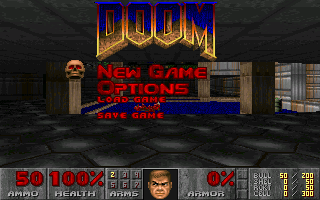
Main menu over the paused level.
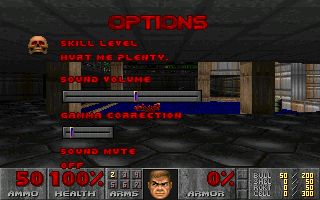
The OPTIONS screen at its default values.
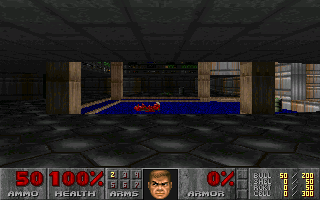
E1M1 at the spawn point, with the status bar.
All three are the native build's own captures, produced by three native recipes (frame 20 for gameplay, 80 for the menu, 140 for the options screen) that set DOOM_MENU_SCRIPT=1, DOOM_SCREENSHOT and DOOM_SCREENSHOT_PATH through PLATFORMIO_BUILD_FLAGS; each writes the finished 320x200 surface as a PPM and then converts that PPM to PNG, so the frames reproduce byte for byte instead of being mock-ups.
Quick path
- Build the firmware:
pio run -e esp32dev_ILI9341(fromgames/doom). - Get the shareware
DOOM1.WADv1.9 and build the containers: the board's.\tools\make_container.ps1 -Wad C:\path\to\DOOM1.WAD -Flash -Port COM4, and fornativethe full-sprite.\tools\make_container.ps1 -Wad C:\path\to\DOOM1.WAD -Out tools\DOOM1-full.whd -FullSprites. - Flash the app:
pio run -e esp32dev_ILI9341 -t upload --upload-port COM4. - Open the serial monitor at 115200 and look for
SHOW,boot,screen=game,level=E1M1,open_ms=....
Each step is explained below.
The one constraint that shapes everything
DOOM renders 320x200, and 320 is structural rather than a setting: SCREENWIDTH sizes distscale[], every visplane_t (top[320] / bottom[320]), floorclip / ceilingclip and the status bar layout. So the logical surface is fixed at 320x200 on every environment.
The rotated ILI9341 frame is 320x240, so the surface fits 1:1 with a 20 px bar above and below — no scaling, no crop.
| Environment | Window | What it does |
|---|---|---|
native | 640x400 (a 320x200 surface at 2x) | SDL2 window from SDL2_Drawer (windowScale = 2, integer nearest-neighbour); runs the full profile below -- per-level music, its own full-sprite container, vanilla's screen melt and twin index planes -- with the HUD, the menu, the palette flashes and the APU audio |
esp32dev_ILI9341 | 320x200 + 2x20 px bars | the board, 1:1 |
The full native profile
[env:native] defines -D DOOM_FULL_PROFILE=1; no shipped 4 MB environment does (the host sound_test defines it too, so its assertions exercise the native bank). It is the only additive gate: it adds features to native, changes nothing in a 4 MB build, and there is no separate profile environment. It turns on four things the 4 MB image leaves out:
| Feature | What the gate adds | Evidence |
|---|---|---|
| Per-level music | nine committed themes, src/assets/music/MusE1M1..9.inc, one per level id; 192,816 B of note data added (227,136 B in total, E1M1's 34,320 B included) | SHOW,music,event=start,track=e1mN,... names the level's theme |
| Full sprite container | the default container becomes tools/DOOM1-full.whd through -D DOOM_WHD_DEFAULT="tools/DOOM1-full.whd", built with make_container.ps1 -FullSprites; it keeps all 239 frames the shipped recipe drops | 3,349,928 B of the 3,375,104 B wad row (25,176 B spare), with 370/384 manifest entries |
| Twin index planes | two 320x200 8bpp planes, alternated per frame; the previous completed plane feeds the melt | SHOW,twin,planes=2,bytes=128000 at boot |
| Vanilla screen melt | a level transition runs vanilla's column melt over its two screen copies and reports every step | SHOW,melt,frame=..,step=..,done=.., 18 steps (observed E1M1 to E1M2 beside SHOW,level,from=E1M1,to=E1M2) |
The 4 MB image keeps every cut: it reads tools/DOOM1.whd (3,078,396 B, 296,708 B spare), ships E1M1's theme only, keeps its 8-step palette fade (SHOW,fade,steps=8) and has no twin planes. The simulator is the only target with the full set; a 16 MB ESP32-S3 hardware profile does not exist.
Why the build flags look transposed
DisplayConfig::applyRotationNormalization() swaps width and height — and the offsets — whenever the rotation is odd. The flags therefore state the geometry in the panel's own portrait axes:
| Flag | Value | After the swap |
|---|---|---|
PHYSICAL_DISPLAY_WIDTH / _HEIGHT | 200 / 320 | 320x200 window |
LOGICAL_WIDTH / _HEIGHT | 200 / 320 | 320x200 surface |
X_OFF_SET / Y_OFF_SET | 20 / 0 | 20 px bars above and below |
The platform header static_asserts that translation, so a flag set that does not resolve to 320x200 fails the build instead of drawing off-panel.
Build and upload
From games/doom:
pio run -e native
pio run -e esp32dev_ILI9341If pio is not on PATH, use the PlatformIO venv's copy (%USERPROFILE%\.platformio\penv\Scripts\pio.exe on Windows).
The native build needs SDL2 (libsdl2-dev on Linux, brew install sdl2 on macOS, MSYS2/MinGW on Windows). The [env:native] flags ship with the MSYS2 paths; swap them for the commented Homebrew lines on macOS.
The simulator does not embed the game's data: it opens a compressed container from disk, built once with tools/make_container.ps1 (or tools/whd_encode.py plus tools/bake_graphics.py). native reads tools/DOOM1-full.whd, the full-sprite build described under "Get the WAD and build the container"; the board reads tools/DOOM1.whd. Both live next to the WAD and are resolved relative to the working directory, so run the simulator from games/doom. DOOM_WHD overrides the path. The containers and the WAD are all gitignored, so regenerate rather than commit them.
The native controls are the board's, on a keyboard: arrows walk and turn, A (attack) is Space, B (use and run) is Enter, and Start is Escape, which opens and closes the menu. Select has no native key, so the automap is board-only.
The three native recipes each build the same game, run it headless, write one finished frame as a PPM and exit. Set PLATFORMIO_BUILD_FLAGS in the same PowerShell invocation as pio run: PlatformIO's build task rebuilds when the flags change, and it does not carry a variable set in another shell. Every flag recipe below uses that shape with the environment named in the text. A complete capture is
$env:PLATFORMIO_BUILD_FLAGS='-D DOOM_MENU_SCRIPT=1 -D DOOM_SCREENSHOT=20 -D DOOM_SCREENSHOT_PATH=\".pio/screenshots/gameplay.ppm\"'; pio run -e native -t execwith DOOM_SCREENSHOT=80 and menu.ppm for the main menu and 140 and settings.ppm for the options screen.
pio run -e esp32dev_ILI9341 --target upload
pio device monitoresp32dev_ILI9341 is the one board environment and the shipped image: it selects partitions_wad.csv and carries the full feature set. The diagnostic and measurement builds below are flag recipes or local configuration edits on it, never a separate image.
Do not run pio pkg update on this project. The platform pin is load-bearing: an unpinned update moves espressif32@7.1.2 (Arduino-ESP32 2.0.17) to 8.0.0 (Arduino 3.x), and the same sources then measure 686,446 B of flash and overflow dram0_0_seg by 680 B. Bumping the platform is a repartition decision, not a routine update. The host test environments link_test and sound_test name gperez88/PixelRoot32-APU@^2.3.0 explicitly; the firmware gets the APU through the engine's own dependency (the engine requires ^2.3.0).
What 1.14.0 carries
The port needs four things the engine did not have before 1.14.0: a present path whose frame transfer can be closed before the next frame (the 20-line DMA block, PIXELROOT32_DRAIN_PRESENT), a caller-supplied 8bpp expansion table (the PLAYPAL path), the persistence module (PIXELROOT32_ENABLE_PERSISTENCE: the key-value and slot stores, the RecordCodec envelope and the ESP32 NVS adapters), and the APU hybrid-synthesis work with its render block. All four ship in that release, so the pin is gperez88/PixelRoot32-Game-Engine@^1.14.1. The engine contains no DOOM source; the GPL boundary is this demo's binary, not the engine tree (see License).
Get the WAD and build the container
The firmware does not ship DOOM's data. DOOM1.WAD is id Software's shareware artwork under its own terms, not the GPL, and it is 4,196,020 B -- larger than the board's entire flash. Download the shareware WAD from the Doom Archive's Shareware page:
https://www.doomarchive.com/ListFiles.php?FolderId=216&ContentsFolderId=216
Take v1.9 -- doom19s.zip, or doom1.wad.zip for the WAD on its own. The v1.0 release listed on the same page is a different WAD: the port's container, partition sizes and graphics bake are all measured against v1.9, so a v1.0 file will not match them.
Then turn it into the containers, from games/doom. The board reads the trimmed container:
.\tools\make_container.ps1 -Wad C:\path\to\DOOM1.WADIt writes tools/DOOM1.whd -- 3,078,396 B of the wad partition's 3,375,104 -- and proves the result four ways: the WAD rebuilds byte for byte, the container parses, all nine levels open through lib/doom/doom_map.c, and every baked texture recomposes from the source WAD's patches. A fifth gate, tools/hud_check.py, proves the 86 status-bar patches listed in tools/hud_lumps.txt (generated by tools/gen_hud_lumps.py) are stored raw and equal their source patches; they are kept raw by name, not registered in the bake manifest, so they cost no RAM. The same holds for the weapon (psprite) art: tools/weapon_check.py proves the 28 patches of tools/weapon_lumps.txt (generated by tools/gen_weapon_lumps.py from weaponinfo[] and the state table), and for the menu: tools/menu_check.py --container proves the 17 menu patches and the HU font of tools/menu_lumps.txt (generated by tools/gen_menu_lumps.py). The encode also reads kBakedCapacity out of src/doomc/BakedGraphics.h and refuses a bake whose manifest holds more records than the firmware can: that budget is separate from the flash one, and a container past it is rejected whole at boot. The baker stores a mask plane only for textures TEXTURE1 marks as masked; an opaque texture's patch gaps are palette 0, which vanilla draws as black.
-Flash writes the container to the board at 0x0C0000 after building it:
.\tools\make_container.ps1 -Wad C:\path\to\DOOM1.WAD -Flash -Port COM4native reads tools/DOOM1-full.whd, the same recipe with -FullSprites: every sprite lump stays instead of the 239 frames no list can name (264,819 B stored). Those frames are not baked -- the PWBAKE manifest and kBakedCapacity are unchanged -- so they are decoded on demand through the container's name directory.
.\tools\make_container.ps1 -Wad C:\path\to\DOOM1.WAD -Out tools\DOOM1-full.whd -FullSpritesThat build is native-only. It is a host file, not a flash image: the script measures it against the container format's own size field instead of the wad partition and refuses -Flash, because the board's image is the trimmed tools/DOOM1.whd.
The encoder underneath is committed and usable on its own (python tools/whd_encode.py --help; --check re-decodes a container and compares it with the WAD it came from).
Neither DOOM1.WAD nor any .whd is committed: tools/.gitignore refuses both, because a container is a repacked copy of shareware data.
Flashing the board
The board needs both halves: the container in the wad partition, and the app image built by an environment that selects partitions_wad.csv. The table:
nvs       0x009000 .. 0x00F000        24 KB    settings record
factory   0x010000 .. 0x0C0000       720,896 B   the app
wad       0x0C0000 .. 0x3F8000     3,375,104 B   the container
saves 0x3F8000 .. 0x400000 32 KB six save slotsFlashing this table over a different one writes NVS, so the menu's settings record can be lost; the save slots at 0x3F8000 are untouched. Reflashing the same table keeps whatever is there, with one caveat: an upload always writes boot_app0.bin at 0xE000, the last page of nvs (see "Saves" below).
A freshly flashed board with nvs and saves erased boots on the defaults, with sound on and six EMPTY slots:
SHOW,persist,status=ok,settings=1,saves=1,slots=6,record=3968
SHOW,menu,settings=default,skill=2,volume=8,gamma=0,mute=0,level=67
SHOW,boot,screen=game,level=E1M1,open_ms=199
SHOW,frame00 ... hash=1d8b3849ab3f76750056937f2827bf2bcbb2b98e82976fb3a7ce263d5273c9d3The frame00 hash is the first world frame of the shipped image; a change that moves it changed what E1M1's spawn view looks like.
Hardware
The board is an esp32dev module: 240 MHz, dual core, 4 MB flash, no PSRAM. The pin map is copied from the pong demo, which is where it was validated; demos in this repository do not import each other's code.
| Function | GPIO |
|---|---|
| TFT MOSI / SCLK / DC / RST / CS | 23 / 14 / 2 / 4 / 15 |
| Backlight | 16 (TFT_BL, active high) |
| SPI clock | 40 MHz (SPI_FREQUENCY) |
| I2S BCLK / LRCK / DOUT | 5 / 21 / 19, 22050 Hz |
| D-pad up / down / left / right | 32 / 33 / 25 / 26 |
| A / B | 27 / 13 |
| Start / Select | 34 / 35 (external 10 kOhm pull-ups) |
| Touch | none claimed (TOUCH_CS=-1); XPT2046 only if the panel module carries one |
PIXELROOT32_TFT_ESPI_LINES_PER_BLOCK is pinned to 20 in lib/platformio.ini: the drawer allocates two DMA line buffers of physicalWidth * 2 B * linesPerBlock each, so 60 lines at 320 px costs 76,800 B against the 25,600 B a 20-line block costs — 51,200 B that the port needs elsewhere. A 20-line block only renders cleanly with PIXELROOT32_DRAIN_PRESENT defined, which closes each frame's transfer instead of leaving its tail in flight into the next frame.
Wiring note for GPIO 34 and GPIO 35. The engine's input layer (InputManager::init()) calls pinMode(pin, INPUT_PULLUP) on every configured pin and reads a button as pressed when digitalRead() == LOW (active low, with a 100 ms debounce). GPIO 34 and GPIO 35 are both input-only on the ESP32 and have no internal pull-up or pull-down, so INPUT_PULLUP does nothing there: each button needs an external pull-up (10 kOhm from the pin to 3V3, switch to GND). analogRead() must not be used on those pins. A cold joint on GPIO 35's resistor shows up as short low pulses and spurious automap toggles; reflow the joint, and a 100 nF from the pin to GND filters the pulses if they persist.
What the shipped image runs
The status bar
The shipped image carries -D DOOM_HUD=1: the 3D view shrinks to DOOM's screen size 9 (320x168, centery 84) and lib/doom/st_stuff.c repaints the bottom 32 rows every frame from the player the world already owns (ammo, health, armor, the arms digits, the three key boxes and the face). The HUD frame's frame-00 hash is 1d8b3849...; the host harness still pins the 200-row view's 50fb3d9c..., a separate render path that is not this image. Building esp32dev_ILI9341 with -D DOOM_HUD_NOFACES=1 gives the no-faces fall-back (the bar without the face widget), kept for the case the full bar misses its frame rate. lib/doom/r_psprite.c draws the weapon in hand over the view and under the bar (R_DrawPlayerSprites: the weapon and its muzzle flash, lit by the player's sector, full bright for the flash frames); its patches are the raw lumps of tools/weapon_lumps.txt. Adding -D DOOM_HUD_NOWEAPON=1 to the same environment gives the same build without that call, kept only to measure what the weapon costs. Not drawn: the invisibility fuzz and the deathmatch frags (the palette flashes are below). python tools/hud_draw_check.py --wad DOOM1.WAD and python tools/weapon_draw_check.py --wad DOOM1.WAD compare the bar and the weapon with independent oracles pixel by pixel.
The palette flashes
-D DOOM_PALFLASH=1 (on in esp32dev_ILI9341 and native, needs DOOM_MENU for the gamma) ports ST_doPaletteStuff: once per rendered frame the scene asks lib/doom/palflash.c which of PLAYPAL's 14 pages the player's counters call for (red 1-8 for damage and the berserk fade, gold 9-12 for a pickup, green 13 for the radiation suit and its blink) and re-applies the palette only when the page or the gamma changes. Berserk is the strength POWER, not the wielded weapon; red page 1 is never chosen (upstream's (cnt + 7) >> 3 is 0 only when there is no flash).
A flash page is a mapped raw view of the container's PLAYPAL: page p is view + p * 768, copied into the scene's 768-byte buffer, so a page change costs one copy and no heap, and page 0 stays resident (768 B). Decoding the whole 10,752 B lump instead would need a transient internal-RAM block larger than the largest one left after the save buffer (heap_largest 7,924). A container that stores PLAYPAL deflated makes the view answer ERR_NOT_RAW: the scene keeps the page it already has, and there is deliberately no allocation fallback. Gamma is applied to each page.
python tools/palflash_check.py --wad DOOM1.WAD --container DOOM1.whd compares the page selection, the 14 pages at five gamma levels and the decay on the real world with an independent oracle (--perturb must fail). Building esp32dev_ILI9341 with -D DOOM_PALFLASH_SCRIPT=1 plays a scripted damage and pickups into the real player state and prints every switch (SHOW,palette,...); a diagnostic, never the shipped image. -UDOOM_PALFLASH on the same environment compiles the feature out for A/B.
The menu and the settings
esp32dev_ILI9341 also carries -D DOOM_MENU=1: DOOM's menu, ported from linuxdoom's m_menu.c (lib/doom/m_menu.c), drawn over the finished frame with the container's own M_* patches and the HU font.
Buttons. The six game buttons keep their mapping. Start (GPIO 34) opens the menu on its press edge (a held Start does not flicker it) and, while the menu is open, closes it from any screen, as Esc toggles DOOM's menu. Start is never a game button: the world never sees it. LEFT + RIGHT held together is a game input (both cancel to no turn) and opens nothing. Select (GPIO 35) toggles the automap (see "The automap" below) and is not a game button either. While the menu is open:
| Button | Does |
|---|---|
| Start | close the menu (from any screen) |
| Up / Down | move the cursor (wraps) |
| Left / Right | on a slider row, one step down / up |
| A | enter the screen; on a skill row, start the new game at that skill; on a slider row, one step up; on a slot row, load or save it (see "Saves") |
| B | back one screen; from the main screen, close the menu |
Opening the menu pauses the 35 Hz world (the tic clock keeps running, nothing is replayed when it closes) and the world is handed no buttons until every button has been released, so the Start press does not reach the game and the B that closed the menu does not become a use.
Screens. NEW GAME, OPTIONS, LOAD GAME and SAVE GAME. NEW GAME is linuxdoom's skill screen (the cursor starts on the saved skill); choosing a row reloads E1M1 at that skill over the world's own arena (rules, random position and every THING run again). OPTIONS is the setup-lite screen: skill (the one New Game starts on), sound volume (0-15, a thermometer), gamma (0-4, a thermometer) and mute (OFF/ON, the same slider row with a range of one). LOAD GAME and SAVE GAME are six-row slot screens: the rows are the save records' labels (E1M1 HURT 03:12) or EMPTY, the titles and rows are drawn with the HU font instead of vanilla's two title patches (M_LOADG/M_SAVEG, 2.3 KB each, not in the container), and an activation reports an action to the scene rather than touching a store -- the menu is C and engine-free. There is no READ THIS or QUIT (no help screens, nothing to quit to), no episode screen (shareware has one episode) and no nightmare "are you sure?" (the board has no Y/N keys). A SAVE over a used row writes immediately: vanilla's confirm dialog would need a third screen and two keys.
What each setting does. Gamma changes the palette for real: the PLAYPAL tables are rebuilt through gammatable (lib/doom/m_gamma.c) and handed to the panel with setPalette8() again, live while you move the thermometer. Skill takes effect when a New Game starts. Volume and mute drive the APU, live: the 0..15 slider and the mute row are mapped onto DOOM's own 0..127 level (0 -> silence, 15 -> 127, mute -> 0) in src/doomc/AudioLevels.h, and that level is applied once, as the engine's master gain, so the four SFX voices and the music tracks are scaled by the same number (see "Volume and mute" under Sound). Mute is a separate stored field, never volume = 0, so unmuting restores the slider's position.
Persistence. The four values live in NVS (namespace doom, key cfg, 8 bytes: magic, version, the values, a checksum). They are written through the engine's persistence layer -- an Esp32NvsKeyValueStore in src/doomc/DoomPersistence.cpp, behind the src/doomc/SettingsStore.h seam -- whose ESP32 adapter is byte-compatible with an Arduino Preferences record in the same namespace and key. They are written when you leave the options screen or close the menu, not on every step. A missing, short, damaged or out-of-range record falls back to the defaults (skill 2, volume 8, gamma 0, mute off). Boot always starts E1M1 at medium skill; the stored skill is where the New Game cursor starts. On a board whose NVS has never been written, the read fails and the boot line says settings=default. SHOW,menu,settings=nvs|default,... is that boot line; it ends ...,mute=0|1,level=0..127, which is the value the engine was actually given.
The mute flag rides in byte 6, the record's former reserved, must be zero byte. A record holding 0 there reads as "not muted", and the version is still 1, so records written without the flag stay valid. Skill, volume and gamma keep their bytes (a board that stored 444D01030C020048 reads skill 3, volume 12, gamma 2, mute off). Byte 6 is 0 or 1 and nothing else; any other value rejects the whole record, and the checksum covers it too.
Gates. python tools/menu_check.py (the state machine against an independent model, the stored form, the gamma table), python tools/menu_check.py --arena tools/DOOM1.whd (New Game fits the board's arena at all five skills; under DOOM_MENU the arena is sized at nightmare), python tools/menu_check.py --container tools/DOOM1.whd --wad DOOM1.WAD (the menu art is raw and equal to the WAD's), python tools/menu_draw_check.py --wad DOOM1.WAD (the menu screens against an independent drawer, pixel by pixel, the mute row included) and pio test -e menu_test (the mute codec and the volume mapping among its cases). Building esp32dev_ILI9341 with -D DOOM_MENU_SCRIPT=1 plays a fixed input script into the real button path so the board can be driven without pressing anything; it is a diagnostic, never the shipped image.
The automap
esp32dev_ILI9341 also carries the automap: lib/doom/am_map.c, a translation of linuxdoom's am_map.c (the window and its scale, the outcode clipper, the Bresenham rasteriser, the block-aligned grid, the wall colour ladder, the player arrow and the crosshair), drawn into the 168 rows above the status bar. While the map is up the world frame and the weapon are not drawn at all -- the bar and, if it is open, the menu are painted on top, exactly upstream's D_Display order.
Buttons. While the map is up, none of them reach the world's tic command (the player stands still behind the map, as they do behind the menu):
| Button | Does |
|---|---|
| Select (GPIO 35) | opens the map, or closes it; one press is one toggle |
| Up / Down / Left / Right | pan the window; the first press cancels "follow the player" |
| A | zoom in (1.02x a tic, twice a second) |
| B | zoom out (to the whole level, then it stops) |
| Start | opens the menu over the map, as upstream draws the menu on top of it |
An arming latch keeps a stuck-low Select pin from toggling the map forever (see the wiring note under "Hardware").
There is no button for the grid: upstream toggles it with g, this board has no keyboard, and no control was invented for it. The grid is proven by the host gate and not reachable on the panel.
What is drawn. A line appears only when the wall pass has stored a range for it, which is upstream's rule (ML_MAPPED): the port's linedefs are a frozen flash record, so the session owns a shadow bitmap of one bit per linedef (60 bytes for E1M1's 475 lines, 130 for E1M2's 1,033) and r_segs.c sets a bit for every wall range it stores -- the same third statement of upstream's R_StoreWallRange. The colours are upstream's: red for a solid wall, brown for a floor-level change, yellow for a ceiling-level change, yellow-ish for a line special 39 teleporter, grey for the computer-map power-up's unseen lines. AM_updateLightLev()'s strobe is ported but not running, because upstream 1.10's own call to it is commented out: every wall is its base colour, exactly as the reference is. Marks, AM_drawThings, the IDDT cheat and the deathmatch followers are not ported (no keyboard, no marks art, no cheats, one player).
Rate. AM_Ticker runs once per 35 Hz world tic (not per frame), so a pan is 140 px a second and a zoom 2x a second whatever the panel's frame rate is.
What it costs. On the board a map frame costs 0.81-1.02 ms (us= on every SHOW,map line; mean 0.84-0.87 ms across two runs) against ~30 ms for the world frame; the shadow bitmap is 60 bytes of heap taken at level load and freed with the session, and the whole static cost is 240 B, the automap's state and two counters.
Log. While the map is up, each reported frame also prints SHOW,map,us=<map microseconds>,active=1,follow=<0|1>,scale=<scale_mtof>, grid=<0|1>,hash=<SHA-256 of the 320x168 window>. That hash is the number tools/am_check.py prints for the same state: the board's first map frame (b1677b75..., the spawn view with the lines the wall pass stored there) is the gate's spawn_mapped state, byte for byte. With the map down the log is unchanged: the automap adds no field to SHOW,frame.
Gates. python tools/am_check.py --wad DOOM1.WAD renders ten scripted states through the real am_map.c (and the real BSP walk and wall pass, for the mapped bits) and compares the whole 320x200 surface with an independent oracle in tools/doom_ref.py: E1M1 at the entry scale, the same view after a walk, the light strobe, the grid, zoom-in, a pan with the follow cancelled, zoom-out to the clamp, the computer-map power-up, E1M2 with its own bounds, and the stopped map. Rows 168-199 must stay untouched. --perturb colour|scale moves one oracle constant and must fail. Building esp32dev_ILI9341 with -D DOOM_MAP_SCRIPT=1 plays a fixed input script (Select, A, B, the d-pad, a walk, Select again) through the real button path and prints SHOW,map for every reported frame; it reads only the script's Select bit, so the pin's electrical noise cannot scramble the states. A diagnostic, never the shipped image.
Sound
esp32dev_ILI9341 and native carry -D DOOM_AUDIO=1: DOOM's own sound API -- S_StartSound, S_UpdateSounds, S_Start, S_ChangeMusic, S_PauseSound -- ported from linuxdoom's s_sound.c and sounds.c in lib/doom/, with the DMX half replaced by a narrow C seam into the APU (src/doomc/DoomAudio.cpp). Every cue is pure APU synthesis on the Famicom profile: four SFX voices (slots 4..7), no PCM sample, no DMX decode. The profile is selected once at boot through the APU command queue (src/DoomScene.cpp); see The profile is Famicom below.
What plays. Weapons (pistol, shotgun, chaingun through its chgun link, chainsaw start/idle, punch, rocket/plasma/BFG where a level can hand them out), doors (open, close, blazing, the crush bounce), lifts and floor movers (pstart/pstop/stnmov), switches (pressed lines, exits), monsters (sight, active, attack, pain, death), the player (pain, death, the hard-landing oof), pickups (itemup/wpnup/getpow) and the teleporter. The "one sound per origin", S_sfx[] priority/link, distance culling and M_Random pitch jitter are upstream's rules, statement for statement.
The timbre is fitted, not asserted. Each cue's values are derived from the WAD's 55 DS* lumps: tools/sfx_design.py parses S_sfx[], resolves DS + uppercase(name), reads the DMX sample, and fits each cue's frequency, 4-point pitch/duty contour and ADSR to the original's 16-segment RMS envelope, ZCR/2 centroid contour and autocorrelation pitch track. The 53 ids the shareware WAD has no lump for (Doom 2's monsters and weapons, the super shotgun, the boss family) are fitted from the closest relative in the same family; tools/sfx_fit.txt names the donor and the reason for every one. The generator is deterministic: the same WAD produces a byte-identical SfxBankTable.inc.
AudioEvent has no envelope field, so the bank carries its ADSR as 109 InstrumentPreset rows generated from the same table and looks one up per cue; src/doomc/SfxCueEvent.h is the single cue -> event translation shared by DoomAudio.cpp and the host gate. One logical cue per APU voice, eight logical channels onto four voices, no allocation. The 109 presets cost 9,252 B of flash.
The gate. python tools/sfx_check.py --wad tools/DOOM1.WAD compiles tools/sfx_render.cpp with the system g++ against the real ApuCore, renders every cue through it at 22050 Hz, and compares duration (5 % / 25 ms), the 16-segment envelope (Pearson >= 0.80), class, centroid (factor 2) and pitch (1.5 semitones) with the original. All 108 cues are measured: the 55 ids with a shareware lump compare against it, and the 53 donor cues compare against the donor's original (the cue they copied). Of the 55 originals, 30 pass every check and 25 are recorded as accepted-deviation with the measured number and a reason (a multi-lobe RMS contour one ADSR cannot follow, or the 8-bit original's broadband grit putting its ZCR centroid 3-4x its fundamental); the donor copies inherit their source's result, so the whole run is 49 pass and 59 recorded, 0 failed. --perturb (frequency x1.5) and --stub (a fixed 440 Hz square) must both fail. The gate proves the cue is the sound it claims to be; whether it is pleasant takes a listening pass.
The shipped profile is a separate measurement. The gate renders on Legacy, the profile the bank was fitted against; the port ships Famicom. Adding --profile famicom to the same command renders the shipped character: on the 2026-11-06 build it reports 6 of 108 ids outside the identity windows -- bfg and rxplod at envelope r=0.638, metal/tink/radio at r=0.768, and podth2 classified triangle -> pulse with a rendered centroid of 174 Hz. The identical correlations across ids that share a waveform, and the fact that only the NES-character cues move, point at stepped duty, unipolar noise, the NES mix weights and the output stage rather than a wrong cue, which is why that run informs and does not replace the gate. A non-Legacy run never rewrites tools/sfx_fit.txt: that record is the Legacy fit.
Music. esp32dev_ILI9341 plays E1M1's track on every level. lib/doom/s_sound.c keeps upstream's S_ChangeMusic/S_StartMusic/S_StopMusic/S_PauseSound; the three doom_music_* calls they make are implemented in src/doomc/DoomAudio.cpp over the engine's MusicPlayer. S_Start asks for the map's own track (mus_e1m1 + (episode-1)*9 + map-1); in the 4 MB build MusicBank answers E1M1's track for every level id (e1m1..e1m9), so a level change restarts the same music instead of going silent. That is a 4 MB limitation: the other eight themes are another 192,816 B and the app has 57,699 B free. Native is not limited that way: under DOOM_FULL_PROFILE MusicBank selects one theme per level from the nine committed includes (227,136 B of note data in total). The intermission and title answer nullptr. The menu's open/close calls S_PauseSound/S_ResumeSound (DoomScene::runMenu), so the pause path is upstream's, not a second control.
The converter. tools/mus2tracks.py reads a d_* MUS lump, parses it by mus2mid.c's rules, and writes a deterministic C++ include. MUS has no tempo field: its clock is fixed at 140 ticks/s and a quarter note is 70 ticks. ApuCore clamps tempoBPM to 300, so the converter runs MusicPlayer at 300 BPM, where a beat is 0.2 s and one sequencer tick is 1/4 beat = 0.05 s — exactly 7 MUS ticks, the finest grid the API allows. Every press's start is placed on the nearest grid tick (round(cumulativeMusTicks / 7)) and its duration is the difference of consecutive grid starts / 4 beats, an exact multiple of 0.25 that the sequencer's truncation returns unchanged. The track closes at round(scoreEnd / 7) / 4 beats, so all four tracks end on the same grid tick (E1M1: 1,920 ticks = 480.000 stored beats = 96.0 s) and the loops align exactly. Pitch is octave = midi / 12 - 1, note = midi % 12, clamped to octave 0..8 (D_INTRO's bass is MIDI 8 and its 24 notes become G#0); pitch-wheel events are counted and ignored (1,146 in E1M1, a few cents each).
Roles are measured, not fixed. The three busiest melodic channels are kept and register decides: lowest mean pitch is the triangle bass, highest the pulse lead (duty 0.5), the last the pulse harmony (duty 0.125). A fixed channel number would not hold -- E1M1's bass is ch2, E1M3's ch0, E1M5's ch1, D_INTER's ch2 with a different melody/third order. Channels that do not make the three are dropped and printed (D_INTER drops ch3's 400 notes and ch4's 194).
Percussion. One noise track. Simultaneous hits are folded by a fixed priority (kick > snare > tom > open hi-hat > closed hi-hat > crash > ride > other) because ApuCore plays one percussion voice per hit; the losers are counted (190 of E1M1's 702 drum presses, mostly the kick+snare+tom stack DOOM layers on one tick). The APU has three presets, so the mapping is kick (35/36), snare (38-40), tom (41/43/45/47/48/50, folded to the snare's mid-band body), and hi-hat for open/closed hats, crash, ride and the odd 75/80/81. A drum's audible length is the preset's defaultDuration; the note's duration only advances the sequencer. This is a deliberate fidelity cost of one percussion voice. Under Famicom the kick and snare keep their authored noise periods (APU 2.3.0's noisePeriodMode = Note) and the hi-hat takes the profile's NES LUT index 0, the brightest period, so the kit keeps its body and gains the authentic bright NES hi-hat.
What ships. The 4 MB build ships one theme: E1M1's. MusicBank.cpp includes src/assets/music/MusE1M1.inc once and answers it for every level id (mus_e1m1..mus_e1m9). E1M1: 2,332 press events -> 2,145 MusicNotes -> 34,320 B (melody ch0 657 array entries, third ch1 712, bass ch2 263, percussion 513). D_INTRO is 80 notes = 1,280 B and D_INTER is 3,975 = 63,600 B; both are converted and gated in memory, but not committed. With 57,699 B free in the app, one more theme would fit and the other eight do not. Native (DOOM_FULL_PROFILE) ships all nine: MusE1M1.inc .. MusE1M9.inc are committed, and the eight extra themes add 192,816 B for 227,136 B in total. Only MusicBank's lookup changes, so a 4 MB build still links one theme.
The gate. tools/music_check.py converts D_INTRO, D_INTER and D_E1M1 in memory, re-derives every press's pitch and grid start from the MUS, checks every percussion tick against the fold priority, and proves each track's stored durations sum to round(scoreEnd / 7) / 4 and project to the same round(scoreEnd / 7) APU ticks. For E1M1 it also requires the committed include to be byte-identical to a fresh conversion and parses the arrays back to compare against the MUS. --perturb (every melodic pitch +1 semitone) and --stub (empty tracks) both fail all three lumps. tools/mus2tracks.py --check reproduces the committed asset byte for byte. The record is tools/music_check.txt, and it carries the worst start error per track.
The grid's price. The 300 BPM ceiling fixes the grid at 50 ms, so a note can start at most 25 ms from its original tick; the measured worst is 21.43 ms on all three lumps. At 22,050 Hz the 0.05 s tick truncates to 1,102 samples (49.977 ms), a 0.045 % shortening shared by all four tracks, so it cannot desynchronise them. A finer grid would need a higher TICKS_PER_BEAT in the APU; the BPM clamp is the API's ceiling.
Telemetry. The SHOW,audio line ends in two APU counters on the board. underruns= and worst_us= are read once a second through doomAudioSetTelemetrySource(), which src/platforms/esp32_dev_ILI9341.h installs after engine.init() with the I2S backend it owns:
underruns--ESP32_I2S_AudioBackend::getUnderrunCount(): blocks whosei2s_writebarely waited (less than a tenth of the block, meaning the DMA ring was already empty), failed, or came back short, after the ten warm-up blocks that prime the ring. It is the number that says the render task missed its deadline; one is a defect, not a jitter figure.worst_us--getWorstRenderUs(): the longestgenerateSamples()of one block over every block since boot. It says what the voices actually cost.
The seam is engine-free (src/doomc/AudioTelemetry.{h,cpp}): one function pointer plus one user pointer in .bss, asked for once a second by the scene's report and never from the frame path, so an audio subsystem nobody listens to costs the loop nothing. pio test -e sound_test proves both arms -- no source (or a source that answers false) keeps the line at underruns=-,worst_us=-, and an installed one puts its numbers on it -- with no engine and no APU. The native simulator has the sound layer but installs no source (SDL2's backend exposes no counters), so its line keeps the dashes too: a zero would claim a measurement nobody took. The wiring costs 44 B of flash.
The soak. Building esp32dev_ILI9341 with -D DOOM_AUDIO_SOAK=1 adds the soak script to the shipped HUD build. E1M1 plays from level load, and every four tics the scene submits all four longest one-shots -- barexp, telept, rlaunc, pldeth -- from four distinct S_SectorOrigin() tokens. Each token re-fires its own origin, so re-arming a cue never has to steal a voice, and four sequencer tracks plus four SFX voices synthesise continuously (about 30 submits a second at the shipped frame rate, because a round runs at most once per frame). Once a minute it prints
SHOW,audio,soak,t=60,plays=..,steals=..,refused=..,active=..,underruns=..,worst_us=..,fps_x10=..and after ten minutes the closing pair
SHOW,audio,soak,end,minutes=10,underruns=..,worst_us=..,plays=..,steals=..,refused=..,resets=0
SHOW,audio,soak,budget,block_us=5804,worst_us=..,pct_x10=..resets is the soak's own restart count: 0 by construction, because the window runs once and a board reset ends the capture at a boot line instead of incrementing a field. pct_x10 is worst_us in tenths of a percent of the 5.80 ms 128-sample block at 22 050 Hz (the DMA granularity). The engine's render block is 512 samples, 23.22 ms, so divide that percentage by four to read it against the deadline an underrun is measured against.
Recorded baseline, the board, one 10-minute run ($env:PLATFORMIO_BUILD_FLAGS='-D DOOM_AUDIO_SOAK=1'; pio run -e esp32dev_ILI9341 -t upload, whole log captured):
underruns0 at every minute and at the end -- the acceptance criterion.worst_us5,938 -> 5,971, i.e. 102.8 % of the 5.80 ms reference and 25.7 % of the real 23.22 ms block.plays18,092 at the ten-minute mark (18,956 by the end of the 10.5-minute capture),steals0,refused0,active4 every minute.fps_x10145-167 across the ten one-minute windows, mean 151.5. The first window reads 145 because it includes boot and the level load; a frame line inside the same run reads 150-155, the shipped band.resets0, and the theme is stillplaying=1at the end.
The shipped image prints the same two counters with music alone (underruns=0,worst_us=5314), so the 5.97 ms is what four music voices plus four SFX voices cost, not what the soak's serial writes cost. The script, its counters and its lines live entirely inside DOOM_AUDIO_SOAK; the shipped HUD build carries none of it.
Those figures were recorded on Legacy, the profile the port ran before this change. Famicom adds the profile's output stage -- two high-pass sections, the LPF and the trim -- on top of the integer core for every sample, so worst_us and the underrun gate have to be re-measured on the board before the block budget is trusted under the shipped profile; the host cannot produce that number.
The profile is Famicom, selected once at boot. The engine's default is Legacy, so DoomScene::init queues one SET_SOUND_PROFILE command carrying SoundProfile::Famicom (value 2) before S_Init and the first cue, while every voice is silent; the profile is audio-thread state and the command queue is the documented path, so there is no direct setSoundProfile call. The same constant feeds the boot line's mode= field, so the log names the profile the APU is on. Legacy stays one constant away (kSoundProfile); Nes is not used. This is a character change, not a level change -- Famicom carries a trim matched on crest-weighted loudness against Legacy -- but its peak on a dense mix was not measured, so the master level is the thing to re-check by ear (see Volume and mute).
Volume and mute. The menu's slider and its mute row reach the APU. src/doomc/AudioLevels.h owns the one conversion in the port -- the menu's 0..15 and its mute flag onto DOOM's 0..127 level, volume * 127 / M_VOLUME_MAX, muted -> 0 -- and the scene hands that level to AudioEngine::setMasterVolume() as level / 127 from its settings load at boot and from runMenu() every frame (the first statement is the comparison, so only a moved value costs a call).
The application point is deliberate, and it is why S_SetSfxVolume is not used for gain: MusicPlayer::setMasterVolume() only forwards to AudioEngine::setMasterVolume(), and the engine applies the master to the accumulated mix (ApuCore sums all eight voices and multiplies once, before the soft clip). It is therefore not a music level: it is the only level that can scale SFX and music together, and applying the menu value there and through S_SetSfxVolume would attenuate SFX by the square of the setting (volume 8 would be -11 dB, volume 1 about -43 dB) while the music saw one factor. So snd_SfxVolume stays at S_MAX_VOLUME (127), each event keeps upstream's own volume / 127 from S_StartSoundAtVolume(), and the one gain the player moves is the master. Mute is master = 0, which silences both, and it does not touch the stored volume.
S_StartMusic (looping = 0) is never called by the port; the shipped track loops, and a non-looping view would need a second MusicTrack struct per asset.
Gates and board proof. pio test -e menu_test proves the encoded flag -- an old 8-byte record with the reserved byte zero decodes as "not muted", the flag round-trips through the store, a flag byte of 2 is refused even with a valid checksum -- and the mapping (0 -> 0, M_VOLUME_MAX -> 127, 8 -> 67, mute -> 0 while settings.volume is unchanged). tools/menu_check.py carries the fourth row and the flag in its model and its golden bytes (444D01030C020149 is (3, 12, 2) muted), and tools/menu_draw_check.py a fifth options state (mute ON); both still fail under --perturb.
Recorded on the board (COM4), NVS erased first:
- shipped image, nothing stored:
SHOW,menu,settings=default,skill=2,volume=8,gamma=0,mute=0,level=67-- the default 8 of 15 is level 67 of 127, so the master gain is 0.527. -D DOOM_MENU_SCRIPT=1onesp32dev_ILI9341, one full script: the OPTIONS save readsSHOW,menu,saved=ok,skill=2,volume=5,gamma=3,mute=1, the five New Games keepvolume=5,gamma=3,mute=1, and the last one leavesskill=3.- RTS reset of that image:
SHOW,menu,settings=nvs,skill=3,volume=5,gamma=3,mute=1,level=0-- the volume, gamma and mute came back from NVS, the slider's stored value is 5 and the level the engine was given is 0, i.e. silence. - the shipped image flashed over it reads the same record (
nvs,...,volume=5,gamma=3,mute=1,level=0;skillin that line is whatever the diagnostic's script had reached last), andframe00is unchanged.
Erase NVS after such captures: a shipped image left muted is silent, and that reads as a broken audio path. Two limits apply: the APU clamps every release to 100 ms under any profile, so a cue whose original tail is longer decays inside its own duration; and sector-originated cues (doors, lifts, floors) are non-local at full volume because p_sector_t has no soundorg, their sector-index token keeping one-sound-per-sector and S_StopSound working.
Eight channels, four voices. DOOM keeps its eight logical channels, so vanilla's priority and origin rules still apply. The APU has four SFX voices: an idle voice is taken first, otherwise the least important sounding cue is stolen, and when every voice holds a Reserved cue (the player's pain, the player's weapon, the boss family) the newcomer is refused rather than stealing one. steals and refused are counted, and pio test -e sound_test (including the preset/cue consistency, the shared event translation, the telemetry seam's two arms and the music bank's one shipped track) proves the selector never names a Reserved cue as a victim, for every class combination.
Log. At boot: SHOW,audio,init,status=ok,bank=108,mode=famicom, then SHOW,music,event=init,track=none,...; when S_Start loads E1M1, SHOW,music,event=start,track=e1m1,notes=657/712/263/513, beats=480.00/480.00/480.00/480.00,playing=1,paused=0,underruns=0,worst_us=1013 (480 stored beats at 300 BPM is the original 96 s; at 120 BPM the same score would read 192). Once a second beside SHOW,frame: SHOW,audio,plays=..,steals=..,refused=..,unknown=..,voices=4,active=.., underruns=0,worst_us=.. and the same SHOW,music,event=periodic,... line. Both trailing fields are the APU's own counters (see Telemetry above); a build with no source -- the native simulator -- prints - there.
How to hear it. Building esp32dev_ILI9341 with -D DOOM_AUDIO_SCRIPT=1 adds the twelve-cue script to the shipped build: at boot it plays twelve cues -- pistol, shotgun, door open, door close, switch, lift, imp sight, player pain, item pickup, teleport, barrel explosion, player death -- one every 700 ms through the real S_StartSound path, and prints a SHOW,audio,play,id=..,name=..,voice=..,vol=..,pitch=..,dur_ms=.. line for each. The dur_ms is the fitted duration, so the board log can be checked against tools/sfx_fit.txt without ears. Flash it with
$env:PLATFORMIO_BUILD_FLAGS='-D DOOM_AUDIO_SCRIPT=1'; pio run -e esp32dev_ILI9341 -t uploadIt is a diagnostic, never the shipped image.
The same cue path runs on the desktop: native also carries DOOM_AUDIO=1, so pio run -e native -t exec plays the game's own sounds through SDL2, and adding -D DOOM_AUDIO_SCRIPT=1 to PLATFORMIO_BUILD_FLAGS turns that window into the same twelve-cue listen test.
The level transition's fade
Vanilla's screen melt (f_wipe.c) copies screens[2] and screens[3] -- two more 64,000 B surfaces, plus column-major transposes of both. This board does not have them: the largest free block after setup is 47,092 B, so the 4 MB build substitutes a palette fade, which needs no buffer at all: after every level load -- a map change, a death's reload and a New Game -- the first frame is painted black and the next eight steps ramp back through the PLAYPAL table the palette path already owns (palette::applyGammaScaled(): one integer scale per channel before the gamma table, then the two packings). Native runs vanilla's column melt instead, over the twin planes (wipe_StartScreen/wipe_DoMelt semantics), and it takes eighteen steps: every frame prints SHOW,melt,frame=..,step=..,done=.., and a transition observed from E1M1 to E1M2 prints SHOW,level,from=E1M1,to=E1M2 beside it. The 4 MB build keeps the 8-step fade and its SHOW,fade,steps=8 line.
What it costs. Eight table rebuilds per transition, measured on the board at 1.96-2.01 ms in total (SHOW,fade,steps=8,us=<total>; ~245 us a step, well under one 28.57 ms tic) and nothing at all on the frames between transitions. A fade owns the palette while it runs, so the damage/pickup flashes are skipped for those frames and the gamma path defers to it; the last step hands the table back to the normal path. The reload is noticed without new plumbing: leveltime restarts at 0 on every load, so a tic count that goes backwards is a transition.
Gate. python tools/fade_check.py --wad DOOM1.WAD builds the firmware's own DoomPalette.cpp and compares its tables for gamma 0..4 at every fade scale (0..256 plus out-of-range values that must clamp) against an independent oracle, then proves scale 0 is black, scale 256 is exactly applyGamma(), and every channel is monotone across the scale. --stub builds a copy of DoomPalette.cpp with the scale term removed (no fade) and must fail; --perturb moves the oracle by one scale step and must fail.
Level transitions
Exit lines (specials 11/51 on use, 52/124 on cross) consume the line and write p_level_t::exitRequest; E1M8's ending, sector special 11, writes the same request. The driver reads it after every tic and loads the next map.
What a transition is. The driver carries the level the world is on (gRuntimeLevel, one byte of .bss): it starts at the build's map (PIXELROOT32_DOOM_FRAME_LEVEL), moves to the map an exit names, returns to the build's map on a New Game and after a victory, and is what a save record stamps. After each 35 Hz tic, frameLevelRunTics() reads exitRequest and runs the upstream chain, in upstream's order and before the HUD, automap and sound work of that tic:
exitRequest != P_EXIT_NONE
  -> levelExitNext()            g_exit_from_level + g_completed_next (next map, or the victory)
  -> openSessionMap(next)       the container's nine raw levels; a map view is pointers, no allocation
  -> p_level_unbind_render()    p_level_change copies SECTORS through the live reader
  -> levelChangeLoad(..., true) g_do_world_done + the player carried across the load
-> p_level_bind_render() the new map's live sectors, scroll offsets and animation frameThat composition lives in src/doomc/LevelTransition.{h,cpp}, which is engine-free (lib/doom and <string.h>), so pio test -e level_test drives the same two calls the board runs. There is no intermission screen: the next map loads directly and the palette fade (or, on native, the melt) plays over it.
What carries, and what resets. Upstream finishes a level with G_PlayerFinishLevel() and does not recreate the inventory: P_SpawnPlayer rebirths a player only when playerstate == PST_REBORN, which a death sets, not a completed level. This port's loader cannot express that -- p_spawn_map_thing() answers a type-1 record with p_player_wire(), i.e. G_PlayerReborn -- so the transition takes the carried fields before the load and writes them back after it. The header comment gives the rule each field serves; the table is:
| Carried (a completed level does not reborn the player) | Reset (G_PlayerFinishLevel, plus what a load recomputes) |
|---|---|
health, armorpoints, armortype | powers[] -- an invulnerability does not survive a level |
ammo[], maxammo[] -- the pools and the ceilings a backpack raised | damagecount, bonuscount -- "no palette changes" into a level |
weaponowned[], backpack | extralight, fixedcolormap -- gun flashes and ir goggles |
cards[] (see the deviation below) | attacker -- a pointer into the level being left |
readyweapon, pendingweapon | killcount, itemcount, secretcount, didsecret -- per-level |
viewz, viewheight, deltaviewheight, bob -- P_CalcHeight's | |
psprites[], pspritesStarted -- rebuilt from the carried weapon | |
message, usedown, attackdown, refire, onground, playerstate |
Deviation from vanilla: the keys (cards[]) carry across a level, although upstream's G_PlayerFinishLevel clears them. Everything else in the table is upstream's own rule. The carried health is also written to the new avatar's mobj->health, because P_DamageMobj decrements both.
E1M8, as a named placeholder. The boss map has no exit line: its ending is sector special 11, which sets the same request, and g_completed_next() answers the episode's victory for map 8 before the secret flag is read. There is no finale screen, so the run ends honestly: the driver prints SHOW,level,victory=1,episode=1,map=8, reloads the run's first map with carry=false (G_InitNew is a reborn) and raises a one-shot; the scene opens the main menu over it on the next frame, through the same m_menu_open() a Start press uses, so the menu's own SHOW,menu,state=open line reports it.
The map view. Opening a level at runtime rebuilds the session's one doom_map_t from the container's raw lumps (--raw-level E1M1..E1M9). In the flash build every lump is a pointer into the mapping that stays live for the session, so a transition allocates nothing; the lump order is one function (readMapLumps()) so the startup map and a transition bind the same ten lumps in the same order the RAM probe measures. The automap is re-initialised for a new map (am_level_init() reads its linedef count and bounds), not merely stopped; the HUD restarts; S_SetGameLevel/S_Start run as G_DoLoadLevel's do. The 4 MB build ships one track, so every map plays E1M1's theme rather than the wrong one; native selects each level's own theme.
The eye, before the first tic. A load has no camera height until a tic computes it (p_player_wire() is G_PlayerReborn's memset; P_CalcHeight is what turns viewheight into viewz). Every load therefore states the eye its own tics would reach, in restartLevelPresentation() -- see settleLevelView()'s comment in src/doomc/FrameDriver.cpp. Without it, the frame after a load is drawn from the sector floor, where the wall and plane passes no longer meet and the surface's 0xFF prefill fills the gap as a magenta bar at each edge of the view. The fade (or native's melt) hides that on an ordinary transition; the victory does not, because the main menu opens on the next frame and freezes the world.
The serial lines, one per event:
SHOW,level,from=E1M1,to=E1M2,skill=2,tics=68,health=100,ammo=50
SHOW,level,victory=1,episode=1,map=8
SHOW,level,error=load,from=E1M1,to=E1M2,code=5,recovered=1from/to are the level markers, tics is the level's clock at the request, health/ammo are the carried values read after the load (clip ammo), and a refusal names the step that refused (levelChangeLoad's code in g_level_error_t's vocabulary). A failed load is re-laid from the map the world was on, and a world that cannot be re-laid is closed rather than drawn zeroed.
Gate and board proof. pio test -e level_test (nine cases: the switch through p_use, E1M1 -> E1M2 with every carried and reset field, the no-carry control, E1M3's secret exit to E1M9, E1M8's ending, a save in E1M2 round-tripping into E1M2, the slot budget, the weapon repair, no request) and tools/level_check.py (the nine-change chain). On the board, esp32dev_ILI9341 with -D DOOM_LEVEL_TEST=1 (the shipped image plus the transition script) stands the avatar in front of E1M1's own exit switch at frame 20 and holds USE through the real button byte from frame 24. Captured on COM4:
SHOW,level,script=stand,status=ok,level=E1M1,line=330,special=11,standoff=2097152,...
SHOW,level,from=E1M1,to=E1M2,skill=2,tics=68,health=100,ammo=50
SHOW,map,init,status=ok,lines=1033,bytes=130        (E1M2's automap)
SHOW,fade,steps=8,us=2195,frame=32
SHOW,save,slot=3,status=ok,bytes=2030               (in E1M2)
SHOW,fade,steps=8,us=2184,frame=88                  (New Game, back to E1M1)
SHOW,load,slot=3,status=ok,level=2,skill=2,tics=96  (back in E1M2, from E1M1)
SHOW,map,init,status=ok,lines=333,bytes=42          (E1M8, loaded by the script)
SHOW,level,victory=1,episode=1,map=8
SHOW,menu,state=open,frame=121,arena_used=16736,arena_free=6224,...
SHOW,fade,steps=8,us=2117,frame=128The same image proves the other two halves end to end. It saves the live E1M2 world into slot 3, starts a New Game (back to E1M1), then loads the record -- and SHOW,load names level 2 while the world was on level 1, because a restore opens the map the record names. And it loads E1M8 at the running skill, raises the exit request the sector special raises, and the next tic takes the shipped victory branch: the run reloads on E1M1 (mobjs=92 at medium, so the boss map fit the arena the session sized from its startup map), the main menu opens and the fade runs again. frame00 stays 1d8b3849ab3f76750056937f2827bf2bcbb2b98e82976fb3a7ce263d5273c9d3.
Watching the whole episode. Building esp32dev_ILI9341 with -D DOOM_LEVEL_TEST=1 -D DOOM_LEVEL_WALK=1 gives a viewing aid, never shipped: it walks E1M1 -> E1M2 -> E1M3 -> E1M9 (E1M3's secret line 51) -> E1M4 -> E1M5 -> E1M6 -> E1M7 -> E1M8 -> the ending, dwelling about three seconds per level. Each press is the real one (p_use through the held B byte), and the driver's SHOW,level,script=stand, from=... and victory= lines are the record of what the panel showed. Flash it with those flags, reset, watch; reflash the shipped image to return to the game. On COM4 the sequence was:
E1M1 -> E1M2 -> E1M3 -> E1M9 -> E1M4 -> E1M5 -> E1M6 -> E1M7 -> E1M8
SHOW,level,victory=1,episode=1,map=8
SHOW,menu,state=open,...Boot and failure screens
A boot that cannot open the container shows the reason on the panel as well as on the serial port, so a failed boot is distinguishable from a hung board before any level exists.
The loading screen is painted and presented from DoomScene::init(), before the level session opens: title DOOM, PIXELROOT32 ESP32, OPENING THE WAD, E1M1, and the footer SHAREWARE DOOM1.WAD. You see the display work before the game does, and a boot that dies in the loader is not silent.
The error screen replaces it when the open fails, and draw() keeps painting it while the scene runs. The title, one-sentence body and advice come from a taxonomy in src/doomc/LevelFailure.cpp; the footer carries the machine pair (CODE 3 E1M1) so a photograph of the panel is enough to find the branch in the serial log.
reason= | Title | What it means | What to do |
|---|---|---|---|
partition_missing | NO WAD SLOT | the image has no wad partition | flash a table that has one |
partition_map_failed | WAD UNREADABLE | the partition exists but did not map | reflash and retry |
container_invalid | BAD CONTAINER | the header or its length is not a container | reflash DOOM1.WHD |
unavailable | NO FLASH ACCESS | this build has no flash mapping | use the board build |
baked | NO BAKE | the baked-graphics manifest is missing or malformed | rebuild the container |
palette | NO PALETTE | PLAYPAL is absent or too short | check the WAD, rebuild the container |
level | NO LEVEL | the level marker lump is missing | check the WAD |
map_lump | MAP LUMP | a required map lump or directory failed | rebuild the map lumps |
colormap | NO COLORMAP | COLORMAP is missing or rejected | check the container |
sprites | NO SPRITES | the thing list is empty/oversized, or its heap block failed | free memory; rebuild |
storage | NO RENDERER | the renderer's pools failed to initialise | reboot; rebuild the container |
world | NO WORLD | the level's arena did not fit | free memory; retry |
surface | NO DISPLAY | the build has no usable framebuffer | check the display build |
Why the font is embedded. The failure it must report includes "the WAD is missing", so the message cannot come from a WAD font. src/doomc/BootScreen.cpp carries a 5x7 column font for ASCII 32..95 -- 64 glyphs, 320 bytes -- which also keeps the screen legible at the panel's 0.75 downscale and makes the painter host-testable. Uppercase-only is a deliberate limit of that font.
Why the painter writes RGB332. The engine's 8bpp surface stores RGB332 bytes until setPalette8() installs the PLAYPAL expansion table. A boot screen is only ever painted before a level session exists, so its bytes are RGB332; once a session is open the same byte is a DOOM palette index, and painting a boot screen then would lie about every colour. That is why drawSceneFrame() paints the boot screen only while isOpen() is false, and keeps the last good picture (and its SHOW,renderfail line) for an open session that refuses a viewpoint.
The serial lines. One line per outcome, beside the setup line:
SHOW,boot,screen=loading,level=E1M1
SHOW,boot,screen=game,level=E1M1,open_ms=142
SHOW,boot,screen=error,reason=container_invalid,code=5,detail=The open_ms field is the measured openLevelSession() plus PLAYPAL cost. On failure the SHOW,setup,status=fail,... line still prints with its exact text and fields; the boot line only adds the screen's own classification.
Reading a photograph of the panel. The title names the failure in words, and CODE <n> <level> in the footer joins the picture to the log: search the serial capture for SHOW,boot,screen=error,reason=<name>,code=<n> where <name> is the title's meaning from the table above. The third line, when present, names the lump or baked error that failed.
Proving the failure screens. The host gate proves the painter's bytes; the board proves the two WAD-missing branches, because those are the failures a person can actually create.
A table with no wad row. Build the shipped image over partitions_nowad.csv: add board_build.partitions = partitions_nowad.csv to the kept [env:esp32dev_ILI9341] block in a local, uncommitted edit, then flash it:
pio run -e esp32dev_ILI9341 -t upload --upload-port COM4It proves ERR_PARTITION_MISSING: esp_partition_find_first("wad") returns null, the serial keeps SHOW,setup,status=fail,reason=open,code=3 and adds SHOW,boot,screen=error,reason=partition_missing,code=3,detail=, and the panel shows NO WAD SLOT, with no SHOW,frame and no panic. That local build is a diagnostic, never the shipped image.
An erased container over the shipped table. This one destroys the container on the board, so the restore is part of the proof, not a cleanup step:
esptool.py --chip esp32 --port COM4 --baud 921600 erase_region 0xC0000 0x338000
esptool.py --chip esp32 --port COM4 --baud 921600 write_flash 0xC0000 tools/DOOM1.whd
esptool.py --chip esp32 --port COM4 --baud 921600 verify_flash 0xC0000 tools/DOOM1.whdThe erase covers the wad row only. Its offset and size are 0x0C0000 and 0x338000: erasing from 0x0B0000 would touch the last 64 KB of the app row, and a 0x348000 length would reach into the saves partition -- a diagnostic that costs the app or the save slots is not a diagnostic.
(esptool.py ships with PlatformIO at %USERPROFILE%\.platformio\packages\tool-esptoolpy\esptool.py; run it with the PlatformIO venv's python.exe.) The erase proves ERR_CONTAINER_INVALID, not ERR_PARTITION_MISSING: the table still has the partition, so the open gets past esp_partition_find_first() and fails on the header instead -- the erased bytes are 0xFF, which read as a container size of 0xFFFFFFFF, larger than the partition. The serial prints reason=open,code=5 and SHOW,boot,screen=error,reason=container_invalid,code=5,detail=, and the panel shows BAD CONTAINER.
The board cannot play until the container is restored. Until the write_flash (and a verify_flash that reports verify OK) succeed, every boot lands on BAD CONTAINER; the app image itself is untouched by the erase, so the restore is a container write and nothing else.
Gate. python tools/boot_check.py compiles BootScreen.cpp and LevelFailure.cpp with the system g++ and hashes every screen state's 320x200 RGB332 bytes. It asserts bootScreenFits(), the ASCII 32..95 alphabet, the 25-character line limit, distinct titles, and the CODE/level pair in every error footer, then compares the title, lines, footer and hash with tools/boot_screens.txt. --perturb (one string shifted) and --stub (a blank surface) must both fail.
Saves
A save is one level's mutable world, written by the port itself. Vanilla's p_saveg.c archives a memory image: a flat copy of player_t, every mobj_t and every sector thinker, with pointers stored as offsets into a 32-bit DOS build of the same structs. That cannot load here -- this port's thinkers live in a caller-owned arena whose addresses differ on every load, and doom_map is a zero-copy view over (on the board) a mapped flash page -- so the record is self-describing and index-based instead. src/doomc/SaveGame.{h,cpp} is that record: engine-free, allocation-free, no floating point, no stdio.
What one record holds. A fixed 48-byte header -- magic, version, schema, map number, skill, leveltime, kill count, map fingerprint, a 15-character label (E1M1 HURT 03:12) and the body's length and checksum -- which is all the slot menu reads. Then the player record (health, armour, ammo, weapons, powers, the weapon/psprite state, the view height and the screen-flash counters, with the avatar and the attacker as mobj indices), the level counters and the M_Random position, the sector and linedef deltas, every thinker in list order, the P_NoiseAlert targets by mobj index, and the scroll offsets.
Why deltas and indices, not a full dump. One record is capped at 3,968 B -- the largest blob that stays inside one NVS page -- and there are six slots. A full sector dump is 2,210 B for E1M1's 85 sectors and a full mobj dump is ~90 B for each of the 116 things at nightmare; together they do not fit. So sectors are stored only where floor/ceiling height, flat, light, special or tag moved -- plus every sector whose WAD special is nonzero, because P_SpawnSpecials() rewrites special and the record must pin the result -- and each mobj carries a mask of the fields that still equal what a fresh p_spawn_mobj() of the same type would produce. A monster asleep in its spawn state costs 16 B; one mid-chase costs about 64 B. The state is a statenum_t index, target/tracer are indices into the mobj list (0xFFFF for none), and the thinker list is written in order so a restore reproduces the order RNG draws and collision walks happen in.
Measured. pio test -e save_test prints its numbers. The budget line is the state the record must cover, and the long-run line is where it actually peaks:
SAVE_BUDGET mobjs=116 bytes=2607 max=3968
SAVE_LONGRUN t=16272 mobjs=120 alive=115 bytes=3393 ...
SAVE_MARGIN max=3393 bound=15662 budget=3968 headroom=14.4%116 is the most things E1M1 can spawn (nightmare and hard share option bit 4; medium spawns 92). The first line is that state at tic 0: 2,607 B. The long run is ten minutes of deterministic combat (21,000 tics, fire held, a USE tap every 40 tics, the avatar topped up); the peak is 3,393 B with 120 live and 115 awake mobjs, 575 B of headroom over the measured record (14.4 % of the 3,968 B slot). The analytic bound -- 116 mobjs at their widest, 85 tag movers, every sector and linedef -- is 15,662 B, so the record is bounded by measurement and a save taken in a state the run never reached answers TooLarge and says so rather than dropping a field. It does not corrupt or silently truncate.
What the differential proves. A round trip compares the writer with its own reader; a field the writer forgot is absent from both sides and the comparison is still equal. So the gate is a differential: save world A at tic 20, run A 35 more tics with a fixed script (turn, fire, walk), snapshot every observable; build world B the same way, restore the payload at tic 20, run B the same 35 tics, and require player position/angle/health/armour/ammo/weapon, the mobj count and each mobj's position/health/state/reference, the sector heights and the RNG position to match. A failure names the observable and both values. The same differential runs with a door mid-motion, and once more at the end of the ten-minute run. One more case deliberately restores without the RNG and must diverge -- that case is what makes the gate's silence about the RNG mean something.
What is not archived, and why. r_mobj_t::spawnpoint is written by P_SpawnMapThing() and read by nothing in this port (there is no item/nightmare respawn path); the moment a respawn path reads it, the record must grow. sprite/frame are exactly states[state], subsector/sector are recomputed from x/y at spawn, and radius/height come from mobjinfo[type]. p_level_t::animFrames, the per-sector animation frames and the sound flood's epoch are recomputed from leveltime/geometry on the next tic, and P_UpdateSpecials() runs before any draw. The full list, with the reason for each, is the header comment in src/doomc/SaveGame.h.
How it is wired
The partition. The 4 MB part is fully allocated (see "Flashing the board" for the table). The saves row takes the top 32 KB of flash, and the app row is 720,896 B. To fit both, the container omits the 239 sprite frames no list can name -- 264,819 B stored, 271,532 B of container with their directory entries (tools/whd_encode.py --drop-unused-sprites). That is not a fidelity loss: the renderer's sprite table is the union bake (216 frames from the nine levels' THINGS and their state chains) plus the 28 weapon patches that are raw by name, and nothing else is addressable.
32 KB is 1,008 NVS entries of 32 B. One NVS page is 126 entries, so the largest blob that stays inside one page is (126 - 2) x 32 = 3,968 B; six of those use 756 entries (24.2 KB) and leave two pages for NVS metadata and garbage collection. Eight at that size would use all 1,008 with no slack, which is why there are six. tools/make_container.ps1's $Budget and $ContainerOffset follow the wad row, so a rebuild cannot write over the app or the slots.
The stores. src/doomc/DoomPersistence.{h,cpp} owns one PersistenceService and its two media. On the board they are the engine's Esp32NvsKeyValueStore("doom", 64) on nvs and Esp32NvsSlotStore("doom", "save", 6, 3968, "saves") on the saves partition; on a host the same code uses the engine's HostFile* adapters under save_data/. Engine does not own any of it -- the scene constructs it, calls init() once in DoomScene::init() before the menu can be opened, and binds the two roles. The save payload and the envelope scratch are one 7,936 B heap block taken there: dram0_0_seg has under 1 KB free, so a static pair could not link, and nothing is allocated on the frame path. A store that cannot initialise answers Unavailable and the game runs on defaults with saves disabled -- which is the honest state on a board flashed with a table that has no saves row.
The settings record. The eight-byte record (D M v1 skill volume gamma mute checksum) lives in namespace doom, key cfg on nvs. doomc::KeyValueSettingsStore (src/doomc/SettingsStore.h) sits on the engine's IKeyValueStore, whose ESP32 adapter is byte-compatible with Arduino Preferences in the same namespace and key. The engine's RecordCodec envelope is deliberately not used for this record -- its bytes are a contract pinned by menu_check -- while a save slot does carry the envelope, whose CRC is a second guard beside the record's own checksum.
The six slots, from the menu. MAIN has LOAD GAME and SAVE GAME in vanilla's order after OPTIONS; each opens a six-row screen drawn from labels the scene fills by reading the six slot headers (one loadRecord() per slot, into the same scratch). A row with no usable record reads EMPTY. Activating a LOAD row reloads the record's level at its skill through the same g_demo_reborn() path a New Game uses and then applies the record; an EMPTY row does nothing and keeps the screen open. A SAVE writes the live world into the row immediately -- vanilla asks "are you sure?", and this port has no confirm dialog, which is stated in m_menu.h. The menu itself stays C and engine-free: it receives labels and returns an action, never a store.
The map number is real. A record's header names the level the world was on: frameLevelSave() stamps frameLevelNumber() and frameLevelLoad() opens the map the record names before applying it. That is what makes a save written in E1M2 load back into E1M2 -- and into E1M2 from E1M1, which is the case the board proof exercises. The body's map fingerprint still refuses a record applied to the wrong world, so a wrong header cannot put a level's state onto another level's geometry.
The serial record. One line at boot and one per operation, all through the same console as every other line:
SHOW,persist,status=ok,settings=1,saves=1,slots=6,record=3968
SHOW,save,slot=0,status=ok,bytes=3393
SHOW,load,slot=0,status=ok,level=1,skill=3,tics=16272status is ok when both roles are bound, partial when only one is (settings work, the saves partition is missing) and unavailable when neither is. A record the envelope rejects prints status=corrupt; a payload the save layer rejects prints its own word (truncated, bad_magic, bad_version, wrong_level, wrong_skill, apply_failed). A load that fails leaves the world freshly loaded, never half-restored.
Operational caveat: a reflash can cost you the settings, not the saves.pio run -t upload always writes boot_app0.bin (the 8 KB otadata image) at 0xE000, which is the last page of the nvs partition (0x9000..0xF000), so a reflash can lose the settings record. The saves partition is at 0x3F8000, far above it and not in the upload list, so a reflash does not touch it. That is why the settings are one small record (defaults are a solved state) and the slots are their own partition. Whether a given upload hits the record depends on where NVS placed its live entries; in the save proof below the uploader printed Wrote 8192 bytes ... at 0x0000e000 and the record survived. The engine's persistence smoke tool has a fix this project does not wire in: tools/persist_nvs_smoke/keep_nvs.py in the engine repository is an extra_scripts = post: hook that drops the 0xE000 image from FLASH_EXTRA_IMAGES/UPLOADERFLAGS; add it to the environments you flash if a reflash ever loses a settings record you need.
Flash and RAM budget (measured). The shipped image is 663,197 B of the 720,896 B app row (92.0 %), leaving 57,699 B; the container is 3,078,396 B of 3,375,104 B, leaving 296,708 B; dram0_0_seg keeps seg_free=1124 (the image is 123,456 B of the region, 37.7 % of the chip's RAM). The save record (src/doomc/SaveGame.cpp) is 25,737 B and PlatformIO links every project source, so it is in the image even in environments that never call it; the persistence wiring (the engine's persistence module, the NVS partition adapter, the two menu screens) is a further 35,700 B. On the DRAM side the scene is a heap object and the engine is not (a Engine* here would alias DoomScene.cpp's extern Engine engine; and crash).
Running the gate. pio test -e save_test needs tools/DOOM1.WAD (or DOOM_WAD pointing at one): a differential against a synthetic map would not exercise 116 mobjs. That WAD is shareware data and is not committed. The slot budget, the six labels and the activation rules are gated by pio test -e menu_test, tools/menu_check.py and tools/menu_draw_check.py; the engine's own persistence contract suite lives in the engine repository.
Proving a save survives a reset
The record has to outlive the run that wrote it. The board has no buttons the build host can press, so the proof is driven by esp32dev_ILI9341 with DOOM_MENU_SCRIPT (PLATFORMIO_BUILD_FLAGS='-D DOOM_MENU_SCRIPT=1'); the renderer, the world and the frame path are the shipped ones. The diagnostic chooses its script at boot from slot 0's label: empty means the full script (settings, six New Games, SAVE slot 0, LOAD slot 0, SAVE slot 1), used means the load-only script. One image, two boots, and no reflash between the save and the load -- the reset is the only event between them.
The capture sequence, on COM4 at 115200:
- Erase
saves(esptool erase_region 0x3F8000 0x8000) so all six rows startEMPTY, flash the diagnostic ($env:PLATFORMIO_BUILD_FLAGS='-D DOOM_MENU_SCRIPT=1'; pio run -e esp32dev_ILI9341 -t upload --upload-port COM4), then reset and capture 100 s of the full script. - Reset (open COM4,
RtsEnable=$truefor 150 ms,RtsEnable=$false) and capture 30 s; the same image now runs the load-only script. - Compare
x,y,angle,healthand the playertics, plus theSHOW,loadlevel/skill/tics. TheSHOW,frameline immediately after a load is forced by the load itself (showReportAfterLoad_), so it describes the restored world before another tic can run; the ordinary cadence is one line a second and would otherwise compare a world that had already advanced.
Before the reset (full script; slot 0 was EMPTY).
SHOW,save,slot=0,status=ok,bytes=2613
SHOW,slot,row=0,label=E1M1 HURT 00:10
SHOW,slot,row=1,label=EMPTY
SHOW,slot,row=2,label=EMPTY
SHOW,slot,row=3,label=EMPTY
SHOW,slot,row=4,label=EMPTY
SHOW,slot,row=5,label=EMPTY
SHOW,load,slot=0,status=ok,level=1,skill=3,tics=358
SHOW,frame=1141,x=69206016,y=-236978176,angle=1073741824,viewz=2686976,tics=358,health=100,...,hash=5e89591346c4222f86628b84235224df8c2b6254e7b06e77b0df3b13bc11a436
SHOW,save,slot=1,status=ok,bytes=2615
SHOW,slot,row=0,label=E1M1 HURT 00:10
SHOW,slot,row=1,label=E1M1 HURT 00:17
SHOW,slot,row=2,label=EMPTY
SHOW,slot,row=3,label=EMPTY
SHOW,slot,row=4,label=EMPTY
SHOW,slot,row=5,label=EMPTYAfter the reset (load-only script, same image and same two records).
SHOW,persist,status=ok,settings=1,saves=1,slots=6,record=3968
SHOW,boot,screen=game,level=E1M1,open_ms=198
SHOW,menu,settings=nvs,skill=3,volume=5,gamma=3,mute=1,level=0
SHOW,frame00,x=69206016,y=-236978176,z=2686976,angle=0,hash=1d8b3849ab3f76750056937f2827bf2bcbb2b98e82976fb3a7ce263d5273c9d3
SHOW,slot,row=0,label=E1M1 HURT 00:10
SHOW,slot,row=1,label=E1M1 HURT 00:17
SHOW,slot,row=2,label=EMPTY
SHOW,slot,row=3,label=EMPTY
SHOW,slot,row=4,label=EMPTY
SHOW,slot,row=5,label=EMPTY
SHOW,load,slot=0,status=ok,level=1,skill=3,tics=358
SHOW,frame=93,x=69206016,y=-236978176,angle=1073741824,viewz=2686976,tics=358,health=100,...,hash=5e89591346c4222f86628b84235224df8c2b6254e7b06e77b0df3b13bc11a436The two SHOW,frame lines are character-for-character equal in x, y, angle, viewz, tics, health and hash; the two SHOW,load lines name the same level, skill and tic; and SHOW,menu,settings=nvs,skill=3,volume=5, gamma=3,mute=1,level=0 is identical in both boots, so the settings record crossed the same reset.
A reset is not an unplug. The proof uses the ESP32's RTS reset, not a physical power cut. For this feature the distinction does not weaken the claim, because the claim is flash retention across a run, not behaviour under a brownout: the record is bytes in the saves NVS partition, no boot path erases that partition, and the only writer is an explicit menu SAVE. A reset and an unplug both leave those bytes in flash. What the reset does not prove is that a record written while the supply is collapsing is atomic; the engine's RecordCodec CRC is the guard for a torn write, and savetest below exercises the rejection path.
Six slots, and a corrupted record is refused. The labels above are the six rows the slot screen draws: two used, four EMPTY. A corrupt row is not loaded and not labelled: DoomPersistence::readSlotLabels() asks the engine's loadRecord() for each row, and a Corrupt answer leaves the row EMPTY; loadSlot() would print SHOW,load,slot=N,status=corrupt. The board-level proof is esp32dev_ILI9341 built with -D DOOM_SAVE_TEST=1, which writes the live world to slot 5 through the real saveRecord() envelope, then writes the same encoded record to slot 4 with one payload byte flipped in its RAM buffer and the slot store's raw write() (so the stored CRC no longer covers the payload; calling saveRecord() again would recompute it and store a valid record). Its boot line is:
SHOW,savetest,valid=ok,corrupt=corruptvalid is the engine's StoreResult for the untouched record and corrupt is its answer for the flipped one. Slots 4 and 5 are used so the proof never touches the record in slot 0. This is the one property no host gate can prove: the CRC the engine installed on the board rejecting bytes on the board.
Performance and settings
The frame time is documented per panel, and every setting behind the numbers is written down once. All the measurements below are board captures on COM4 at 115200, reduced by tools/perf_report.py -- the command is the reproducibility, not a table typed from memory.
Two stages are measured separately, and that separation is the point:
- the world-pass stage, the
esp32dev_ILI9341block with a local, uncommitted edit that removes the shipped feature flags (SHOW_E1M1,HUD,MENU,PALFLASH,AUDIO, the two persistence flags and-Itools) and adds-Ostobuild_unflags(so the framework's-Osis removed), plusPLATFORMIO_BUILD_FLAGSset to-D PIXELROOT32_DOOM_FRAME_PROBE=1,-D PIXELROOT32_DOOM_RASTER_PROBE=1,-Itoolsand-O2. It renders the world pass alone (20 sampled views, two runs each,-O2), and - the shipped image, which draws the same world plus the status bar, the weapon and the sound seam.
Comparing the two directly would call three shipped features a regression. The comparison is made on the world-pass stage; the shipped image is reconciled against it member by member, below.
The panels
| Panel | Role | Geometry | SPI | DMA block | Pixel format | Source |
|---|---|---|---|---|---|---|
| ILI9341 240x320 (ESP32 DevKit) | shipped | 240x320 panel rotated to a 320x240 frame (DISPLAY_ROTATION=3); 320x200 window at 1:1 with two 20 px bars | 40 MHz | 20 lines | RGB565 | src/platforms/esp32_dev_ILI9341.h, platformio.ini [env:esp32dev_ILI9341] |
| ST7789 240x240 | bench, not shipped | 240x180 window, 320x200 logical surface, Y_OFF_SET=30 | 40 / 80 MHz | 60 lines | RGB565 | bench/README.md |
The ST7789 is a bench row, not a configuration of this project. There is no esp32dev_ST7789 environment, and the bench rows were measured while the firmware drove the square panel's pin map on the board (no CS, no backlight), so nothing reached a panel: the SPI and DMA work is real but each figure is a pipeline number, not a validated frame. Its recorded present cost for a 240x180 window, and the block-size effect beside it, are:
| Panel | SPI | Lines/block | present_us | Status |
|---|---|---|---|---|
| ST7789 240x180 (bench) | 40 MHz | 60 | 18,198 | pipeline only |
| ST7789 240x180 (bench) | 40 MHz | 20 | 17,892 | pipeline only |
| ST7789 240x180 (bench) | 80 MHz | 60 | 9,557 | pipeline only |
On the shipped board the same 320x200 RGB565 window is 128,000 B, which is 25.6 ms of wire time at 40 MHz; the shipped present_us below is 26.98 ms, the wire time plus the DMA tail and the Arduino yield(). That is the number the present path is allowed to have, and it is measured, not modelled.
The shipped image's frame (three 40 s runs)
env:esp32dev_ILI9341, container at 0xC0000. Each run is a separate reset and a separate 40 s capture. The table below is world frames only: these captures were taken while a bad solder joint on the Select pin (GPIO 35) kept opening the automap by itself, and a map frame renders in about 0.9 ms, so those samples are excluded and counted rather than left to flatter the band.
| phase | count | min | max | mean |
|---|---|---|---|---|
frame_us | 61 | 62,128 | 65,099 | 63,848.8 |
render_us | 61 | 27,125 | 28,212 | 27,409.8 |
convert_us | 61 | 0 | 0 | 0.0 |
present_us | 61 | 26,967 | 26,993 | 26,978.6 |
update_us | 61 | 1,461 | 3,972 | 3,005.9 |
hash_us | 61 | 22,733 | 22,753 | 22,744.1 |
other_us | 61 | 5,706 | 7,459 | 6,454.5 |
fps_x10 | 61 | 153 | 160 | 156.1 |
Three facts about that table. convert_us is 0 on this path: the engine's present performs the 8bpp→RGB565 LUT, so present_us carries the conversion. hash_us is the diagnostic SHA-256 over the index surface, ~22.7 ms, which the firmware subtracts from the period: it is charged to the report, never to frame_us or fps_x10. And update_us is the tic work -- input, thinkers and S_UpdateSounds -- so the audio seam is there, not in render_us.
| run | SHOW,frame samples | world | excluded (automap) | fps_x10 min-max (mean) | render_us mean |
|---|---|---|---|---|---|
| 1 | 36 | 17 | 19 | 154-160 (156.2) | 27,406.5 |
| 2 | 38 | 21 | 17 | 153-160 (155.7) | 27,429.8 |
| 3 | 37 | 23 | 14 | 153-160 (156.4) | 27,394.1 |
| combined | 111 | 61 | 50 | 153-160 (156.1) | 27,409.8 |
The all-frame band, for completeness and labelled as such, is 153-190, mean 168.6 over 111 samples: every automap frame draws in under a millisecond and raises the top of the band, which is exactly why it is not the shipping number. The world band is stable across the three runs (153-160), and every sample clears the rule's floor of 150.
With the pin repaired. A 45 s capture of the current shipped image (settings reset to the defaults first) excludes 0 frames and reads render_us29,002.7 mean (28,849-29,663), present_us 26,987.9, update_us 2,667.4, frame_us 64,996.7, fps_x10 151-157, mean 153.4 -- still above the 150 floor. The render is 1.6 ms above the three-run table: the image gained about 2.5 KB of code (level transitions) and moved, which is inside the ±1.3-3.3 ms flash-placement band measured with the weapon A/B build (-D DOOM_HUD_NOWEAPON=1 on esp32dev_ILI9341); no renderer code changed.
The world-pass stage, and the reconciliation
The world-pass build prints one summary for the 20 sampled views, two measured runs each. The line, verbatim from the capture; a second capture agrees on the mean (20,035 us) and on the gate, with min/max moving by 8 us and 1 us:
FRAMEPROF,summary,views=20,runs=2,samples=40,frame_mean_us=20035,frame_min_us=9051,frame_max_us=29337,walk_us=2755,walls_us=7788,planes_us=6033,masked_us=3291,other_us=168,residency_us=0,residency_permille=0,gate_us=20000,gate=failThe probe's own gate is 20,000 us, so the summary reports gate=fail by 35 us. Two captures agree on the mean to the microsecond, so this is not jitter, and the honest record is a gate miss, not a rounding. It is within the ±1.3-3.3 ms flash-placement sensitivity: neither the renderer's code nor the baked payloads it reads sit at fixed places in the flash cache as the images around them change (this probe image is 506,441 B). Which function pays it cannot be named from these captures, and is not guessed here.
The shipped image's render_us mean is 27,409.8 us against the world pass's 20,035 us, a difference of 7,374.8 us. The draw-path features on top of the world pass have recorded costs:
| added cost | recorded | source |
|---|---|---|
| status bar / HUD | 4,780 us | hud_us 4.63-4.78 ms in the HUD captures |
| weapon sprite | 854-870 us | weapon_us 0.854-0.87 ms |
| letterbox | 0 | 20 px of unwritten panel outside the 320x200 surface; the present is unchanged |
| audio seam | not a render cost | S_UpdateSounds runs in the tic; its work is in update_us and no per-frame render figure was recorded |
| attributed | 5,650 us | 76.6% of the difference |
| unattributed | 1,725 us | 23.4% of the difference; 6.3% of the shipped render |
One like-for-like check before calling that gap final. The shipped image always draws E1M1's spawn view, and the world-pass build's view 00 is 20,455 and 20,297 us in its two runs (mean 20,376 us), not the 20,035 us mean over all 20 sampled views. Against the view the shipped image actually draws, the difference is 7,034 us: 5,650 us is still attributed and 1,384 us (19.7%) is not. The table above uses the 20,035 us mean because that is the probe's summary; the view-00 baseline is stated here so the reconciliation is not flattered by averaging in the cheaper views.
The remainder does not close. The first place to look is the flag split the two stages are built with: the shipped image is -Os (the framework appends it), the world-pass build removes -Os and keeps -O2, so the 20,035 us baseline is an -O2 world pass while the shipped world pass is compiled differently. That difference lives inside the 1,725 us and cannot be separated from flash placement with the captures that exist. It is reported as a gap, not assigned to a feature to make the arithmetic tidy.
No cheap win is left in the captures. The frame is the renderer plus the bus: render_us 27.4 ms and present_us 27.0 ms against a 63.8 ms period, with update_us 3.0 ms and other_us 6.5 ms. There is no per-frame recomputation in the captures that a small change removes; the remaining costs are the features and the display settings below.
Settings that produce the numbers
| Setting | Value | Why it is what it is | Measured or assumed |
|---|---|---|---|
| Build environment | esp32dev_ILI9341 | the shipped image; the world-pass configuration is the measurement build and is never shipped | measured (capture) |
| Platform pin | espressif32@7.1.2 = Arduino-ESP32 2.0.17 | load-bearing: an unpinned pio pkg update moves it to 8.0.0 (Arduino 3.x), which measured 686,446 B of flash and overflowed dram0_0_seg by 680 B. Bumping the pin is a repartition decision | measured |
| Optimization | shipped -Os; world-pass build -O2 with -Os removed | the framework appends -Os after build_flags, so only build_unflags = -Os lets -O2 win. The split is deliberate and is why the two stages are not byte-comparable | measured (pio run -t envdump: shipped CCFLAGS end -O2, -Os; the world-pass build has no -Os and ends -O2) |
| DMA block | PIXELROOT32_TFT_ESPI_LINES_PER_BLOCK=20 (lib/platformio.ini [base_esp32]) | two line buffers of physicalWidth * 2 B * lines; 20 lines at 320 px is 25,600 B, which is the DRAM budget; the engine's default is 60 (57,600 B at 240 px, 76,800 B at 320 px), which this project does not use | measured (40 MHz/60 18,198 vs 20 17,892 us on the bench) |
| SPI clock | 40 MHz (SPI_FREQUENCY=40000000) | 80 MHz corrupts this panel on this wiring and 55 MHz is not an achievable divider step | measured (bench) |
| Pixel format | RGB565 through a 256-entry LUT, byte-swapped for the panel | the engine's present path; DOOM renders 8bpp indices and pays one LUT lookup per pixel | measured (present_us matches 25.6 ms wire time) |
| Loop task stack | ARDUINO_LOOP_STACK_SIZE=12288 | a fix, not a tuning knob: at the framework's 8 KB the firing path overflowed into the level's zone (see "Known limitations") | measured (SHOW,stack: peak 5,380 B) |
| Flash flags | -fno-exceptions, -fno-rtti, -Wl,--gc-sections, -flto/-fno-lto, -ffunction-sections, -fdata-sections | a flash/RAM budget decision from [base]/[base_esp32], not a frame-time one | assumed frame-neutral (no A/B) |
| Letterbox | 20 px bars; X_OFF_SET=20, Y_OFF_SET=0 pre-swap | the 320x200 window is 1:1 on the rotated 320x240 panel; the bars are panel rows nothing writes | measured (geometry) |
| Runtime defaults | skill=2, volume=8, gamma=0, mute=0 | every capture boots SHOW,menu,settings=default,... after an NVS erase | measured (capture) |
| Settings storage | nvs partition, namespace doom, key cfg, 8 checksummed bytes | the record's bytes are a contract; the engine's IKeyValueStore keeps the same namespace and key so a stored record survives | measured (source + capture) |
| Save slots | six, 3,968 B each, saves at 0x3F8000 | not touched by a world-pass flash because both builds use partitions_wad.csv | measured (slots=6,record=3968) |
How to reproduce
# World-pass stage: a local, uncommitted edit removes the shipped feature flags
# from the esp32dev_ILI9341 block and adds -Os to build_unflags; the probe flags
# go in the same shell, so the build task sees them:
$env:PLATFORMIO_BUILD_FLAGS='-D PIXELROOT32_DOOM_FRAME_PROBE=1 -D PIXELROOT32_DOOM_RASTER_PROBE=1 -Itools -O2'; pio run -e esp32dev_ILI9341
pio run -e esp32dev_ILI9341 -t upload --upload-port COM4
# reset: open COM4, RtsEnable=$true for 150 ms, RtsEnable=$false; capture 60 s
# the FRAMEPROF,summary,... line is the result

# Shipped image: three separate 40 s captures, each after its own reset
pio run -e esp32dev_ILI9341 -t upload --upload-port COM4
python tools/perf_report.py run1.log
python tools/perf_report.py run2.log
python tools/perf_report.py run3.log
python tools/perf_report.py run1.log run2.log run3.log # combined bandThe log format is the firmware's own, one line per reported frame:
SHOW,frame=<n>,x=...,y=...,angle=...,viewz=...,tics=...,health=...,
render_us=...,convert_us=...,present_us=...,frame_us=...,fps_x10=...,
update_us=...,hash_us=...,other_us=...,refused=...,hash=...perf_report.py reads the fields by name, so a field added later cannot shift a column. It keeps SHOW,frame samples with render_us > 20000 by default, prints how many it excluded and why, and exits non-zero when a run has no world frame or the world fps_x10 minimum is under 150 (--min-fps). --all-frames prints the unfiltered band, labelled. --self-test exercises the parser and every rule on synthetic logs with no board; --perturb lowers the parsed band (on a capture, or on its synthetic log when no file is given) and must exit non-zero, which is what proves the gate can fail. Both builds use partitions_wad.csv, so flashing the world-pass build and then the shipped image does not move nvs, wad or saves; leave the board on the shipped image.
Testing
Run everything from games/doom. The suites and gates that read DOOM's data need tools/DOOM1.WAD and tools/DOOM1.whd (see "Get the WAD and build the container"); neither is committed.
Host suites. Twenty pio test environments, one per test/unit/ suite:
foreach ($e in 'clock_test','frame_log_test','link_test','wad_test','wipe_test',
               'whd_test','zone_test','rdat_test','rbsp_test','rsegs_test',
               'world_test','frameprof_test','input_test','menu_test','baked_test',
               'flashprof_test','sound_test','boot_test','save_test','level_test') {
    pio test -e $e
}Gates. Each tools/*_check.py compares the port's C or C++ against an independent oracle or a committed record, and most take --perturb (and some --stub) to prove the gate can fail:
python tools\am_check.py --wad tools\DOOM1.WAD
python tools\fade_check.py --wad tools\DOOM1.WAD
python tools\hud_check.py --container tools\DOOM1.whd --wad tools\DOOM1.WAD
python tools\hud_draw_check.py --wad tools\DOOM1.WAD
python tools\weapon_draw_check.py --wad tools\DOOM1.WAD
python tools\menu_draw_check.py --wad tools\DOOM1.WAD
python tools\menu_check.py
python tools\menu_check.py --container tools\DOOM1.whd --wad tools\DOOM1.WAD
python tools\menu_check.py --arena tools\DOOM1.whd
python tools\palflash_check.py --wad tools\DOOM1.WAD --container tools\DOOM1.whd
python tools\rsegs_check.py --wad tools\DOOM1.WAD
python tools\capacity_check.py --wad tools\DOOM1.WAD
python tools\attack_check.py --wad tools\DOOM1.WAD
python tools\damage_check.py --wad tools\DOOM1.WAD
python tools\enemy_check.py --wad tools\DOOM1.WAD
python tools\door_check.py --wad tools\DOOM1.WAD
python tools\specials_check.py --wad tools\DOOM1.WAD
python tools\movement_check.py --wad tools\DOOM1.WAD
python tools\movement_check.py --wad tools\DOOM1.WAD --player
python tools\things_check.py --wad tools\DOOM1.WAD
python tools\level_check.py --wad tools\DOOM1.WAD
python tools\demo_check.py --wad tools\DOOM1.WAD --strict --demo DEMO1
python tools\demo_check.py --wad tools\DOOM1.WAD --strict --demo DEMO2
python tools\demo_check.py --wad tools\DOOM1.WAD --strict --demo DEMO3
python tools\sfx_check.py --wad tools\DOOM1.WAD
python tools\music_check.py --wad tools\DOOM1.WAD
python tools\boot_check.py
python tools\bake_graphics.py --check-container tools\DOOM1.whd --wad tools\DOOM1.WAD
python tools\whd_encode.py --check tools\DOOM1.whd
python tools\perf_report.py --self-test
python tools\perf_report.py --perturb # must exit 1Every gate exits 0 except perf_report.py --perturb, which exits 1 by design. The demo_check runs replay the WAD's three demos through the port's simulation and require every stream to be consumed with both readers agreeing.
Known limitations
- E1M1's music on every level (4 MB). The 4 MB build ships one theme; the intermission and title are silent (see "Music"). Native ships all nine themes, one per level.
- No screen melt, no finale, no intermission (4 MB). Level changes use a palette fade; E1M8's ending opens the main menu (see "Level transitions"). Native runs vanilla's column melt.
- 239 sprite frames are not in the 4 MB container. None is reachable: the sprite table is the union bake (216 names from the nine levels' THINGS and state chains) plus the 28 weapon patches kept raw by name. To restore one, first make it addressable: add it to the union bake (
tools/e1m1_sprites.py,tools/sprite_check.py) or to a raw-by-name list, rebuild the container, and keep it underkBakedCapacity(384; currentlymanifest=370/384) and inside the container's spare (296,708 B; all 239 need 271,532 B). Native's full container keeps them all. - The four cuts above are 4 MB only. Native (
DOOM_FULL_PROFILE) implements all four: per-level music, the full sprite set, vanilla's melt and twin index planes. A 16 MB ESP32-S3 hardware profile still does not exist, and nothing here claims S3 hardware support. - The world-pass probe misses its own gate by 35 us (20,035 against 20,000), and 1,725 us of the shipped render is unattributed (see "Performance and settings"). Both are inside the flash-placement band; recovering them is a placement or renderer investigation.
- The map-in-RAM A/B control cannot link, by design. It is the world-pass build plus the flags
-D PIXELROOT32_DOOM_MAP_IN_RAM=1,-D PIXELROOT32_DOOM_SAMPLED_VIEW_CAPACITIES=1and-D PIXELROOT32_TFT_ESPI_LINES_PER_BLOCK=10, a local build never shipped; its configuration records thatdram0_0_seghas 256 B free where the walkable capacity set needs 15,424 B. It exists to prove a measurement. - The loop task's stack is 12 KB, and that is a fix. At the framework's 8 KB, entering the room before E1M1's exit and firing panicked the board (
LoadProhibitedinsidez_zone.c'srefreshLargestFree) or hung it with no output: the firing path (P_AimLineAttack+P_LineAttack, each with a 768 B intercept array, then the intercept walk andP_SpawnMobj) overflowed the stack into the level's zone. Measured peak 5,380 B withSHOW,stack; 12 KB leaves 6.9 KB, the arena still fits (chosen=18432), and the boot's heap keeps 25,912 B free. A change that deepens a call chain has to move this number with a measurement. - A reflash can lose the settings record (
boot_app0.binat0xE000), never the saves (see "Saves"). - Atomicity under power loss is not proven. The save proof uses an RTS reset; the
RecordCodecCRC is the guard for a torn write. - Proven by gates, not by eye or ear.
sfx_checkproves each cue is the sound it claims to be, not that it sounds good; that needs a listening pass. The palette flashes and the map colours are proven by gates and hashes, not by looking at the panel, and GPIO 34's electrical path was proven with a scripted press, not a pressed button.
Project layout
games/doom/
├── platformio.ini          # every environment: native, the esp32dev builds, host tests
├── lib/platformio.ini      # [base] / [base_native] / [base_esp32] templates, platform pin
├── partitions_wad.csv      # the shipped flash table (nvs / factory / wad / saves)
├── partitions_nowad.csv    # a table with no wad row, for the failure-screen proof
├── lib/doom/               # the DOOM core (GPLv2, see License and lib/doom/NOTICE)
├── src/
│   ├── main.cpp            # platform selector only
│   ├── DoomScene.h/.cpp    # composition root: menu, automap, palette, audio, saves
│   ├── doomc/              # the C<->C++ seam: FrameDriver, WAD/container readers,
│   │                       # baked graphics, audio, saves, boot and failure screens
│   ├── palette/            # PLAYPAL, gamma and fade tables
│   ├── perf/               # the SHOW,frame log
│   ├── time/               # the drift-free 35 Hz tic clock
│   ├── assets/music/       # the nine generated level tracks
│   └── platforms/          # native.h, esp32_dev_ILI9341.h
├── tools/                  # container encoder, generators, gates (*_check.py), perf_report.py
├── test/unit/              # the 20 host suites
└── bench/ # standalone measurement firmware (not shipped)Measurement bench
bench/ is a standalone PlatformIO project, not a demo: it sits at depth 4, so the demo CI does not discover it, and it is not shipped. It measured the numbers the port is built on — SPI clock, DMA block size, fill throughput, DRAM census, the flash partition map and the letterbox. Its own README carries the env table, the serial commands and the results.
License
The DOOM demo is distributed under the GNU General Public License, version 2 (LICENSE). It links id Software's DOOM source, which is copyleft, so the firmware built here is a GPLv2 combined work.
The port relies on the 1999 GPLv2 release of that source; the tree it ports from (linuxdoom-1.10, pinned commit 4eb368a9) still carries the 1997 Doom Source Code License headers. lib/doom/NOTICE records both, lists which files are derived from upstream and which are original to this port, and is the document to read before redistributing anything here.
This does not reach the rest of the repository. The engine (PixelRoot32-Game-Engine) is MIT, lives in its own repository and contains no DOOM code; MIT is compatible with the GPL, so the combined firmware is GPLv2 while the engine stays MIT for every other game. The root LICENSE carries the same scope note, and every other demo is unaffected because none of them contains or links this code. The boundary is the binary, not the directory: if DOOM's source ever entered the engine or a shared library, every game would be reached, which is why the engine-side invariant is that it mentions DOOM nowhere.
Assets are not GPL. DOOM1.WAD is id Software's shareware data under its own terms; neither it nor the container built from it is committed. See "Get the WAD and build the container" above.
Source code: https://github.com/PixelRoot32-Game-Engine/PixelRoot32-Demo-Projects/tree/main/games/doom