
Top-Down City
Demonstration project — provided as an example of what the PixelRoot32 Game Engine can do. It is not a product: parts may be incomplete, experimental, or deliberately simplified to keep one idea in focus.
✅ ORIGINAL CC0 ARTWORK
Every tile, sprite, map and sound in this demo is original work authored for it — hand-drawn as character grids in
tools/art_*.py, laid out by a seeded generator, and synthesised at runtime fromconstexprdata. The handheld Grand Theft Auto games are named below as a design reference, the way one names a genre: nothing here is derived from them. No sprite, no map, no note, no name and no line of code. Colour, technique and layout are not copyrightable; the pixels are, and these are ours.
A top-down GTA, the way the Game Boy Advance did one — running on a microcontroller. Not a port and not a subset: the whole loop, on an ESP32 with a 240×240 panel, 320 KB of RAM and a 40 MHz display bus.
Steal a car out of moving traffic, take a courier run, buy a gun with what it paid, shoot up the police station, climb the five stars, get chased on foot and then by patrol cars, and wake up on the station steps broke and unarmed. One island of 128×128 tiles across five districts, thirty drivable cars, a streamed crowd with police mixed into it, two enterable interiors, three story chapters, and a day that turns to night for the price of a palette and twenty tiles.
It fits in 8.8 % of the ESP32's RAM and 44.5 % of its flash, which is the part worth reading this file for: everything below is how an open world that size is made to cost that little.
It has never run on real hardware. Everything here has been played in the SDL2 simulator and the
esp32devbuild fits, but nobody has yet seen what 25 fps over a 40 MHz bus does to the traffic or to four radio stations sharing a core. Every measurement below is from the build, not from a board.
What you can do in it — the city, the missions, the economy — is in ROADMAP.md. This file is the build: the flags, the targets, the budgets, and the engine decisions worth reading before borrowing any of it.
Language: C++17
Engine: gperez88/PixelRoot32-Game-Engine@^1.9.0
Environments: native, esp32dev, host_test
Category: Games
Screenshots
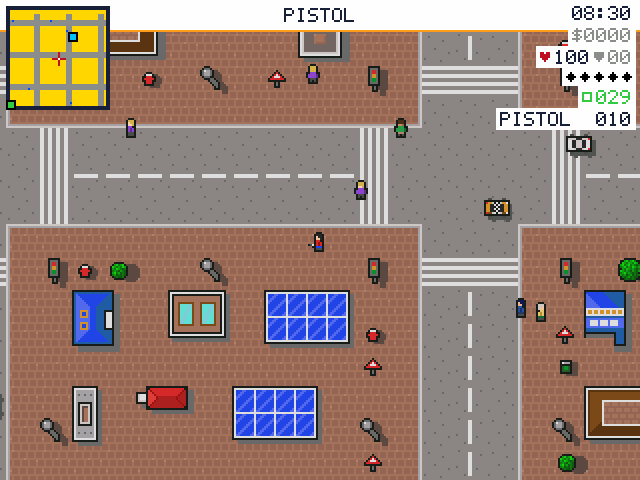
The native window at 2×. Its logical size is 320×240, not the panel's square: the simulator shows more street to either side than the hardware does, which is worth remembering when judging how much of the city is on screen.
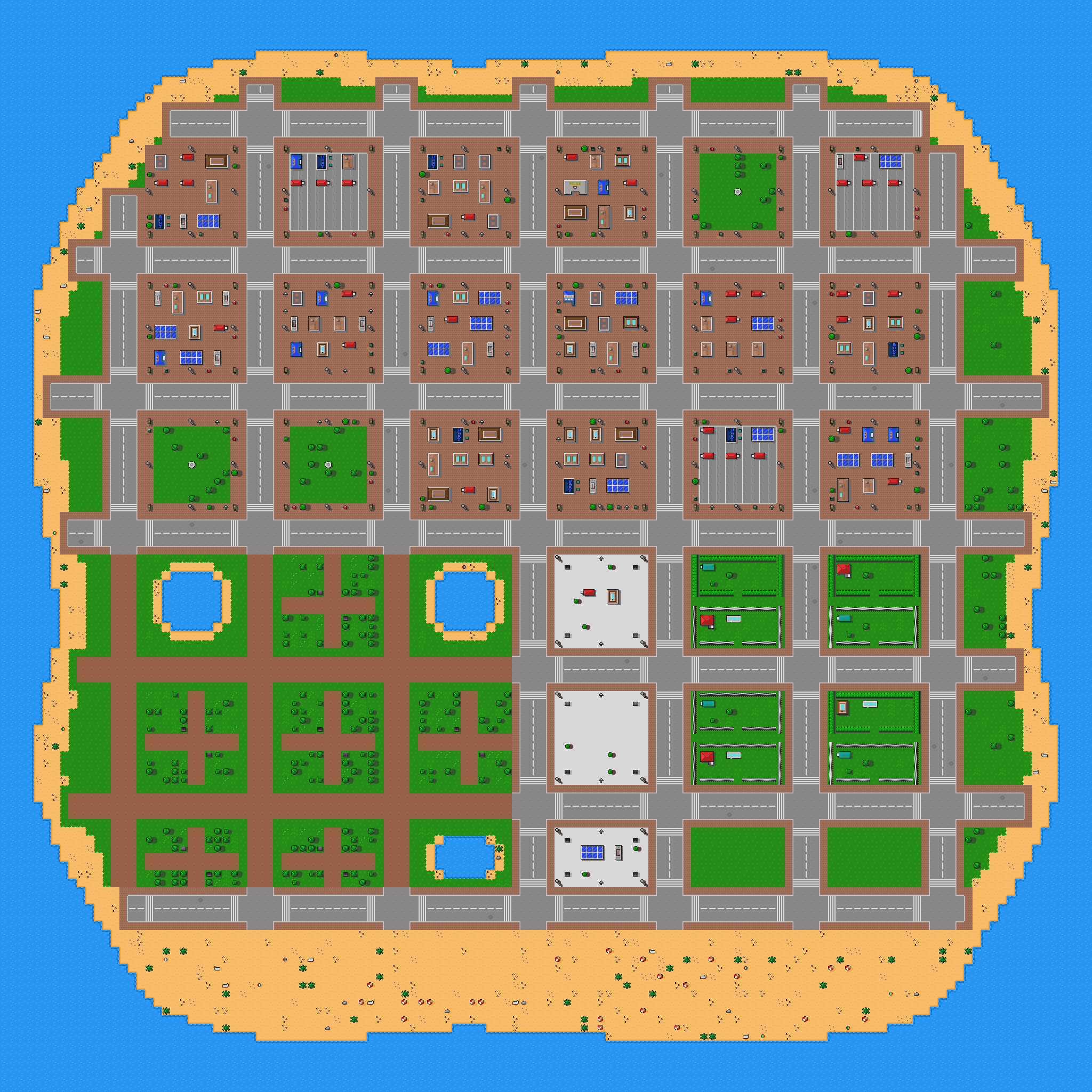
All 128×128 tiles at once, composited the way the engine draws them — three layers in order, every cell through its own palette slot. The panel shows roughly a seventieth of this, which is the only reason the map is worth a picture of its own. Rendered by tools/render_map.py, which runs the same generator the build runs and writes nothing but a PNG.
Its one idea: a procedural world that still speaks the editor's format
The city is generated, not drawn — nobody is hand-placing 16,384 cells. But the generator emits exactly what the PixelRoot32 Tilemap Editor exports (gameplay/room_screen/src/assets/ is an editor-produced example of the same format), and that is what buys the engine features a bespoke one-layer map cannot have: three layers, per-cell palette slots (eight 16-colour palettes selected through paletteIndices, so 120 usable colours where one palette gives 15), and TILE_SOLID behaviour layers read through the engine's own physics::getTileFlags and isWorldPixelSolid.
The layers are not decoration. isWorldPixelSolid decodes a tile's 4bpp bitmap and blocks only where a pixel is opaque — useless if the prop tile has terrain baked into it, because then the whole 16×16 cell is solid and per-pixel collision is indistinguishable from whole-tile. Separating the layers is what makes walking between tree canopies and past lamp posts possible at all. The generator asserts every prop tile has a cut-out, so that cannot silently regress.
Cost on esp32dev: 8.8 % RAM (28,932 B) and 44.5 % flash (582,721 B), of which 173,696 B is map data — all static const in flash — and roughly 39.8 KB is audio. RAM holds three 40-byte TileMap4bpp descriptors, the dirty grid, 24 vehicle actors, the 12-slot pedestrian pool, the 6-slot traffic pool and the audio director's fixed-size state, and nothing else.
Requirements (build flags)
Set in lib/platformio.ini:
| Flag | Value | Why |
|---|---|---|
PIXELROOT32_ENABLE_4BPP_SPRITES | on | Every tile, car, pedestrian and the player is a 16-colour 4bpp sprite. Everything on screen goes through this one path. |
PIXELROOT32_ENABLE_AUDIO | 1 | Gates both getAudioEngine() and getMusicPlayer() (Engine.h), so it covers the twenty-two one-shot cues, the four radio stations and the siren at once. Measured: +244 B RAM and +40,724 B flash against the same build at 0. |
PIXELROOT32_ENABLE_PHYSICS | 0 | The collision helpers used here — TileAttributes, TilePixelCollision — are standalone. The flag gates the collider/solver graph, which a 10,000-obstacle city could never fit (PHYSICS_MAX_ENTITIES is 64). This is also why the player, cars and pedestrians derive from core::Entity and tag EntityType::GENERIC: core::Actor is the CollisionSystem participant, and EntityType::ACTOR is what Scene::addEntity downcasts on. Nothing registers with that system, so claiming to be one would be a lie with a static_cast behind it. |
PIXELROOT32_ENABLE_GAMEPLAY_GRID_SPACE | 0 | Movement is free eight-way at sub-pixel resolution, so GridSpec/GridMotion would only get in the way. |
PIXELROOT32_ENABLE_GAMEPLAY_OBJECT_POOL | 1 | The crowd is a fixed slab of 12 pedestrian slots streamed around the camera. ObjectPool is placement-new over aligned storage, so acquiring one inside the game loop still allocates nothing. |
PIXELROOT32_ENABLE_DEPTH_SORT | 0 | Traffic stacks in a fixed order — bodies, cars, people, player — written out as four loops. A per-frame sort would cost more than the ordering is worth, and MAX_LAYERS is 4 with layer 0 reserved. |
PIXELROOT32_ENABLE_PARTICLES | 0 | No effects in this demo. |
PIXELROOT32_ENABLE_UI_SYSTEM | 0 | The HUD is a handful of Renderer calls; a layout tree would be dead weight. |
PIXELROOT32_ENABLE_DIRTY_REGIONS | 1 | All three layers draw as LayerType::Static, which suppresses per-cell dirty marking, so only the cells the player and HUD touched are marked. beginFrame() clears those instead of the whole 57,600-byte framebuffer. |
PIXELROOT32_TFT_12BIT_COLOR | 1 (esp32dev) | 12 bits per pixel over the SPI bus instead of 16. See Where the frame goes. |
esp32dev deliberately does not set PIXELROOT32_ENABLE_DEBUG_OVERLAY though native does: Engine.cpp forces redraw = true whenever it is set, so the FPS counter would cost the very frame it is measuring.
Neither the interiors nor the day/night cycle adds a flag. The rooms share palette slot 4, freed when cars became actors; the cycle rewrites palettes the renderer already reads and repoints a tileset it already draws from.
Platforms
| Environment | Display | Driver | Input | Audio |
|---|---|---|---|---|
native | 320×240 logical | SDL2 (DisplayType::NONE) | Keyboard (SDL scancodes) | SDL2, 22050 Hz |
esp32dev | 240×240 ST7789 | TFT_eSPI | 6 GPIO buttons | I2S — MAX98357A-class DAC on BCLK 26 / LRCK 25 / DOUT 22 |
ESP32 button pins: Up 32, Down 27, Left 33, Right 14, A 13, B 12.
Controls
| Action | Native | ESP32 |
|---|---|---|
| Walk (8 directions) | Arrow keys | D-pad |
| Run | Space (hold) | A (hold) |
| Get in / out of a car | Space (tap, beside a car) | A (tap) |
| Drive: accelerate, brake / reverse, steer | Arrow keys | D-pad |
| Enter / leave a building | Space (tap, in the doorway) | A (tap) |
| Answer the payphone | Space (tap, in the cyan ring) | A (tap) |
| Open / close the shop picker | Space (tap, at the counter) | A (tap) |
| Shop picker: move up and down the list | Up / Down | D-pad up / down |
| Shop picker: buy the highlighted line | S | B |
| Fire (once armed) | S | B |
Six buttons is the whole pad and every one is spoken for, which is the constraint the interaction model is built around. RUN is contextual — held it sprints, tapped beside a car it drives, tapped in a doorway it enters, tapped on a payphone it takes the job — and doors are tested before cars, because the station entrance is on a pavement where a car may well be parked in reach.
The shop picker is the same trick from the other end: the shop is empty by design, so while the picker is up it can own the pad the way the chess demo's promotion picker owns the touchscreen. Close it and every button is the sprint, the door and the trigger again.
Walking is 62.5 px/s — one whole pixel per 16 ms logic step, the pace 8- and 16-bit top-down games move at. Running is 1.75× that. Not double: double the walk is also double ordinary traffic, which made the man on foot the fastest thing in the city. Diagonals are scaled by 1/√2. A car tops out at 156 px/s.
Where the frame goes
Worth measuring before optimising, because the answer is not the blitter:
Per frame on esp32dev | Cost |
|---|---|
| Panel transfer, 240×240 RGB565 over a 40 MHz bus | ~23.0 ms |
| Background blit — 256 opaque 16×16 cells, 65,536 px | ~1 ms |
| Items + Details blit — ~36 non-empty cells | ~0.1 ms |
The bus is a 43 FPS ceiling before any game code runs, and it dwarfs everything else by twenty to one. That ranking rules out most of the usual tilemap optimisations here:
StaticTilemapLayerCachewould be a net loss. It re-keys on the sampled camera position, so a camera centred on a walking player invalidates it almost every frame — a full rebuild plus 57,600 B of heap, for nothing. It fits a room-per-screen game (gameplay/room_screen), not an open world.- Span tables (
computeSpanTable) do not exist in engine 1.9.0, and would save little here anyway: the layer that dominates is the fully opaque one. - Dirty regions do not shorten the transfer.
Renderer::endFrame()callssendBuffer()unconditionally. They save the framebuffer clear, which is worth one flag, but it is not where the frame goes.
Two levers are left, and both are about the bus rather than the drawing.
Not sending the frame at all. Engine::draw() is skipped outright when Scene::shouldRedrawFramebuffer() returns false, and a pedestrian game spends a lot of its time standing still. BaseCityScene implements it by comparing what the last drawn frame contained: the focus visualKey(), a fold of the whole crowd's keys, the district id, the banner and prompt states, and a fingerprint of every bullet in the air. The bullets have to be in there — they are the only thing that moves while the player stands still. Sub-pixel movement is deliberately outside the key, and so is the camera, which is a pure function of what it follows.
Sending a smaller frame. With the panel capped at 40 MHz, that leaves the pixel format: PIXELROOT32_TFT_12BIT_COLOR sends RGB444 and takes the frame to 17.3 ms, about 58 FPS. Two preconditions, both checked rather than assumed — the driver silently keeps RGB565 unless the physical width is a multiple of 4 (240 is), and RGB444 keeps only the top 4 bits per channel, so palette entries can collapse into each other. tools/check_rgb444.py counts those collisions under every light; none of them crosses an outline or a cut-out. Set the flag to 0 if your panel does not accept MIPI DCS COLMOD 0x03.
A Color is an index, not a colour
A primitive and a sprite do not read the same palette, and this demo spent five stages believing they did.
A sprite blit resolves through the sprite palette slot the draw call names — which is how the cars, the street recolours and the police uniform each get their own sixteen colours. Every drawing primitive — rectangle, line, pixel, glyph — resolves through the background palette, which this demo never replaces. So the HUD and the radar, which are made entirely of primitives, were reading engine palette indices while believing they read the demo's own: ink::kSand was the number 13, which the engine's table calls Purple, and the radar's ground drew purple.
It hid for five stages because the old radar nearest-matched its swatches across the whole 0–15 range, and any spread of sixteen colours over a city map still looks like a city map. A wrong mapping that produces plausible output is not caught by looking at the output.
HUD and radar colours are now engine Color enumerators, named once in hud:: in CityConstants.h, and the generator's radar inks are static_asserted against them so the two ends cannot drift apart quietly again.
Collision
Two layers, two strategies, chosen because they are exact rather than as a compromise:
| Layer | Test | Why |
|---|---|---|
background | whole-tile getTileFlags | Only water is solid, and water tiles are opaque edge to edge, so per-pixel would give the same answer for more work. |
items | isWorldPixelSolid, erosion 1 | Props are cut-outs. Erosion is applied to the prop, not the player, so the box slides past thin silhouettes instead of catching on a single opaque pixel. |
Three things move, and they do not need the same precision — hence CityCollision.{h,cpp}:
| Mover | Test | Why |
|---|---|---|
| Player | per-pixel, eroded | The expensive one, for the thing the player is looking at. |
| Cars, pedestrians | whole-tile | A car is nearly as wide as its cell; a dozen pedestrians running the per-pixel loop every 16 ms would not fit the frame budget. |
| All three | dynamic blocker | Cars are actors, so nothing in the exported scene knows where they are. The scene lends its vehicle list to the movers through one function pointer — neither actor has to learn what a vehicle is. |
The mode is a compile-time switch resolved with if constexpr, so the unused branches cost nothing. Only the player's feet collide: a 10×6 box at the bottom of the 16×16 sprite, because a top-down character whose whole sprite collides cannot stand next to a wall its head visually overlaps.
The rules are engine-free, and that is what makes them testable
build_src_filter = +<game/rules/> is the whole of [env:host_test]. Nothing in src/game/rules/ includes an engine header, so the fifteen suites in test/ — 359 cases — build on a bare host with no display, no SDL2 and no board.
Naming the directory rather than the files means a new rule is covered by putting it there, and a rule that quietly grows an engine dependency breaks the test build. That is the point of the line.
What lives behind it is everything that can be wrong without looking wrong: the day/night curve, the wanted ladder, the courier allowance, line of sight, the lane grammar, the shop's catalogue, the radar's run decomposition, the weapon table's tunnelling check, and the audio cue budget. A ray that always says "clear" is a wanted level with no exit, and nothing on screen is drawn wrong; a projectile sampled only where it lands passes straight through a six-pixel target if it steps far enough. Both are tests, not comments.
Sound
Twenty-two one-shot cues and four original radio stations, all constexpr data in src/audio/ — nothing sampled, nothing transcribed.
The 4+4 voice split cannot be rebalanced, and it is the most likely place a reader tries to "fix" something. The engine partitions its eight voices into four music and four SFX slots at compile time (MAX_MUSIC_TRACKS, no #ifndef guard), and ApuCore::findVoiceForSfxEvent never scans slots 0–3: a two-voice station leaves a music slot idle, it does not lend it to SFX. That is why the siren rides a music voice — AudioEngine::playEvent returns void, so a looping SFX event could be started but never provably stopped — and why the traffic layer is five throttled one-shots rather than an engine hum.
On top of the engine's blind voice-stealing, game/rules/AudioCues.h adds the policy: every cue the player caused or that is about to hurt them is Essential and never refused; everything droppable is Ambient, capped at one live voice, and silenced for 224 ms after any Essential cue. A street that kept chattering under gunfire would be the actual bug.
Day and night
An in-game day lasts four real minutes. No tile index, sprite or behaviour flag changes — the tint is the fifteen palettes being rewritten, which is why a 128×128 city can afford it. After dark two of the three tileset pools are swapped as well, for lit windows and street lamps: twenty of 128 tiles differ, and every other entry points straight back into the daylight pool.
| RAM | 480 bytes — 15 palettes × 16 entries × 2 bytes |
| Flash | 2,560 bytes: the tiles whose after-dark form differs, and nothing else |
| Per frame | nothing |
| Per tint change | 240 colour conversions and two pointer writes, once every 5 s |
The RAM is not optional, and it is the one thing worth knowing about the engine's palette API: setBackgroundCustomPaletteSlot stores the pointer you hand it, it does not copy. The generated palettes are const and live in flash, so a runtime tint has to own buffers of its own.
Three more decisions fall out of the same design:
- The tint is quantised to 48 steps of 30 in-game minutes, recomputed every five seconds rather than every frame — not for the 240 conversions, but because a palette rewritten every frame is a city repainted every frame, and the frame skip above is the whole reason this demo fits its budget.
- No colour is ever tinted to
0x0000. The framebuffer treats a colour that packs to zero as skip, not as black, so a dim entry rounded down would punch holes through the buildings. Entries are floored to0x0001. - Adjacent steps never differ by more than 40/255 on a channel. There are no in-between frames to soften a palette change, so a larger jump reads as a flash rather than a fade.
Two doors, three scenes
The police station and one corner shop can be walked into, and each is a separate 15×15 tilemap and a separate core::Scene — its own namespace, palette, tileset pools, indices, behaviour layers and init(). In the generator a room is an Interior object and the emitters take one as an argument, so adding a third room is an entry in INTERIORS and a door in the city; there is no third branch anywhere. Measured cost of the second room: 1,052 B of RAM and 7,508 B of flash — the expensive part was building the first one.
No door tile was added, for either. The building stamps have always been drawn with an entrance notch cut out of the bottom edge, and the player's collision is per-pixel against the Items bitmap, so the notch has always been somewhere you could stand. The generator reproduces PlayerActor's own tile arithmetic, enumerates every sprite position that would report the door cell, and fails the build if none of them is free. The art means it, and the code reads the art.
Both rooms took a post-pass rather than a smaller candidate list, and that is a generator constraint worth knowing before editing tools/: the lot packer shares one RNG stream with every pass after it. The layout drew six police stations; dropping POLICE from DOWNTOWN_LOTS would not have removed five buildings, it would have regenerated the whole island. The five surplus ones are rewritten in place instead, and the open shopfront is a SWAP_ONLY stamp placed over a shop the packer had already put down.
Build
From this folder:
pio run -e native                    # SDL2 simulator
pio run -e native --target exec      # build and run it
pio run -e esp32dev                  # ESP32 firmware
pio run -t clean -e nativeplatformio.ini ships configured for Windows/MSYS2. On Linux and macOS remove the -IC:/msys64/..., -LC:/msys64/... and -mconsole flags from [env:native]; on macOS also uncomment the two Homebrew lines.
Upload (ESP32)
pio run -e esp32dev --target upload
pio device monitor # 115200 baudTests
pio test -e host_testFifteen suites, 359 cases, no display and no board. Only src/game/rules/ is built — the scenes, the entities and the audio director link against the engine and are checked by compiling them.
Regenerating the art and the map
Everything under src/generated/ comes from one script:
python tools/generate_city_assets.pyIt assembles the art modules through tools/city_art.py — daylight and after dark — lays the city out, runs the layout self-checks and refuses to write if any fails; src/generated/README.md says what each one catches. Edit a tile in tools/art_*.py, change MAP_W/MAP_H, the street pitch or a district bound and re-run: no C++ needs editing, because CityConstants.h derives the world geometry from the generated city_scene.h.
To review art without building anything, from tools/:
python -c "import art_dsl, art_urban; art_dsl.preview(art_urban, 'urban.png')"art_cars and art_player are sprite modules with no tiles, so they preview through city_art.vehicle_frames() and art_player.preview_frames() instead.
To re-render the island picture above after a layout or art change:
python tools/render_map.py screenshots/city_map.pngSource layout
src/
├── main.cpp                    the platform selector, and nothing else
├── platforms/                  DisplayConfig, InputConfig, Engine, entry point
├── audio/                      the two data files and the director that plays them
├── generated/                  emitted by tools/ — never edited by hand
│   ├── sprites/
│   └── tilemaps/
└── game/
    ├── CityConstants.h         world geometry, timing, palette slots, HUD
    ├── rules/                  NO engine dependency; host-tested
    ├── entities/               things with a position that draw themselves
    ├── systems/                things that own a rule and no position
└── scenes/ the run, the router, and one file pair per spaceTwo conventional directories are deliberately absent. There is no Game.{h,cpp} — the engine owns the loop and platforms/*.h owns the wiring, so the class would have nothing in it. There is no data/ — the level is a seeded generator, and empty folders are a diagram, not a structure. It is generated/ rather than assets/ because there is no hand-authored asset file here at all: the sources are the Python modules in tools/.
All local includes are written relative to src/ (#include "game/systems/CityCollision.h"), never relative to the including file, so moving a file is a git mv and one line.
Engine documentation
- PixelRoot32 Game Engine
- Sprite renderer
- Audio API
- Core API
- Memory system — gameplay flags and byte budgets
License
Source code: MIT.
| Asset | Source | Licence |
|---|---|---|
src/generated/tilemaps/* | 8 palettes, 205 × 16×16 4bpp tiles (77 terrain, 94 items, 34 details) plus the 20 that differ after dark, 128×128 × 3 layers, and the three exported scenes | CC0 1.0 — original, emitted by tools/generate_city_assets.py |
src/generated/sprites/PlayerSprites.h | 3 facings × 3 walk frames, armed and unarmed, 16×16 4bpp | CC0 1.0 — original |
src/generated/sprites/VehicleSprites.h | 7 car colours × 4 headings, 16×16 4bpp, shadow baked in | CC0 1.0 — original |
src/generated/sprites/PedestrianSprites.h | 4 recolour palettes over the player's frames, plus the squashed pose | CC0 1.0 — original |
src/audio/CitySfx.h, src/audio/CityRadio.h | Twenty-two one-shot SFX events, four original radio stations and the siren, hand-typed constexpr frequency, envelope and note data. GTA Advance (GBA) was a design reference for the car-bound model, loop length and instrumentation; no note is transcribed from it or any other title | CC0 1.0 — original, synthesised at runtime, no sample file of any kind |
Engine code is MIT — see the PixelRoot32 Game Engine repository.
Source code: https://github.com/PixelRoot32-Game-Engine/PixelRoot32-Demo-Projects/tree/main/games/top_down_city