
Pool
Demonstration project — provided as an example of what the PixelRoot32 Game Engine can do. It is not a product: parts may be incomplete, experimental, or deliberately simplified to keep one idea in focus.
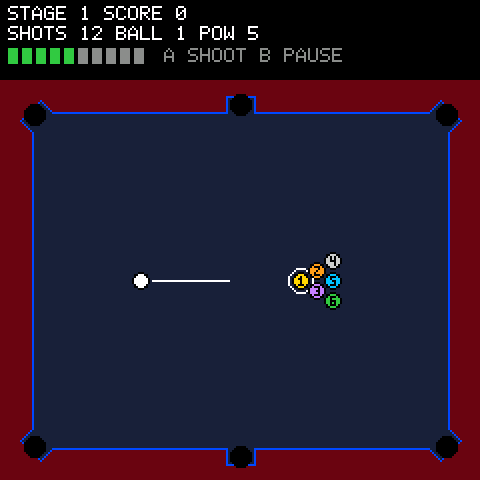
Fixed-point pool: aim the cue ball, sink the 6 numbered targets in ascending order, and clear all 10 tables on 12 shots each. The single idea it is about is the engine-free integer core: ball movement, collisions, cushions, pockets, friction, and the turn/shot rules all run on plain integers in src/pool/ — no engine headers, no float/double, no heap — so the same recorded input sequence replays bit-identically on native and on the ESP32.
Language: C++17
Engine: gperez88/PixelRoot32-Game-Engine@^1.10.0
Environments: native, esp32dev
Category: Games
Requirements (build flags)
Set in lib/platformio.ini's [base] template, so every environment inherits them. Everything the game does not use is off on purpose — the demo is one scene, silent, with hand-drawn HUD and its own physics core:
PIXELROOT32_ENABLE_PHYSICS=0— deliberate. Balls integrate on the demo's own fixed-point core (src/pool/), not the engine's float-basedScalarsolver. Costs ~9 KB when on.PIXELROOT32_ENABLE_AUDIO=1— required. One looping stage track per table plus win/lose jingles throughMusicPlayer, and cue/pocket/foul effects throughAudioEngine(src/audio/PoolAudio.*). ~17 KB, nearly all of it the scheduler's own buffers. The scene still compiles silent with the flag at 0 — every engine call in the director is fenced.PIXELROOT32_ENABLE_UI_SYSTEM=1— the title scene is engine widgets: aUIButtonSTART GAME row plus twoUICheckBoxrows (MUSIC, SFX) andUILabeltitle/hint, all drawn by the menu scene. The HUD itself stays hand-drawndrawText. ~9 KB.PIXELROOT32_ENABLE_PARTICLES=0— no particle effects in v1. ~2 KB.PIXELROOT32_ENABLE_SCENE_TRANSITIONS=0— a single scene for the whole game, nothing to transition between.PIXELROOT32_ENABLE_STATIC_TILEMAP_FB_CACHE=0— no tilemaps; the felt is filled from border row spans, not a static cache.
Display size is 240×240 in the project platformio.ini (see PHYSICAL_DISPLAY_*). The top 40 px are a reserved HUD band; the table area starts below it.
Platforms
| Environment | Display | Audio backend |
|---|---|---|
native | SDL2, 240×240 | (–) in src/platforms/native.h |
esp32dev | ST7789 240×240 | (–) in src/platforms/esp32_dev.h |
Pin choices (ST7789 SPI, D-pad + two buttons) are in src/platforms/esp32_dev.h — edit there if your wiring differs.
Controls
| Action | native (keyboard) | esp32dev (GPIO) |
|---|---|---|
| Menu: move cursor | Arrow keys Up/Down | D-pad Up/Down (32/27) |
| Menu: start / toggle | Space | Button A (13) |
| Aim: tap nudges 0.35°, hold sweeps | Arrow keys Left/Right | D-pad Left/Right (33/14) |
| Power level (tap) | Arrow keys Up/Down | D-pad Up/Down (32/27) |
| Shoot / confirm | Space | Button A (13) |
| Pause (gameplay + music) | Return | Button B (12) |
The menu is its own black-background scene (PoolMenuScene, bomberbot title-screen pattern): START GAME plus two independent checks — MUSIC and SFX, both on by default. Muting music stops the sequencer (unmuting replays the current stage track); muting SFX silences every effect. Choices persist for the whole session. START deals a fresh run from stage 1; there is no trip back once the run begins.
Aim tracks the held level for smooth sweeps; power steps on the press edge so one tap is exactly one meter level. Input is only read in Aiming (plus confirm in Menu/GameOver and pause mid-shot) — live shots run hands-off until every ball rests. On GameOver, A retries the stage after a loss and restarts the run from stage 1 after clearing stage 10.
Rules (v1)
- Each stage grants
targets × 2shots (12); every shot costs 1, foul or not. - Correct pocket: +100. Foul (scratched cue or out-of-order ball): −50, floored at 0; pocketed balls stay down and the cue respots at its start (or the topmost-leftmost free pixel when blocked).
- Clearing the table advances with the score carried over; clearing stage 10 wins the run. Difficulty comes from the table, like the original — every stage plays the same 6 balls.
The 10 tables
| Stage | Table | NES reference |
|---|---|---|
| 1 | Classic rectangle | STAGE01 |
| 2 | Side bites | STAGE08/10 |
| 3 | Angled teeth | STAGE04 |
| 4 | Center bar | STAGE15 |
| 5 | Inward chevron | STAGE13 |
| 6 | Fortress (bites on all four runs, 40 cushions) | STAGE03 |
| 7 | Central island, split rack | STAGE09 |
| 8 | Twin islands | STAGE25 |
| 9 | Octagon, only 4 pockets | STAGE06 |
| 10 | Narrow corridor, single ball column | STAGE20 |
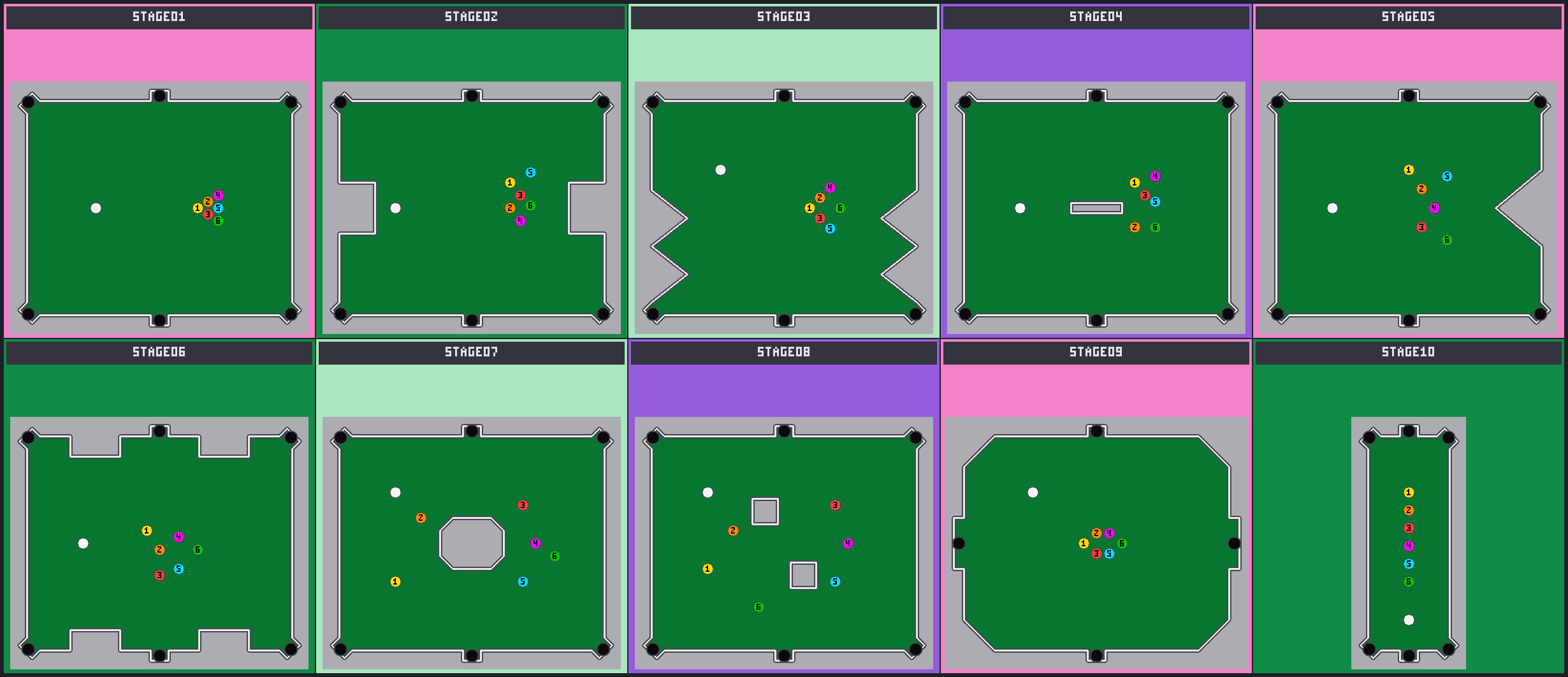
Each step adds one harder element without taking any away: open table, side dents, angled teeth, a first obstacle, an angled wall, bites everywhere, a full island, two islands, fewer pockets, no banking angles.
Audio
One looping track per stage, all original chiptune compositions informed by the 1985 original's stage loop — a soft, airy, non-invasive backdrop rather than a dense bouncer — but with their own melodies throughout (no transcriptions): a square-wave lead over a triangle bass walking the chord roots, a shared noise groove, a pulse harmony entering from stage 6, and a tempo that climbs the difficulty curve (×1.00 → ×1.34). Every loop runs 16 beats in two 8-beat halves — statement, then answer — so the repetition breathes; stage 1 is the sparsest of the set. Clearing stage 10 plays a major fanfare, losing a descending line; both are one-shot jingles, then silence until retry.
| Stage | Feel | Tempo |
|---|---|---|
| 1 | C major, airy 16-beat ambient loop | ×1.00 |
| 2 | Jaunty | ×1.04 |
| 3 | Wide leaps | ×1.08 |
| 4 | March | ×1.10 |
| 5 | Turn to minor | ×1.14 |
| 6 | Driving minor (+ harmony) | ×1.18 |
| 7 | Half-time, mysterious | ×1.16 |
| 8 | Call and response | ×1.22 |
| 9 | Tense | ×1.28 |
| 10 | Urgent | ×1.34 |
Effects (same NES vocabulary — pulse blips, noise ticks, sweeps): cue strike, ball click, cushion thud, pocket drop, scratch wah, order-foul buzz, a 6-note stage-clear arpeggio, an aim-step tick in the spirit of the original's cursor chirp, confirm and pause blips. Clicks and thuds come from deterministic contact flags in World (set only on a real reflection/impulse, so resting contact never machine-guns); pockets and fouls are read off the active-ball mask and the score each tick — the scene never writes the sim to make a sound. Backends: SDL2 audio on native, I2S (BCLK 26 / LRCK 25 / DOUT 22, clear of the display and button pins) on ESP32.
What it demonstrates
- Determinism as a build property.
src/pool/includes no engine header and uses no floating point: positions are 1/256-px integers (src/pool/Fixed.h), every rounded division goes throughdivRound(half away from zero), roots through the integerisqrt64, and aim through a Q14 cosine table (src/pool/Trig.h). The host suites replay the same shots the device runs. - Rules without the engine FSM.
pool::Game(src/pool/Game.h) is a hand-rolledswitchoverMenu → Aiming → Shooting → BallsMoving → EvaluateShot → NextTurn, plusGameOver. It owns theTable+Worldand never draws or reads input — the scene keeps pacing, buttons, and pixels. - Tables as validated data. The 10
TableDefs insrc/pool/Tables.cppareconstexpr(flash, zero RAM).loadTable()(src/pool/Table.cpp) rejects bad winding, narrow pocket mouths, overlapping balls, and balls starting inside cushions, pockets, or obstacles before the first frame — so a broken table is a load error, never a mid-game glitch. - Exact 60 Hz pacing in integers. The scene piles up
ms × 60units and steps oneGame::stepFrame()per 1000, capped at 4 catch-up steps per tick: under heavy lag the game slows down instead of spiralling, and every step stays deterministic (PoolScene::stepSimulation()). - One rendering lesson, kept. Ball numbers use a hand-authored 3×5 micro-font of 1bpp
Sprites — butdrawSprite()walks bits MSB-first (bitwidth-1= left pixel), opposite to theSpritedoc comment, so every asymmetric glyph is stored pre-mirrored. Symmetric digits (0, 1, 8) hid the bug until 2–7 and 9 exposed it. - Sound as observation, never as input. The scene hears the game three ways —
Worldcontact flags (set only on a real bounce, drained per tick), the active-ball mask (a 1→0 edge is a pocket), and the score (a drop is a foul) — and none of them can feed back into the simulation, so the soundtrack is deterministic by construction (PoolScene::pollAudio()). - A fixed shot budget as difficulty. No lives, no timer: 12 shots per stage, −50 per foul, and geometry doing the rest.
Project layout
src/
├── PoolScene.h/.cpp   input map, 60 Hz pacing, table/balls/aim/HUD draw, audio triggers
├── PoolMenuScene.h/.cpp   black-bg title: START GAME + MUSIC/SFX checks (engine UI widgets)
├── main.cpp                platform selector
├── platforms/              native.h, esp32_dev.h — backend wiring per target
├── assets/audio/           PoolMusic.h (10 stage loops + jingles), PoolSfx.h (effect bank)
├── audio/                  PoolAudio.h/.cpp — music/SFX director (silent at AUDIO=0)
└── pool/                   engine-free integer core (no floats, no heap)
    ├── Fixed.h/.cpp        units, divRound, isqrt64, toPixel
    ├── Trig.h/.cpp         Q14 angle table (1024 steps/revolution)
    ├── Geometry.h/.cpp     segment/vertex contact, point-in-polygon, rowSpans
    ├── TableDef.h          authoring-time table structs
    ├── Tables.h/.cpp       the 10 shipped tables (constexpr, flash)
    ├── Table.h/.cpp        runtime table + load-time validation
    ├── World.h/.cpp        ball integration, cushions, ball-ball, pockets
    └── Game.h/.cpp         turn/shot state machine, scoring, progression
test/
├── test_fixed/ test_trig/ test_tables/
└── test_world_balls/ test_collisions/ test_game/   # host suites, Unity
tools/ # rules reference + phased plan (working docs)Run the suites with pio test -e host_test — they build only src/pool/, no display needed.
Engine documentation
Memory
Measured sizeof on the host (identical layout for these PODs on ESP32):
| RAM | Flash | |
|---|---|---|
pool::Game (owns Table 964 B + World 252 B) | 1,256 B | — |
Scene (Game + accumulator + flags) | ~1.3 KB | — |
10 TableDefs (constexpr) | 0 | ~2 KB |
13 music tracks + drum grooves (static const, ~260 notes) | 0 | ~5 KB |
| SFX bank (9 effects + 6-step arpeggio) | 0 | ~1 KB |
| 3×5 digit font (10 glyphs) | 0 | ~200 B |
No per-frame allocation: ball starts, segments, pockets, and the pocket log are fixed-size arrays; the HUD formats into a 32-byte stack buffer.
Build
From **games/pool**:
pio test -e host_test   # engine-free unit suites (no display needed)
pio run -e native       # SDL2 desktop
pio run -e esp32dev # firmware (adds -Os, -fno-rtti, no exceptions)Upload (ESP32)
pio run -e esp32dev --target uploadLicense
Source code: MIT.
| Asset | Author | License | Source |
|---|---|---|---|
| 3×5 digit font | This repository | CC0 1.0 (public domain) | Original work, hand-authored rows in PoolScene.cpp |
This demo ships no art and no generated asset headers — felt, rails, pockets, balls, aim guide, and HUD are renderer primitives, and the digits above are the only font data, so there is nothing else here to attribute.
Not in this iteration
- No aim ricochet preview — the guide is a straight 44 px line, no bounce simulation.
- No per-stage par, high-score persistence, or versus modes.
Source code: https://github.com/PixelRoot32-Game-Engine/PixelRoot32-Demo-Projects/tree/main/games/pool