
State Machine
Demonstration project — provided as an example of what the PixelRoot32 Game Engine can do. It is not a product: parts may be incomplete, experimental, or deliberately simplified to keep one idea in focus.
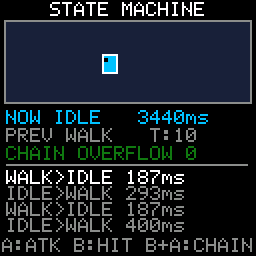
One pixelroot32::gameplay::StateMachine driving one actor through four states — Idle, Walk, Attack, Hurt — declared in a single const table, with every transition put on screen: the current state and how long it has lasted, the previous state, a running transition count, the chained-transition overflow counter, and a four-line log of the most recent transitions with the dwell time of each. The single idea is that a state machine is only as useful as the transitions you can see, so nothing here is hidden behind an animation.
Language: C++17
Engine: gperez88/PixelRoot32-Game-Engine@^1.9.0
Environments: native, esp32dev
Category: Gameplay
Requirements (build flags)
Set in lib/platformio.ini (base template, inherited by every environment).
| Flag | Set to | Why |
|---|---|---|
PIXELROOT32_ENABLE_GAMEPLAY_STATE_MACHINE | 1 | The topic. The whole of <gameplay/StateMachine.h> sits inside #if PIXELROOT32_ENABLE_GAMEPLAY_STATE_MACHINE, and platforms/PlatformDefaults.h defaults it to 0. Omitting it is not a silent no-op and not a black screen: the header expands to nothing, pixelroot32::gameplay::StateMachine is not a type, and the build stops. src/StateMachineScene.h tests the flag and raises an #error naming it, so you get one line instead of a page of "is not a member of" errors. |
PIXELROOT32_ENABLE_AUDIO | 0 | Off on purpose. Frees roughly 17 KB of RAM: mixer voices, the SPSC command queue, and the sequencer state. This demo makes no sound. |
PIXELROOT32_ENABLE_PHYSICS | 0 | Off on purpose. Frees roughly 9 KB: CollisionSystem's actor tables and the fixed-timestep PhysicsScheduler, both members of every Scene. The actor is clamped against four constants, not against colliders. |
PIXELROOT32_ENABLE_UI_SYSTEM | 0 | Off on purpose. Frees roughly 9 KB: UIManager's widget and hit-test tables, again a per-Scene member. The HUD here is Renderer::drawText and a few rectangles. |
PIXELROOT32_ENABLE_PARTICLES | 0 | Off on purpose. Frees roughly 2 KB of particle pool. Nothing on screen sparkles. |
The four zeros are the second half of CONTRIBUTING.md's rule for the category folders: a demo enables the minimum set of flags its topic needs. Leaving the default-on subsystems enabled would spend roughly 37 KB of RAM that nothing in this demo touches, and would make the ESP32 figures below meaningless as a measure of what a state machine costs.
Platforms
| Environment | Display | Audio backend |
|---|---|---|
native | SDL2, 128×128 logical size | none — PIXELROOT32_ENABLE_AUDIO=0 |
esp32dev | ST7735 128×128 (GreenTab3 profile), SPI pins in platformio.ini: MOSI 23, SCLK 18, DC 2, RST 4, CS -1 | none — PIXELROOT32_ENABLE_AUDIO=0 |
Controls
| Button | native | esp32dev | Action |
|---|---|---|---|
| D-pad | arrow keys | GPIO 32 / 27 / 33 / 14 | Move. Idle → Walk while a direction is held, Walk → Idle when they are all released. Attack and Hurt ignore the pad: the state gates the movement, not an if in update(). |
| A | Space | GPIO 13 | Attack — a timed state that returns to Idle on its own after 400 ms. Pressing A during Attack calls restartState(), and the log line reads ATTACK>ATTACK. A is ignored during Hurt. |
| B | Enter | GPIO 12 | Hurt — 600 ms, and it interrupts Attack. Pressing B during Hurt restarts it. |
| B held + A | Enter + Space | GPIO 12 + 13 | Chain-overflow demonstration. See Chained transitions below. |
What it demonstrates
Five things about StateMachine that are each a silent trap, in the sense that getting them wrong produces working-looking code rather than an error.
1. The table is not copied
configure(owner, table, count) stores the pointer and nothing else. The table has to outlive the machine, so it is a class-static const array (StateMachineScene::kStates) defined at namespace scope in the .cpp, which lands in .rodata/flash and costs no SRAM. The shape that compiles and then misbehaves is a table declared local to a setup function: configure() accepts it happily, the function returns, and every later transition reads freed stack.
Rows are matched by State::id, never by position, so the order in the table is a readability choice.
The three callbacks are raw function pointers taking void* owner (void (*)(void*, StateId) and friends). A capturing lambda does not convert to that type, and neither does a non-static member function — every callback here is a static member that opens with auto* self = static_cast<StateMachineScene*>(owner);.
2. requestState(getCurrentState()) is a no-op, not a re-entry
It returns true, which reads like success, and then does nothing: no onExit, no onEnter, and getTimeInState() keeps counting from where it was. The verb for a genuine re-entry is restartState(), which fires a real exit/enter pair against the same state and zeroes the timer.
enterOrRestart() in src/StateMachineScene.cpp picks between the two, which is why pressing A during Attack visibly resets the timer bar and writes ATTACK>ATTACK into the log, instead of doing nothing at all. requestState() returns false only for an id that matches no row.
3. reset() fires no onExit
It is teardown, not a transition: it clears current, previous, pending and the timer, and dispatches nothing — deliberately, because a scene reset may run after the owner is already gone. Anything an onExit would have released has to be released by the caller. It also leaves the configuration in place, so start() can run again without a fresh configure(), and it does not clear the transition-overflow counter, which is monotonic by design. This demo calls reset() at the top of init() for exactly that reason: start() asserts the machine is not already running, and Scene::init() can be entered more than once.
4. update() credits the frame's delta to the state being left
update() adds deltaTime to time-in-state before dispatching onUpdate, and requestState() zeroes time-in-state. So a state that transitions from inside its own onUpdate — which is what a timeout is — hands that frame's milliseconds to the state it is leaving, and the state being entered starts at getTimeInState() == 0 having consumed none of it. At most one onUpdate runs per update() call: the one that was current on entry.
Measured against this demo's 400 ms attack at 16 ms frames: 25 frames run in Attack, the 25th sees timeInStateMs == 400 and requests Idle, and update() returns with the machine in Idle at 0 ms. Idle's own onUpdate does not run until the following frame.
The accounting is right — the time really was spent in the old state — but it differs from the usual hand-rolled switch plus accumulator, where changeState() zeroes the accumulator and the same frame's delta is then added to the new state. Code ported from that shape loses one frame per transition, which is a sub-frame phase shift in an animation and therefore easy to ship unnoticed. If you need "reset, then accumulate this frame", request the transition before update() rather than from inside onUpdate — which is what this demo does for the A and B buttons — or keep your own accumulator and zero it from onEnter.
5. Chained transitions cap at 8, and the counter is the only witness
A requestState() made from inside an onEnter or onExit never recurses. The call that is already transitioning owns the whole chain, and drains it like this:
- The guards run first. An id matching no row returns
falseand changes nothing. An id equal to the current state returnstrueand changes nothing. A call made while a transition is in progress stores the id as the machine's singlependingslot and returnstrueimmediately — control goes straight back to the loop below, which is where the work happens. - The initiating call then loops at most 8 times. Each iteration first clears
pending, so only a request made during that iteration counts; then fires the current state'sonExit(owner, target)— at that moment the machine has not moved yet, sogetCurrentState()is still the state being left andgetTimeInState()is still its dwell, which is how this demo logs every transition from one sharedonExit; then sets previous, sets current, zeroes the timer, and fires the target'sonEnter(owner, from), which therefore seesgetTimeInState() == 0. - After each iteration: no
pendingmeans the chain has settled and the loop breaks. Apendingequal to the state just entered is the rule-2 no-op again and also breaks. Otherwise that id becomes the next target and the loop goes round. - If the loop runs all 8 iterations without settling, the request still queued is discarded,
getTransitionOverflowCount()increments (saturating at 255, and not cleared byreset()), and the machine simply stays in the eighth state it actually entered. Nothing is logged, nothing returnsfalse, andrequestState()still returnstrue. The cap constant itself is private, so the counter is the only observable trace.
That last point is why the counter is on screen. Hold B and press A to see it: while the combo is held, Attack's onEnter requests Hurt and Hurt's onEnter requests Attack, so one requestState() call runs 8 exit/enter pairs, stops, and increments the counter — verified here as exactly 8 enters, 8 exits, one overflow, machine left in Hurt. The demo recovers only because Hurt has a timeout; a self-retriggering pair with no way out would sit there for good, with update() still running, getCurrentState() still returning something plausible, and the counter as the single clue.
And the ordinary rules
init()andupdate()call theirScene::base first;draw()does not — it paints the background, then callsScene::draw(), which is what paints the scene's entities.- Nothing allocates after startup. The transition log is a fixed
char[4][24]ring of scene members written bysnprintfat transition time; the three HUD lines are fixedcharmembers refreshed once per frame fromupdate(), sodraw()is pure drawing. Nonew, nomalloc, nostd::string, nostd::vector. - The actor is drawn with
Rendererprimitives only and colour-coded by state (Idle cyan, Walk green, Attack orange, Hurt red), so the colour on screen and theNOWline can never disagree.
Build
From gameplay/state_machine:
pio run -e native
pio run -e native --target exec
pio run -e esp32devThe committed [env:native] flags target Windows/MSYS2. On Linux drop the -IC:/msys64/..., -LC:/msys64/... and -mconsole lines; on macOS drop them and uncomment the two Homebrew lines above them. CI does this itself.
Upload (ESP32)
pio run -e esp32dev --target uploadEngine documentation
- Core API
- Gameplay API
- Graphics / Renderer
- Input API
gameplay/StateMachine.h— the header documents every rule quoted abovesrc/gameplay/StateMachine.cpp— the drain loop, in about thirty lines
License
Source code: MIT.
This demo ships no art, audio, or generated asset headers. Everything on screen is drawn with Renderer primitives and the engine's built-in 5×7 font against the built-in PR32 palette, so there is nothing here to attribute.
Source code: https://github.com/PixelRoot32-Game-Engine/PixelRoot32-Demo-Projects/tree/main/gameplay/state_machine