
Dirty Regions
Demonstration project — provided as an example of what the PixelRoot32 Game Engine can do. It is not a product: parts may be incomplete, experimental, or deliberately simplified to keep one idea in focus.
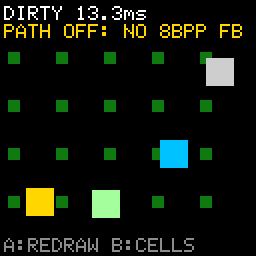
A mostly-static screen — a lattice of small blocks — with four boxes bouncing across it. That is the whole scene, and the whole point: with PIXELROOT32_ENABLE_DIRTY_REGIONS on, Renderer::beginFrame() clears only the 8x8 cells something was drawn into last frame instead of wiping the entire logical framebuffer. Press A to make the scene ask for a full clear every frame instead, press B to outline the cells the engine considers dirty, and watch the rolling frame-time average in the corner.
Language: C++17
Engine: gperez88/PixelRoot32-Game-Engine@^1.9.0
Environments: native, esp32dev
Category: Performance
Requirements (build flags)
Set in lib/platformio.ini (base template, inherited by every environment).
| Flag | Set to | Why |
|---|---|---|
PIXELROOT32_ENABLE_DIRTY_REGIONS | 1 | The topic. Allocates the DirtyGrid in Renderer::init() and turns beginFrame()'s full clearBuffer() into a per-cell clear of whatever the previous frame marked. At 0 (the engine default) beginFrame() always clears everything and Renderer::forceFullRedraw() becomes a documented no-op — so at 0 the A button in this demo does nothing at all. |
PIXELROOT32_ENABLE_DIRTY_REGION_PROFILING | 1 | Makes beginFrame() emit one dirty_ratio=%.4f (marked/total) line per frame. Its #if ANDs this flag with PIXELROOT32_DEBUG_MODE, so both are needed. Without it you still get the overlay, you just lose the number. |
PIXELROOT32_DEBUG_MODE | defined, no value | Two things need it. It gates the dirty_ratio log above, and it is what compiles Renderer::drawDebugDirtyCellOverlay() into something other than an empty function — so without it B does nothing. It is tested with defined(), never with #if, which is why it carries no =1. |
PIXELROOT32_ENABLE_AUDIO | 0 | Defaults to 1. This demo is silent, and the audio subsystem is the most expensive default in the engine: roughly 17 KB of RAM for its voice state and mixing buffers. Turning it off is not an optimization here, it is the honest flag list for a demo that never calls getAudioEngine(). |
PIXELROOT32_ENABLE_PHYSICS | 0 | Defaults to 1. The boxes are four integer positions integrated by hand; there is no collider graph, no Actor, no solver. Roughly 9 KB of RAM for CollisionSystem and SpatialGrid that would otherwise be reserved for nothing. |
PIXELROOT32_ENABLE_UI_SYSTEM | 0 | Defaults to 1. Both text lines are single Renderer::drawText() calls; a layout tree and its widget storage — roughly 9 KB of RAM — would be dead weight. |
PIXELROOT32_ENABLE_PARTICLES | 0 | Defaults to 1. No effects in this demo. Roughly 2 KB of RAM for the emitter pool. |
The four zeroes are half the lesson. A performance demo that leaves the engine's defaults on cannot tell you what its own topic costs, because ~36 KB of ESP32 RAM is already gone before the first frame. The rule for the performance/ category is that a demo's flag list is its topic; here that list is one feature plus the two switches that let you see it.
The RAM figures above are the engine's documented per-subsystem budgets, not measurements taken from this project.
Platforms
| Environment | Display | Driver | Audio backend |
|---|---|---|---|
native | 128x128 logical, SDL2 window | SDL2_Drawer | none (PIXELROOT32_ENABLE_AUDIO=0) |
esp32dev | 128x128 ST7735 (GREENTAB3), SPI at 40 MHz | TFT_eSPI_Drawer | none (PIXELROOT32_ENABLE_AUDIO=0) |
The dirty-region path only runs on esp32dev. Renderer::beginFrame() starts by asking the draw surface for its 8bpp framebuffer, and SDL2_Drawer::getSpriteBuffer() returns nullptr — SDL2 renders into an RGB565 buffer instead. With no 8bpp framebuffer there is nothing to clear selectively, so beginFrame() returns early: full clearBuffer(), dirty grid never sized, no dirty_ratio log, and getCols() == 0 makes the overlay draw nothing. On native this demo still runs and still animates, but A and B are inert and the frame-time readout will not move between modes. Read it on hardware.
Rather than leave that to the README, the scene runs the same test the engine runs and prints the answer under the mode line: PATH ON in green when the draw surface has an 8bpp framebuffer, PATH OFF: NO 8BPP FB in yellow when it does not.
dirtyPathLive = engine.getRenderer().getDrawSurface().getSpriteBuffer() != nullptr;It is read every frame, not cached in init(), so the answer never depends on when a driver allocates its buffer relative to scene construction.
That precondition is the part worth taking away. Setting PIXELROOT32_ENABLE_DIRTY_REGIONS=1 is necessary and not sufficient: the driver has to hand the renderer an 8bpp framebuffer, and the SDL2 one does not. Any demo in this repository that enables the flag — games/brick_breaker and games/top_down_city both do — gets the same early return on native. Measure the feature on the simulator and the honest reading is that it changes nothing, because on the simulator it is not running.
Controls
| Button | Native key | Action |
|---|---|---|
| A | Space | Toggle force full redraw every frame. The header switches between DIRTY and FULL, and the frame-time average resets so the two modes are not averaged together. |
| B | Enter | Toggle the engine's debug dirty-cell overlay — magenta outlines around the cells marked this frame. |
The D-pad is wired in the platform headers because InputConfig takes six buttons, but this demo does not read it.
What it demonstrates
Dirty regions do not let a scene skip drawing. They let the engine skip clearing. Every frame this scene redraws the whole lattice and all four boxes; nothing is retained. What changes is what beginFrame() does first — either a memset of the entire logical framebuffer, or a clear of just the cells that were marked on the previous frame.
Marking is not something the scene opts into. Every Renderer primitive calls into the grid: drawFilledRectangle, drawRectangle, drawLine, drawPixel, drawSprite, and drawText (which is a drawSprite per glyph). That has one blunt consequence, and it is why this scene looks the way it does: a full-screen background fill would mark all 256 cells, all 256 cells would be cleared next frame, and the selective clear would cost exactly as much as the full one. The lattice is sparse and the field is black on purpose. Note also that drawRectangle marks its whole bounding box rather than its outline — a screen-sized border rectangle marks the screen.
The dirty-cell counts are not reachable from game code. DirtyGrid does expose countPrevMarkedCells(), countCurrMarkedCells() and totalCellCount(), but the Renderer holds its grid as a private member with no public accessor, so a scene cannot read them and this demo does not pretend to. Two honest measurements are left:
- On screen: the mode (
DIRTY/FULL) and a rolling average of the last 32 frame times, in milliseconds and tenths. The demo computes it itself from thedeltaTimethe engine already handsupdate(); single frames above 50 ms are clamped so one stall does not poison the average. - On the console:
dirty_ratio=0.NNNN (marked/total), one line per frame fromRenderer::beginFrame(). This is a serial/stdout log, never an on-screen value. Onesp32devread it withpio device monitorat 115200. The log itself costs serial time, so treat the ratio and the frame-time readout as two separate experiments rather than one.
FULL mode is a simulation, not a rebuild. Renderer::forceFullRedraw() sets the grid's full-dirty bit, which beginFrame() consumes by clearing the whole buffer — the same work a PIXELROOT32_ENABLE_DIRTY_REGIONS=0 build does every frame. It is the closest comparison available at runtime, but the flag-off build also drops the grid allocation and the per-primitive marking, which this toggle keeps paying for. For the true cost of the feature, build it both ways.
Where the call goes matters. Engine::run() calls update() and only then draw(), and draw() opens with beginFrame(). forceFullRedraw() is therefore called from update(): from draw() it would land after beginFrame() had already decided how to clear, and the effect would show up one frame late.
Build
cd performance/dirty_regions

pio run -e native                # build the SDL2 simulator
pio run -e native --target exec  # build and run it
pio run -e esp32dev # build for ESP32On Linux and macOS, remove the two MSYS2 lines and -mconsole from [env:native] in platformio.ini; on macOS also uncomment the two Homebrew lines above them. CI does this automatically.
Upload (ESP32)
cd performance/dirty_regions

pio run -e esp32dev --target upload
pio device monitor -e esp32dev # 115200 baud — where dirty_ratio appearsEngine documentation
- PixelRoot32 Game Engine
- Sprite renderer — dirty regions, framebuffer and blit paths
- Memory system — feature flags and byte budgets
- Core API — Engine, Scene, Renderer
License
This demo ships no art. There are no sprite sheets, no fonts of its own, no audio and no generated asset headers: every pixel on screen comes from Renderer primitives and the engine's built-in font, so there is nothing here to attribute. The source code follows the repository's license.
Source code: https://github.com/PixelRoot32-Game-Engine/PixelRoot32-Demo-Projects/tree/main/performance/dirty_regions