
Music Sequencer
Demonstration project — provided as an example of what the PixelRoot32 Game Engine can do. It is not a product: parts may be incomplete, experimental, or deliberately simplified to keep one idea in focus.
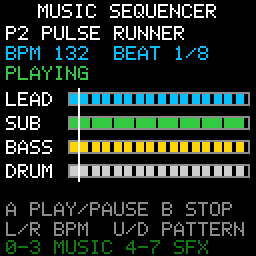
Two four-track patterns — a melodic lead, a sub-voice, a bass and a percussion track — handed to MusicPlayer and driven live from six buttons. A toggles play/pause, B stops, Left/Right move the tempo, Up/Down switch pattern. The screen is the score: one lane per sequencer track, one block per note, and a playhead crossing the eight-beat loop, with the pattern name, the BPM and the transport state on top. The single idea is the multi-track sequencer itself — how a MusicTrack chains three sub-voices, why its notes are measured in beats rather than seconds, and why every byte of it has to be static.
Language: C++17
Engine: gperez88/PixelRoot32-Game-Engine@^1.9.0
Environments: native, esp32dev
Category: Audio
Requirements (build flags)
Set in lib/platformio.ini (base template, inherited by every environment).
| Flag | Set to | Why |
|---|---|---|
PIXELROOT32_ENABLE_AUDIO | 1 | The topic. Costs roughly 17 KB of RAM — the mixer's eight voices, the SPSC command queue between the game loop and the audio thread, and the sequencer state. Without it there is no AudioEngine, no MusicPlayer and no sound, and nothing else breaks: the lanes still draw, the playhead still sweeps, the HUD still reads PLAYING. That failure mode is silence, not a compile error, so src/MusicSequencerScene.h stops the build with an #error naming the flag. |
PIXELROOT32_ENABLE_PHYSICS | 0 | Off on purpose. Frees roughly 9 KB: CollisionSystem's actor tables and the fixed-timestep PhysicsScheduler, both members of every Scene. Nothing here moves in space. |
PIXELROOT32_ENABLE_UI_SYSTEM | 0 | Off on purpose. Frees roughly 9 KB: UIManager's widget and hit-test tables, again a per-Scene member. The HUD is Renderer::drawText and a handful of rectangles. |
PIXELROOT32_ENABLE_PARTICLES | 0 | Off on purpose. Frees roughly 2 KB of particle pool. Nothing on screen sparkles. |
Audio is the most expensive subsystem in the engine, which is exactly why the demo about audio is the one that should not also carry the other three. CONTRIBUTING.md's rule for the category folders is that a demo enables the minimum set of flags its topic needs; leaving the three defaults on would spend another 20 KB on tables this demo never reads, and on an ESP32 that is the difference between a sequencer that fits and one that does not.
Platforms
| Environment | Display | Audio backend |
|---|---|---|
native | SDL2, 128×128 logical size | SDL2_AudioBackend, 22050 Hz, 1024-sample buffer — plays out of the default system device |
esp32dev | ST7735 128×128 (GreenTab3 profile), SPI pins in platformio.ini: MOSI 23, SCLK 18, DC 2, RST 4, CS -1 | ESP32_I2S_AudioBackend, 22050 Hz — external I2S DAC (MAX98357A or similar) on BCLK 26, LRCK 25, DOUT 22 |
src/platforms/esp32_dev.h keeps the internal-DAC alternative (ESP32_DAC_AudioBackend on GPIO 25, 11025 Hz, for a PAM8302A) commented beside the I2S one. Swap the two #includes and the two backend declarations to change route; the AudioConfig line reads audioBackend.getSampleRate() rather than a literal, so it follows either way.
Controls
| Button | native | esp32dev | Action |
|---|---|---|---|
| A | Space | GPIO 13 | Transport toggle. MusicPlayer::pause() when playing, resume() when paused, play() when stopped. |
| B | Enter | GPIO 12 | MusicPlayer::stop(). Silences all voices and drops the sequencer's track pointer. |
| Left | ← | GPIO 33 | setBPM(bpm - 4), floored at 60. |
| Right | → | GPIO 14 | setBPM(bpm + 4), capped at 200. |
| Up | ↑ | GPIO 32 | Previous pattern, then play() on it. |
| Down | ↓ | GPIO 27 | Next pattern, then play() on it. |
The demo starts already playing pattern 1. Tempo changes apply mid-loop and do not restart the pattern; a pattern change does restart, because play() is how the sequencer is handed a new track.
What it demonstrates
- A
MusicTrackis a chain, not a single melody. Its last three fields aresecondVoice,thirdVoiceandpercussion, each an optionalconst MusicTrack*.MusicPlayer::play()walks them in exactly that order and gives the sequencer up toMAX_MUSIC_TRACKS(4) parallel note streams: the main track becomes track 0,secondVoicetrack 1,thirdVoicetrack 2,percussiontrack 3. The four lanes on screen are those four streams. Initialisation is positional —{notes, count, loop, channelType, duty, &second, &third, &percussion}— so a pointer in the wrong slot is a silently different arrangement, not an error. - The voice partition, and why melodic tracks never fight.
ApuCoreowns eight voices. Slots 0–3 are the sequencer's melodic tracks and the mapping is fixed: track N always plays on voice N, so the bass can never steal the lead's voice however dense the pattern gets. Slots 4–7 are the shared SFX pool, chosen by a stealing heuristic — and drum hits land there too, which is why a percussion track can stack several hits on one step without costing a melodic voice. (When 4–7 are all busy, a drum hit may borrow a melodic slot, but only one that is both disabled and not holding a live note, so the rule above still stands.) That is the line the status bar's0-3 MUSIC 4-7 SFXrefers to. - Durations are beats, not seconds.
MusicNote::durationis measured in beats — quarter note =1.0— andApuCore::TICKS_PER_BEATis 4, so the sequencer resolves quarter-beat steps and anything finer is truncated to a tick. Wall-clock length comes fromMusicPlayer::setBPM()alone, which is why Left/Right can re-time the whole arrangement mid-loop without touching a single note. Both patterns insrc/assets/SequencerTracks.hare exactly 8.0 beats on all four tracks, which is what makes four independent streams loop in step. - A drum hit is
Note::Restplus a noise preset. On a track whosechannelTypeisWaveType::NOISE, aNote::Restcarrying a percussion preset (duty == 0) fires a hit; anywhere else the same note is silence and releases the voice. Miss either half and a whole drum track goes quiet with no diagnostic.MusicSequencerScene::drawLane()runs the same test the sequencer runs, so a lane that draws no blocks is telling you the sequencer will play nothing either. - A
durationof0.0is a stacked hit. It fires on the current step without advancing the sequencer, which is how the kick and hi-hat inPULSE RUNNERshare beat one. It is drawn as a 2 px tick because it has no length to draw. - Static lifetime is not a style choice.
MusicPlayer::play()takes a reference and stores a bareconst MusicTrack*; the audio thread then dereferences that track, itsMusicNotearray, and every note'sInstrumentPresetpointer for as long as playback lasts. A track built on the stack ofinit()is freed memory by the time the first note sounds — the symptom is noise or silence, not a crash. Everything inSequencerTracks.hisstatic constorconstexprat namespace scope for that one reason. - Transport state belongs to the caller.
MusicPlayerexposesisPlaying()but noisPaused(), andisPlaying()returnsfalsewhile paused — so "paused" and "stopped" are indistinguishable from outside. The scene keeps its own three-stateTransportenum and decides from it which call to make, which matters because afterstop()the player holds no track andresume()is a no-op: the only way back is a freshplay(). - Zero allocation in the loop. No
new, nomalloc, nostd::string. TheMusicPlayeris a function-localstaticcreated on the firstinit()— after theEngineglobal exists, and without a heap — and the three HUD strings are fixedcharmembers filled bysnprintfon beat boundaries and button presses, not every frame. - What the playhead is, honestly. It is the scene's own estimate, integrated from
deltaTime, the current BPM andgetTempoFactor(), and re-anchored to zero on everyplay(). The authoritative clock lives on the audio thread and engine 1.9.0 exposes no beat position to read back, so the line on screen can drift from the sound over a long run. It shows the shape of the loop, not a sample-accurate cursor.
Song library
The two patterns this demo plays are hand-written in src/assets/SequencerTracks.h — small enough to read, which is the point of the demo.
Alongside them, src/assets/songs/ carries four complete pieces exported from the PixelRoot32 Tool Suite. The demo does not include them; they are here as a library to swap in, and as worked examples of what a full export looks like next to a hand-written pattern.
| Song | BPM | Exported header |
|---|---|---|
| Blaster Ridge | 168 | blaster_ridge.h |
| Coinleaf Grove | 152 | coinleaf_grove.h |
| Lightworld March | 128 | lightworld_march.h |
| Moonwell Hymn | 104 | moonwell_hymn.h |
Each song ships as a pair:
<name>.h— the generated header. It declares its ownInstrumentPresets and tracks asinline constexpr, so it costs flash only while it is included, and nothing at all while it is not.<name>.h.pr32music— the editable project the header was generated from. Keep it. Without it the music is a wall of float literals nobody can revise; with it, the Tool Suite can reopen and re-export the piece.
To play one, include its header and hand its track to MusicPlayer the way MusicSequencerScene does with SequencerTracks.h. Two things to know first:
- The generated namespace is
musicdemo::<song_name>, which names the project these were authored in rather than this demo. Renaming it by hand would desynchronise the header from its.pr32musicsource, so it stays. - A full song is considerably larger than the demo's own patterns —
blaster_ridge.halone is 528 lines. That size is the reason the demo keeps its own patterns for teaching and these for listening.
Build
From audio/music_sequencer:
pio run -e native
pio run -e native --target exec
pio run -e esp32devThe committed [env:native] flags target Windows/MSYS2. On Linux drop the -IC:/msys64/..., -LC:/msys64/... and -mconsole lines; on macOS drop them and uncomment the two Homebrew lines above them. CI does this itself.
Upload (ESP32)
pio run -e esp32dev --target uploadEngine documentation
- Audio API
- Core API
- Graphics / Renderer
- Input API
audio/MusicPlayer.haudio/AudioMusicTypes.h—MusicTrack,MusicNote,Note, theINSTR_*presets and themakeNote()overloads
License
Source code: MIT.
This demo ships no art and no generated asset headers. Everything on screen is drawn with Renderer primitives and the engine's built-in 5×7 font against the built-in PR32 palette, so there is nothing visual to attribute.
The two music patterns in src/assets/SequencerTracks.h — CALM CIRCUIT and PULSE RUNNER — are original work written for this demo and are covered by the same MIT licence as the source. They use the engine's own INSTR_* instrument presets; no external sample, tracker module or third-party composition is included.
Source code: https://github.com/PixelRoot32-Game-Engine/PixelRoot32-Demo-Projects/tree/main/audio/music_sequencer