
Memory Budget
Demonstration project — provided as an example of what the PixelRoot32 Game Engine can do. It is not a product: parts may be incomplete, experimental, or deliberately simplified to keep one idea in focus.
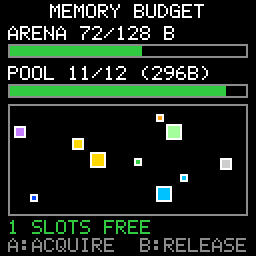
A SceneArena and an ObjectPool<Box, 12> sized at compile time, with their live occupancy drawn on screen as a number and a bar. Press A to acquire one pooled object — a bouncing box — and B to release the most recent one. When the twelfth slot is taken acquire() returns nullptr, and the demo says so in red instead of quietly doing nothing. That is the single idea here: the ceiling is a compile-time constant you can watch, and nothing allocates after init().
Language: C++17
Engine: gperez88/PixelRoot32-Game-Engine@^1.9.0
Environments: native, esp32dev
Category: Performance
Requirements (build flags)
Set in lib/platformio.ini (base template, inherited by every environment).
| Flag | Set to | Why |
|---|---|---|
PIXELROOT32_ENABLE_SCENE_ARENA | defined, no value | Half the topic. The engine tests this one with #ifdef, not #if, so =0 would still switch it on — it takes no value at all. The engine defines it nowhere itself, so a demo that wants the arena must pass it. Without it SceneArena::allocate() returns nullptr for every request and arenaNew() with it. That is not a compile error: this demo keeps a fallback style and still runs, it just draws ARENA 0/0 B and an empty bar. |
PIXELROOT32_ENABLE_GAMEPLAY_OBJECT_POOL | 1 | The other half. The whole of <gameplay/ObjectPool.h> sits inside an #if on this flag, and the engine default is 0, so without it ObjectPool<T, N> does not exist as a type. src/MemoryBudgetScene.h stops the build with an #error naming the flag rather than letting you read a page of template errors. |
PIXELROOT32_ENABLE_AUDIO | 0 | Off on purpose. Frees roughly 17 KB of RAM: mixer voices, the SPSC command queue, and the sequencer state. This demo makes no sound. |
PIXELROOT32_ENABLE_PHYSICS | 0 | Off on purpose. Frees roughly 9 KB: CollisionSystem's actor tables and the fixed-timestep PhysicsScheduler, both members of every Scene. The boxes bounce off four constants, not off colliders. |
PIXELROOT32_ENABLE_UI_SYSTEM | 0 | Off on purpose. Frees roughly 9 KB: UIManager's widget and hit-test tables, again a per-Scene member. The HUD here is Renderer::drawText and two rectangles. |
PIXELROOT32_ENABLE_PARTICLES | 0 | Off on purpose. Frees roughly 2 KB of particle pool. Nothing on screen sparkles. |
Those four zeros are not tidying-up, they are the argument. CONTRIBUTING.md's rule for the category folders is that a demo enables the minimum set of flags its topic needs, and this demo's topic is the RAM ceiling: leaving the four default-on subsystems enabled would spend roughly 36 KB that neither bar on screen accounts for, which is exactly the mistake the demo exists to argue against. Every byte the bars do not show is a byte you did not budget.
Platforms
| Environment | Display | Audio backend |
|---|---|---|
native | SDL2, 128×128 logical size | none — PIXELROOT32_ENABLE_AUDIO=0 |
esp32dev | ST7735 128×128 (GreenTab3 profile), SPI pins in platformio.ini: MOSI 23, SCLK 18, DC 2, RST 4, CS -1 | none — PIXELROOT32_ENABLE_AUDIO=0 |
Controls
| Button | native | esp32dev | Action |
|---|---|---|---|
| A | Space | GPIO 13 | pool.acquire(...) — one box, one slot. At capacity it returns nullptr and the status line turns red. |
| B | Enter | GPIO 12 | pool.release(...) on the most recently acquired box (LIFO). |
Nothing else is wired: the D-pad is declared in the platform headers because InputConfig takes six buttons, and is otherwise unused.
What it demonstrates
- A budget fixed before
main()runs.kArenaBytesandkPoolCapacityarestatic constexprmembers, the arena's backing buffer is a plainunsigned char[]member, andObjectPool's storage is inline (alignas(T) unsigned char storage_[N * sizeof(T)]). Both ceilings are part of the scene's ownsizeof— there is no heap to go and measure. - Occupancy you can read off the screen.
SceneArena::offsetis the bytes used andSceneArena::capacitythe ceiling;ObjectPool::size()andcapacity()are the same pair for slots. Both are drawn asused/capacityplus a proportional bar, and the bar turns red at the ceiling. - The real numbers. 12
BoxStylerecords at 6 bytes each occupy 72 of the arena's 128 bytes.sizeof(ObjectPool<Box, 12>)is 296 bytes on the 64-bit native build — 12 × 24-byteBoxplus auint32_tliveness word and two counters — and is smaller on a 32-bit ESP32, whereBox's style pointer costs 4 bytes rather than 8. The demo prints thatsizeofitself, so the figure on screen is always the one the compiler produced. - A full pool is a visible state, not a swallowed one.
acquire()returningnullptrsets a flag the HUD prints asFULL: GOT NULLPTR. Pooled APIs fail by returning nothing; a demo that hid that would be teaching the failure mode wrong. - The arena's two sharp edges, respected.
SceneArena::reset()only rewinds a bump offset and never runs a destructor, so only trivially destructible types go in it — here,BoxStyle. And the pool is not arena-backed:ObjectPool.hstates plainly that arena-backed pool storage is unsupported, becauseScene::resetState()rewinds the arena unconditionally while the pool's liveness bitmask still claims those bytes. - Zero allocation after
init(). Nonew, nomalloc, nostd::vector, nostd::stringanywhere inupdate()ordraw(). The three HUD strings are fixedcharmembers filled bysnprintf, and only on the frames where the occupancy actually changed. - Ordering the engine cares about.
init()callsScene::init()first — which runsresetState()and rewinds the arena — and only thenpool_.reset(), the orderObjectPool.hdocuments so no released object can leave a dangling pointer in the scene's entity list.
Build
From performance/memory_budget:
pio run -e native
pio run -e native --target exec
pio run -e esp32devThe committed [env:native] flags target Windows/MSYS2. On Linux drop the -IC:/msys64/..., -LC:/msys64/... and -mconsole lines; on macOS drop them and uncomment the two Homebrew lines above them. CI does this itself.
Upload (ESP32)
pio run -e esp32dev --target uploadEngine documentation
- Core API
- Graphics / Renderer
- Input API
- Memory system
core/Scene.h—SceneArenaandarenaNew()are declared here, not in a header of their owngameplay/ObjectPool.h
License
Source code: MIT.
This demo ships no art, audio, or generated asset headers. Everything on screen is drawn with Renderer primitives and the engine's built-in 5×7 font against the built-in PR32 palette, so there is nothing here to attribute.
Source code: https://github.com/PixelRoot32-Game-Engine/PixelRoot32-Demo-Projects/tree/main/performance/memory_budget