
Particles
Demonstration project — provided as an example of what the PixelRoot32 Game Engine can do. It is not a product: parts may be incomplete, experimental, or deliberately simplified to keep one idea in focus.
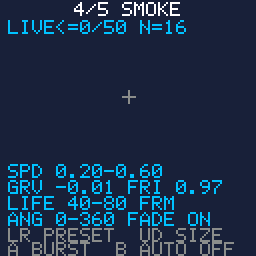
The engine ships five particle presets — Fire, Explosion, Sparks, Smoke, Dust — and this demo walks them one at a time through a single ParticleEmitter. Left/Right change preset, A fires a burst, B turns on continuous emission, Up/Down resize the burst against the emitter's own 50-particle ceiling. Under the effect the demo prints the config it was built from: speed range, gravity, friction, life range, angle cone, fade flag. Those figures are read back off the live ParticleConfig every time the preset changes, so the numbers on screen are the header's numbers and cannot drift from them. That is the single idea here: see the look and the parameters that produce it at once.
Language: C++17
Engine: gperez88/PixelRoot32-Game-Engine@^1.9.0
Environments: native, esp32dev
Category: Graphics
Requirements (build flags)
Set in lib/platformio.ini (base template, inherited by every environment).
| Flag | Set to | Why |
|---|---|---|
PIXELROOT32_ENABLE_PARTICLES | 1 | The topic. Every header under include/graphics/particles/ — Particle.h, ParticleConfig.h, ParticleEmitter.h, ParticlePresets.h — is wrapped in #if PIXELROOT32_ENABLE_PARTICLES and collapses to nothing without it, so ParticleEmitter is not a type and MAX_PARTICLES_PER_EMITTER is not defined. src/ParticlesScene.h stops the build with an #error naming the flag rather than letting you read a page of "unknown type name". Costs roughly 2 KB of RAM and 5 KB of flash. |
PIXELROOT32_ENABLE_AUDIO | 0 | Off on purpose. Frees roughly 17 KB of RAM: mixer voices, the SPSC command queue, and the sequencer state. This demo makes no sound, and the platform headers build the two-argument Engine(config, inputConfig) with no AudioConfig at all. |
PIXELROOT32_ENABLE_PHYSICS | 0 | Off on purpose. Frees roughly 9 KB: CollisionSystem's actor tables and the fixed-timestep PhysicsScheduler, both members of every Scene. Particles carry their own gravity and friction inside ParticleEmitter::update(); they are not physics bodies and never touch a collider. |
PIXELROOT32_ENABLE_UI_SYSTEM | 0 | Off on purpose. Frees roughly 9 KB: UIManager's widget and hit-test tables, again a per-Scene member. The HUD here is eight Renderer text calls and a two-line cross. |
That one-on, three-off list is the clearest example in the catalogue of why the flag list is part of a demo's design. Particles are the cheapest of the four toggles by an order of magnitude: the roughly 2 KB this demo spends buys everything on screen, while the three zeros hold back roughly 35 KB that nothing here would have used. A demo that left all four on would spend roughly eighteen times the RAM its own subject needs.
The measured cost is small and checkable. On the 64-bit native build sizeof(Particle) is 24 bytes and sizeof(ParticleEmitter) is 1272 — 50 × 24 for the fixed particle array, plus the 32-byte ParticleConfig copy and the Entity base. It is a little smaller on the 32-bit ESP32. The emitter is a plain member of the scene, so that figure is part of the scene's own sizeof and there is no heap to go and measure.
Platforms
| Environment | Display | Audio backend |
|---|---|---|
native | SDL2, 128×128 logical size | none — PIXELROOT32_ENABLE_AUDIO=0 |
esp32dev | ST7735 128×128 (GreenTab3 profile), SPI pins in platformio.ini: MOSI 23, SCLK 18, DC 2, RST 4, CS -1 | none — PIXELROOT32_ENABLE_AUDIO=0 |
Controls
| Button | native | esp32dev | Action |
|---|---|---|---|
| Left | Left | GPIO 33 | Previous preset. The emitter is rebuilt, so anything still in the air is cleared. |
| Right | Right | GPIO 14 | Next preset. Wraps around after Dust. |
| A | Space | GPIO 13 | burst(position, N) once, with N the current burst size. |
| B | Enter | GPIO 12 | Toggle continuous emission: four particles every four frames, so the pool refills about as fast as it drains. |
| Up | Up | GPIO 32 | Burst size +1, clamped at MAX_PARTICLES_PER_EMITTER (50). |
| Down | Down | GPIO 27 | Burst size -1, clamped at 1. |
The HUD line under the title reads LIVE<=n/50 N=b: n is an upper bound on the particles alive, 50 the emitter's ceiling, b the burst size Up/Down control. See below for why that bound is an inequality.
What it demonstrates
The five presets, with the values from the header
Read from include/graphics/particles/ParticlePresets.h at engine 1.9.0. The demo prints the same fields off the live ParticleConfig rather than from a copy of this table.
| Preset | Colour | Speed | Gravity | Friction | Life (frames) | Angle | fadeColor |
|---|---|---|---|---|---|---|---|
| Fire | Red → DarkRed | 0.50 – 1.50 | -0.02 | 0.98 | 20 – 40 | 0 – 360 | true |
| Explosion | Yellow → Black | 2.00 – 4.00 | 0.10 | 0.90 | 10 – 20 | 0 – 360 | true |
| Sparks | White → Yellow | 1.50 – 3.00 | 0.15 | 0.85 | 8 – 15 | 0 – 360 | true |
| Smoke | DarkGray → Black | 0.20 – 0.60 | -0.01 | 0.97 | 40 – 80 | 0 – 360 | true |
| Dust | LightGray → DarkGray | 0.30 – 1.00 | 0.08 | 0.90 | 12 – 25 | 0 – 360 | true |
Reading the table sideways is most of the lesson. Speed sets how far the effect throws: Explosion at 2.00–4.00 clears the screen in a handful of frames while Smoke at 0.20–0.60 barely leaves the emitter. Gravity is positive down, so Fire and Smoke — the two with a negative value — are the two that rise. Friction is a multiplier applied to velocity every frame, not a force: Sparks at 0.85 have shed 80 % of their speed after ten frames, Fire at 0.98 keep 82 % of it. Life is what separates a puff from a plume: Sparks live 8–15 frames, Smoke 40–80.
Two things the shipped presets do not vary: every one of them emits over the full 0 – 360 circle, and every one of them sets fadeColor = true. The angle cone is a real parameter — 0 is right, 90 is down, 180 is left — but no preset narrows it, so a directional jet is something you write a ParticleConfig for yourself.
Six of the ten config fields are Scalar, not float
ParticleConfig mixes types on purpose. minSpeed, maxSpeed, gravity, friction, minAngleDeg and maxAngleDeg are pixelroot32::math::Scalar, which is float where the target has an FPU and Fixed16 where it does not; assign them through math::toScalar(...) rather than writing a bare literal. minLife and maxLife are plain uint8_t, fadeColor a plain bool, and startColor / endColor plain Color values. The presets get away with brace initialisation from float literals because both float and Fixed16 are constructible from one at compile time.
The demo's HUD has to print a Scalar on both paths, which it does by casting to float once and formatting hundredths as integers — in refreshPresetText(), called when the preset changes, never inside the frame loop.
Life is measured in frames, and nothing is measured in time
ParticleEmitter::update(unsigned long deltaTime) opens with (void)deltaTime; and never looks at it again. Life counts down by one per call, gravity is added to velocity once per call, friction multiplies velocity once per call. So maxLife = 40 is 0.67 s at 60 fps and 1.6 s at 25 fps, and the same preset that reads as a quick spark on the SDL2 build reads as a slow lob on hardware — not because the numbers changed, but because they were never in seconds. Tune a preset on the target you ship it on.
This demo counts its own continuous-emission cadence in frames too, for the same reason: both sides of the effect then move on one clock.
burst() takes the position explicitly
void burst(pixelroot32::math::Vector2 position, int count);The origin is an argument, not the emitter's Entity position — the emitter never reads its own transform when spawning. One emitter can therefore serve every effect on a screen: pass the enemy's position when it dies, the tyre's position when the car turns. This demo passes one fixed point, drawn as a small grey cross, so the shape of each preset is comparable between presses.
fadeColor = false ignores endColor completely
The colour interpolation lives inside if (config.fadeColor). With the flag off p.color keeps the value it was given at spawn — resolveColor(startColor) — for the particle's whole life, and endColor is dead weight in the struct. All five shipped presets set it to true, so this is a trap you meet when writing your own config, not when using theirs.
Two related edges, both visible in the table above and both about the palette rather than the particle system. Explosion and Smoke end on Color::Black; against a black background their tails fade to invisible, which is why this demo paints navy. And in the PR32 Color enum LightGray, DarkGray and Gray are the same enumerator — so Dust, which fades LightGray → DarkGray, has fadeColor = true and no colour change at all.
50 particles, fixed at compile time, recycled not allocated
MAX_PARTICLES_PER_EMITTER is a #define in ParticleEmitter.h — not a field of ParticleConfig, not a constant in Particle.h — and it sizes a plain Particle particles[50] member. burst() walks that array looking for slots with active == false and stops when it has filled count of them or run out, so asking for 40 particles when 30 are alive gives you 20 and no complaint. Nothing is allocated at any point, which is also why redefining the macro in a demo would be worse than useless: the engine's own translation units were already compiled against 50.
The emitter also kills any particle that leaves the logical screen, before its life runs out, in both update()'s early-cull and its post-move bounds check. An effect fired near an edge is a shorter effect.
There is no live-particle accessor, so the HUD says <=
ParticleEmitter keeps particles[], maxParticles and config all private and exposes exactly three public methods: update(), draw() and burst(). There is no getActiveCount(), no size query, no way to read the config back out. Rather than invent one, this demo tracks what it can from the outside: each burst is recorded as a cohort — how many particles it asked for, and config.maxLife frames as the longest they could possibly last — and the HUD sums the cohorts still inside their window, clamped to 50.
That is an upper bound and is labelled LIVE<=n/50 for it. The real number is lower whenever a particle drew a life shorter than maxLife, left the screen early, or was never spawned because the pool was already full. It is the tightest honest figure available from outside the class, and saying so is more useful than a number that looks exact and is not.
Switching preset without a setter, and without the heap
There is no setConfig(): ParticleConfig is a constructor argument the emitter copies into a private member. Changing preset therefore means a different emitter. This demo keeps one alignas(ParticleEmitter) unsigned char buffer as a scene member and constructs into it with placement new, destroying the previous occupant by hand first. Nothing is allocated, the RAM cost stays at one emitter rather than five, and — because the address never changes — the pointer the base Scene is holding in its entity list stays valid across the switch. Clearing the old preset's particles is a side effect of the rebuild, and the right one.
The emitter is registered with addEntity() once in init(), so Scene::update() and Scene::draw() drive it; the demo never calls the emitter's update() or draw() itself.
Zero allocation in the frame loop
No new, no malloc, no std::string in update() or draw(). The seven HUD strings are fixed char members filled by snprintf: the five preset lines only when the preset changes, the mode line only on a B press, and the stats line only on the frames where the bound or the burst size actually moved.
Build
From graphics/particles:
pio run -e native
pio run -e native --target exec
pio run -e esp32devThe committed [env:native] flags target Windows/MSYS2. On Linux drop the -IC:/msys64/..., -LC:/msys64/... and -mconsole lines; on macOS drop them and uncomment the two Homebrew lines above them. CI does this itself.
Upload (ESP32)
pio run -e esp32dev --target uploadEngine documentation
- Graphics / Renderer
- Core API
- Input API
- Memory system
graphics/particles/ParticleEmitter.h— the class, and theMAX_PARTICLES_PER_EMITTERmacrographics/particles/ParticleConfig.hgraphics/particles/ParticlePresets.hmath/Scalar.h—ScalarandtoScalar()
License
Source code: MIT.
This demo ships no art, audio, or generated asset headers. Every particle is a 2×2 rectangle the engine draws itself, and the HUD uses the built-in 5×7 font against the built-in PR32 palette, so there is nothing here to attribute.
Source code: https://github.com/PixelRoot32-Game-Engine/PixelRoot32-Demo-Projects/tree/main/graphics/particles