
Networking Pong
Demonstration project — provided as an example of what the PixelRoot32 Game Engine can do. It is not a product: parts may be incomplete, experimental, or deliberately simplified to keep one idea in focus.
Three boards and no router: an ESP32-2432S028 "Cheap Yellow Display" runs the match, and two DFRobot Beetle ESP32-C3 boards are the controllers, each with a 128x64 OLED scoreboard. Everything travels over ESP-NOW on channel 6, which is the single idea here — one node owns the truth, two nodes send intent, and the wire is sized so that ownership never needs to be negotiated.
Language: C++17
Engine: gperez88/PixelRoot32-Game-Engine@^1.13.0
Environments: native, esp32cyd_host, esp32c3_p1, esp32c3_p2, host_test, net_test
Category: Networking
Requirements (build flags)
Networking is set once in lib/platformio.ini's [base] template; the rest of the budget belongs to the target, because a controller that draws a scoreboard should not pay for a particle pool.
| Flag | Value | Why |
|---|---|---|
PIXELROOT32_ENABLE_NETWORKING | 1 | Compiles NetSession, the ESP-NOW backend and the loopback bus. Off by default, and this demo refuses to build without it (#error in PongHostScene.h) rather than drawing a court with no link behind it. |
PIXELROOT32_ENABLE_4BPP_SPRITES | defined on native / esp32cyd_host | The ball and both paddles are Sprite4bpp. The gate is #ifdef, so a bare define is the only spelling that turns the path on; -D ...=0 would also enable it. Without it the actors fall back to filled rectangles. |
PIXELROOT32_ENABLE_AUDIO | 1 host, 0 controllers | Six arcade cues on the CYD's DAC. The C3s are silent and have no backend. |
PIXELROOT32_ENABLE_PARTICLES | 1 host, 0 controllers | Contact bursts and the goal spray. |
PIXELROOT32_ENABLE_CAMERA_EFFECTS | 1 host | The screen shake on a contact. Nothing scrolls, so the camera exists only for the jolt. |
PIXELROOT32_ENABLE_PHYSICS | 0 | The ball is integrated by the engine-free rules core; there is no solver to run. |
PIXELROOT32_ENABLE_UI_SYSTEM | 0 | The HUD is Renderer text and rectangles; there is no widget tree to lay out. |
PIXELROOT32_USE_U8G2 | defined on both C3s | Selects U8G2_Drawer for the 1-bit SSD1306 panel instead of the TFT path. |
ESP_NOW_NODE_ID | 2 or 3 | The application label of a controller. esp32_c3_controller.h rejects any other value with an #error, then re-checks the literal against NetConfig.h with a static_assert. |
Two display settings are easy to get wrong:
esp32cyd_hostkeepsLOGICAL_WIDTH/LOGICAL_HEIGHTunset. The panel is mounted portrait (PHYSICAL_*240x320),DISPLAY_ROTATION=3turns it into a 320x240 canvas, andDisplayConfigswaps the logical pair for the quarter turn. Hand-setting 320x240 is swapped back to 240x320 and the scene loses its right-hand 80 px.- Both C3s set
LOGICAL_*equal toPHYSICAL_*(128x64) with zero offsets, so the scoreboard owns the whole framebuffer instead of a window inside it.
host_test deliberately does not extend [base]: it defines no networking flag and ignores the engine library, which is what keeps the codec and the rules compiling on a bare host.
Platforms
| Environment | Board / display | Canvas | Audio | Input |
|---|---|---|---|---|
native | SDL2 window, 640x480 client area (the 320x240 canvas at 2x) | 320x240 | SDL2_AudioBackend, 22050 Hz | Keyboard: W/S for P1, ↑/↓ for P2 |
esp32cyd_host | ESP32-2432S028 "Cheap Yellow Display", ILI9341_2 240x320, DISPLAY_ROTATION=3 | 320x240 | ESP32_DAC_AudioBackend on GPIO 26, 22050 Hz | none — both paddles arrive over ESP-NOW; the XPT2046 panel is left unclaimed |
esp32c3_p1 | DFRobot Beetle ESP32-C3, SSD1306 128x64 over U8G2 | 128x64 | none | GPIO 3 / GPIO 1 |
esp32c3_p2 | same board, same wiring | 128x64 | none | GPIO 3 / GPIO 1 |
host_test | none — Unity over the engine-free layers | — | none | — |
net_test | none — Unity over the real engine session and three loopback nodes | — | none | — |
native and esp32cyd_host compile the same host scene; only the transport, the drawer and the audio backend differ. esp32c3_p1 and esp32c3_p2 compile the same controller translation unit: ESP_NOW_NODE_ID is the whole difference, and every optional subsystem is compiled out because a scoreboard needs none of them.
Controls
Each controller's two buttons move its own paddle and nothing else. There is no shared input, no touch on the CYD, and no button that acts on the other player.
| Input | native | ESP32-C3 | Moves |
|---|---|---|---|
| Up | W | GPIO 3 | that board's paddle towards the top of the court |
| Down | S | GPIO 1 | that board's paddle towards the bottom of the court |
On the C3 the two pins are wired to GND and InputManager applies INPUT_PULLUP to every pin it is given, so no external resistors are needed. The firmware names them kLeftButtonPin (3) and kRightButtonPin (1) because the engine's InputConfig takes left/right; the court is vertical, so the rules read those two bits as up/down.
Holding both buttons on one board cancels out. Releasing both leaves the paddle where it is: only the held state travels, never a delta.
The three roles
| Role | Environment | Node id | Paddle | Screen |
|---|---|---|---|---|
| Host / authority | esp32cyd_host | 1 | both | court, HUD, overlay |
| Player 1 | esp32c3_p1 | 2 | left | score, phase, own paddle bar |
| Player 2 | esp32c3_p2 | 3 | right | score, phase, own paddle bar |
The ids are the wire contract: NetConfig.h is the only place that names them, and the host maps 2 to slot 0 and 3 to slot 1 when the session reports a peer joining under that node id. A board flashed with the wrong environment still boots, but the host either ignores it (duplicate id) or has a permanently still paddle (the other slot stays unbound). Reflash it; there is no runtime switch.
Hardware
ESP32-2432S028 CYD — the pin map is games/chess's, unchanged:
| Signal | GPIO |
|---|---|
Backlight (TFT_BL) | 21 |
| SPI MISO | 12 |
| SPI MOSI | 13 |
| SPI SCLK | 14 |
Data/command (TFT_DC) | 2 |
Reset (TFT_RST) | -1 (tied to the board's reset) |
Chip select (TFT_CS) | 15 |
| DAC speaker | 26 |
DFRobot Beetle ESP32-C3 — both controllers, identical wiring:
| Signal | GPIO |
|---|---|
| I2C SDA (SSD1306) | 5 |
| I2C SCL (SSD1306) | 6 |
| OLED reset | none (255) |
| Button, up | 3 (to GND) |
| Button, down | 1 (to GND) |
GPIO 26 is DAC2 and is where the speaker sits on the common 2432S028; board revisions vary, and the internal DAC does not exist on the C3 at all, which is why the controllers have no audio flag.
Hardware bring-up
This is a source-derived checklist, not a lab report. Every step below comes from the firmware in this directory and from the native simulator; the three physical boards were not available when it was written, so nothing here is claimed as hardware-verified. If a screen disagrees with a row, the screen is right and this section is the thing to fix.
Work in this order — wire both controllers, flash the host, flash Player 1, flash Player 2 — and read one screen after each step. The order exists for the host's panel: it is the only instrument that can tell "that pad joined as node 2" from "that pad is node 2 again".
1. Wire the two ESP32-C3 controllers
Both controllers are the same board with the same wiring. Nothing in the hardware distinguishes Player 1 from Player 2: ESP_NOW_NODE_ID in the flashed environment is the whole difference, and each board prints which one it believes it is (P1 or P2, top-left of its OLED).
| SSD1306 module | ESP32-C3 |
|---|---|
VCC | 3V3 |
GND | GND |
SDA | GPIO 5 |
SCL | GPIO 6 |
| Button | ESP32-C3 | Other leg |
|---|---|---|
| Up | GPIO 3 | GND |
| Down | GPIO 1 | GND |
No external resistors and no OLED reset line: the firmware hands both button pins to InputManager, which applies INPUT_PULLUP, so a press shorts the pin to ground; the panel's reset is passed to the driver as 255, which means "none". The five numbers are the same as in Hardware, and src/platforms/esp32_c3_controller.h is where they are defined.
2. Flash in order: host, Player 1, Player 2
From networking/pong, with one board attached at a time (or all three and an explicit port on each command):
pio device list
pio run -e esp32cyd_host -t upload
pio run -e esp32c3_p1    -t upload
pio run -e esp32c3_p2 -t uploadpio device list prints one entry per attached board, and each entry's Hardware ID is what actually identifies it. The CYD's USB-UART bridge shows a vendor such as VID:PID=1A86:7523 (USB-SERIAL CH340) or 10C4:EA60 (CP210x); a Beetle C3 on Windows shows USB Serial Device (COMn) with VID:PID=303A:1001, Espressif's own USB (on Linux the same board appears as USB JTAG/serial debug unit). Identify a port by unplugging one board and re-listing, not by trusting the order the ports were enumerated in.
With more than one board attached, add --upload-port COM5 (or /dev/ttyUSB0, /dev/ttyACM0) to each command so PlatformIO cannot pick a sibling. Each -t upload echoes the environment it built — confirm the second controller says esp32c3_p2 before you read its screen, because a board flashed with the wrong environment looks perfectly healthy and only fails to be player two.
3. Read the screens at each step
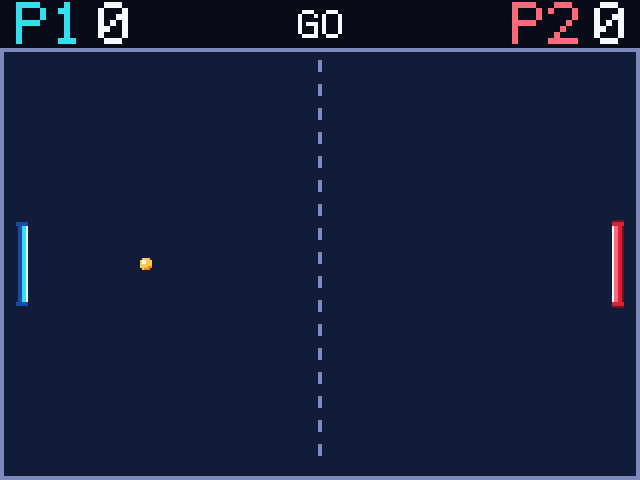
The host's score band shows a phase word (WAITING, 3, 2, 1, GO, POINT, PAUSED, OVER), the two scores, and — while the match is WAITING or PAUSED — a diagnostics panel over the court. The controllers show their own id, a link/version line, the two scores, the phase word, a ball marker and their paddle track.
| After | Host (CYD) | Controller |
|---|---|---|
| Host powered, no pads | Band reads WAITING with 0 and 0; panel reads NET CH 6, P1 -- P2 --, RTT 0 MS, DROP 0, QUEUE 0 | — |
| Player 1 powered | One token flips: P1 OK P2 --. Still WAITING, still no countdown | Top-right LINK V1 under a top-left P1; score 0 - 0; phase WAIT; empty paddle track |
| Player 2 powered | P1 OK P2 OK; the gate opens on that frame | Top-left P2; LINK V1; WAIT for at most one state, then READY |
| Both bound | Band counts 3, 2, 1 (400 ms each, 1.2 s total), then GO; ball and paddles move | READY during the countdown, then PLAY; the score line and the marker track the host |
| A paddle moved | That paddle moves, the other stays | Its own marker slides; the other board's screen does not change |
That is the whole diagnosis: a pad that shows OK in its own token and LINK V1 on its own screen is bound as the id printed top-left. A pad that shows -- on the host while its own screen says P1 is a wrong node id (two boards claiming P1), a different channel, or a board that is not running this firmware — never a gameplay problem.
4. When a step does not happen
| Symptom | What it means | What to do |
|---|---|---|
A pad's token stays -- | That board is not bound: a different channel, out of range, not running this demo, or its frames are never accepted. The tag top-left of its own screen is the id it claims | Compare the two tags. Two P1s means reflash one board with esp32c3_p2; two P2s, esp32c3_p1. Then check the host reads NET CH 6 |
Both pads show the same id (P1 twice) | Duplicate node id. The host keeps the first claimant and ignores the second, so one paddle never moves and that board's token stays -- | Reflash one board with the other controller environment. There is no runtime switch |
DROP is rising on the host | The host's receive queue overflowed. The demo's contract is zero: the cadences are sized to keep it there | Look for another demo or an access point on channel 6. This is saturation, not weather |
A controller is stuck on WAIT after the host is up | WAIT only means "no STATE yet". One pad alone legitimately shows WAIT + LINK V1 while the host waits for the other. NO LNK means the 1500 ms host watchdog expired (never joined, wrong channel, host not running); V? means a protocol-version mismatch | With both pads joined, a WAIT + LINK V1 board means the host is the one stuck — read the host row below |
| Host is stuck on the lobby panel with one pad joined | The countdown needs both slots bound, online and version-compatible, and will wait indefinitely otherwise. This is the gate, not a hang | Read which token is --; that board is the fault. Fix it per the first two rows |
| A pad reconnects mid-set | Expected, not a bug: the survivor freezes on PAUSED, the diagnostics panel comes back on the host, and both boards resume into a fresh 3-2-1 once the rebooted board has handshaked and sent an INPUT | Do nothing. If it stays paused, that board is not sending input: check its two buttons and their ground |
A controller shows a version error (V?) | The two builds disagree on kProtocolVersion, i.e. one board came from a different checkout or commit | Reflash all three from the same tree. The host pauses rather than parse frames with the wrong field widths |
5. Reset and rematch
The set is no longer terminal. When a side reaches 5 the host band reads OVER and the court carries a P1 WINS / P2 WINS band; both controllers show the same winner and a PRESS prompt. Press and release any direction button on either controller and the host turns that press into a rematch: both scores go back to 0 and a fresh countdown starts. Nothing is re-flashed between sets, and either player can start one.
Two details matter when it does not work:
- A button that was already down when the set ended is not a press — the host compares the new held mask with the previous one, so release first.
- Only
MATCH_OVERaccepts the gesture. During a rally the same press just moves that paddle, andRules::restart()ignores every other phase, so a stray frame cannot wipe a score in progress.
There is no persistence anywhere in the demo: the score, the phase and the serve live in the CYD's RAM, so power-cycling the host starts over at 0-0. The controllers hold nothing, which is why a rebooted pad gets its score back from the immediate reliable STATE rather than from flash.
Again: none of the above was observed on the three boards. It is the firmware's behaviour, read from the source and exercised in the native simulator, which puts the host and both controllers on a lossless loopback and therefore says nothing about radio range, antenna orientation or a crowded channel 6.
What it demonstrates
One authority, two intents. The CYD owns the ball, both paddles, the score, the phase and the serve; a controller sends one held-direction byte and paints what it is told. That asymmetry is what makes a lossy radio harmless: a lost STATE costs 33 ms of picture, and a lost INPUT means "keep doing what you were doing", never "move by an amount that never arrived".
A fixed match clock, not the frame clock. The rules advance on a 60 Hz accumulator with at most 3 catch-up steps per frame; a longer stall is dropped rather than replayed, because the positions are stale by then and replaying them would make the next frame late too. The host also clamps a frame delta at 100 ms. A ~25 fps CYD and the uncapped simulator therefore move the ball the same distance per second.
| Clock | Rate | What runs | Delivery |
|---|---|---|---|
| Rules step | 60 Hz fixed | ball, paddles, score, phase, serve | local |
STATE fan-out | 30 Hz, per controller | 19-byte snapshot of the whole match | Unreliable |
INPUT | on change + 250 ms keepalive | 5-byte held mask | Unreliable |
| Controller OLED | at most 10 Hz, change-gated | full 128x64 repaint (~23 ms over I2C) | local |
| Discrete events | on edge | POINT, ROUND_START, PAUSE, MATCH_END, APP_HELLO | Reliable |
Unreliable for state, reliable for edges. STATE is a full picture, so a dropped frame costs one refresh and cannot accumulate drift. The reliable path is the session's ACK-and-retry queue (8 pending frames, three retries), so sending 30 frames a second on it would back the queue up and turn one lost ACK into a stall. Everything discontinuous — a point, a serve direction, a pause, the final score — must not be lost, so it is reliable and rare.
Unicast fan-out. NetSession has no broadcast send. The host walks its two player slots, checks that the slot is bound and reachable, and sends to that peer's peerId:
player 0 -> bindings_[0].peerId
player 1 -> bindings_[1].peerIdBoth controllers receive the same STATE sequence number, so the room can compare the frame one board got with the frame the other got. NetSession is 4 peers / 64-byte payload by default; the largest frame here is 19 bytes, so there is no fragmentation and no chunking anywhere in the demo.
A controller reboot re-syncs instead of re-joining by hand. A session starts with a per-boot generation, so a rebooted C3 looks new to the host rather than like a stale duplicate. On PeerJoined the host rebinds the same node id to its slot, restarts that slot's anti-replay window, zeroes the paddle input, then sends APP_HELLO and a reliable STATE immediately — waiting for the 30 Hz tick would leave the panel showing a stale board for a third of a second. The survivor sees PAUSED while the host's 1000 ms watchdog is unhappy, and the match resumes into a fresh countdown as soon as both controllers are bound, compatible and sending again. MATCH_OVER is never auto-resumed; the set is replayed only by a new controller press (see How do I play another set?).
The wire protocol
Hand-encoded little-endian bytes, tag first, in src/net/PongProtocol.h. The structs are never cast onto the wire: the host is an ESP32 and the controllers are ESP32-C3, and a cast would depend on compiler padding and on the enum's underlying width agreeing across both. Every decoder also checks the length against the exact size of its message before reading a field, so a truncated or padded frame is rejected and leaves the destination untouched.
| Tag | Message | Bytes | Delivery | Sent when |
|---|---|---|---|---|
| 20 | APP_HELLO | 3 | Reliable | On every join, in both directions; carries version 1 and the sender's role |
| 21 | INPUT | 5 | Unreliable | Mask changed, or every 250 ms as a keepalive |
| 22 | STATE | 19 | Unreliable (Reliable on rejoin) | 30 Hz per controller, one sequence for both |
| 23 | POINT | 6 | Reliable | A rally ended; scorer and both scores |
| 24 | ROUND_START | 4 | Reliable | Before each serve; signed serve direction |
| 25 | PAUSE | 2 | Reliable | A peer was lost, or the match resumed |
| 26 | MATCH_END | 4 | Reliable | A side reached 5 |
STATE carries phase, ball position and velocity, both paddle centres, both scores and a reserved flags byte. seq is the payload's own 16-bit counter and wraps with the RFC 1982 comparison in isNewerSequence(): a frame that overtook a newer one is dropped, and the half-open window (distance 0x8000) is not an ordering in either direction. The sequence lives in the payload because the session's own NetEvent::sequence is 0 for unreliable frames.
APP_HELLO is a version gate, not a framework version: it changes only when a layout changes. A peer reporting a different value is refused — the host pauses the match rather than parsing its frames with the wrong field widths, and the controller paints V?.
Native simulator
native runs the host plus both controllers in one window, over a LoopbackBus: one Engine, one host scene, three sessions and three LoopbackTransports with distinct synthetic MACs.
- Auto-join. The scene starts both simulated controllers immediately after the host session, exactly as two C3s would after the CYD, so the room reaches "both ready" on its own. Nothing is pressed to join: the
WAITINGpanel is a status readout, not a screen you have to clear. - Keys.
W/Smove P1 up/down;↑/↓move P2 up/down. - One Engine, one dispatcher. The Engine pumps and dispatches only the host session;
PongHostScene::update()pumps the two controller sessions itself (update, drain, firmware) on the samemillis()it hands the bus. That is a simulation detail, not an engine limit: each real board runs its own Engine. - The loopback is lossless, so it proves the protocol, the cadence, the rules and the drawing — not the RF behaviour.
While the match is WAITING or PAUSED the court is covered by the diagnostics panel. Those are the two phases where nothing moves, and "why is nothing moving" is exactly what it answers:
| Line | Example | Meaning |
|---|---|---|
NET CH n | NET CH 6 | The channel every node must share. "Same board, different channel" is the failure neither screen can otherwise show. |
P1 x P2 y | P1 OK P2 -- | Per slot: OK when the peer is bound, online and speaking this build's protocol version; -- otherwise. |
RTT n MS | RTT 0 MS | Milliseconds of the last ACKed reliable frame. It reads 0 before the first ACK, and it can read 0 on the loopback when a frame is acknowledged inside the same pump; once a point crosses a frame boundary it shows the real round trip. |
DROP n | DROP 0 | Frames the session had to drop from its receive queue. The contract is zero: the cadence is sized so the queue never overflows. A rising value is a bug, not weather. |
QUEUE n | QUEUE 0 | Reliable frames still waiting for an ACK. Briefly non-zero after a join or a goal; staying at capacity means the link is gone. |
Art pipeline
The sprites are generated, never hand-edited. tools/art_source.py holds the character grids and the 16-slot palette; tools/generate_sprites.py packages them into src/assets/PongPalette.h and src/assets/PongSprites.h. Standard library only — no Pillow, no PlatformIO.
python tools/generate_sprites.py            # write both headers
python tools/generate_sprites.py --check    # re-render in memory, fail if stale
python tools/generate_sprites.py --preview # 6x contact sheet, tools/sprite_preview.png--check writes nothing and exits non-zero on a stale header, so a hand-edited grid fails before it ships. --preview paints each sprite over the court ink and shows transparent pixels in magenta. The sheet is gitignored: tools/*.png never enters a commit.
A Sprite4bpp cannot be scaled at draw time, so every sprite is emitted at the exact rectangle the court clips it into — ball 6x6, paddle 6x44 per player — and CourtRenderer.h static_asserts those sizes against the rules geometry, so art and collision cannot drift apart.
Palette roles, in slot order (16 slots, all assigned):
| Slots | Role |
|---|---|
| 0 | Court ink. Must never be 0x0000: Color::Black is index 0 and that word is the 8bpp framebuffer's transparent pixel, which would erase every black primitive. The generated header static_asserts it. |
| 1-2 | Arcade white (ball specular, paddle edge, scores) and court navy (playfield, P1 cap) |
| 3-5 | P1 blue, P1 cyan, deep teal |
| 6-7 | Arcade green and pale mint: spare cool footer inks, unused today (the diagnostics panel draws in white) |
| 8-9 | Ball gold and ember — also the particle fade pair |
| 10-12 | P2 rose, P2 red, P2 maroon |
| 13-15 | Violet and magenta (spares) and slate, which draws the court frame, the dashed centre line and dim text |
Effects and sound
| Event | Sound | Particles | Shake |
|---|---|---|---|
| Paddle contact | 660 Hz pulse, 40 ms, 50% duty | 8 | 2 px, 100 ms |
| Wall bounce | 330 Hz triangle, 30 ms | 4 | 1.5 px, 70 ms |
| Goal | pulse falling 440 -> 110 Hz, 250 ms, exponential | 24 | 3.5 px, 200 ms |
| Countdown | 880 Hz pulse, 60 ms, 25% duty | — | — |
| Pause / resume | 220 Hz triangle, 80 ms | — | — |
| Match point | C5-E5-G5 arpeggio, 360 ms | — | 5 px, 320 ms |
The wall is a secondary contact, so it sits under the paddle cue instead of competing with it; the goal's exponential sweep is the one sound in a rally that should feel final. One 50-particle emitter serves every event (the burst origin is a parameter), and it is stepped at a fixed 25 Hz rather than once per frame: the emitter ages a particle by one step per call, so a per-frame step would burn a burst in a fraction of a second on the uncapped native loop while stretching it past a second on the CYD.
Both particle colours stay high-luminance on purpose. ParticlePresets::Explosion and ::Smoke are unused because both end on Color::Black, which is RGB565 0x0000 — transparent on the ESP32, correct-looking under SDL2.
The cues live in src/presentation/PongSfx.cpp behind the same no-op shim pattern the other demos use: playSfx() is declared once, and with PIXELROOT32_ENABLE_AUDIO=0 it compiles to an empty function, so no call site in the scene is guarded.
Host tests
pio test -e host_test
pio test -e net_testTwo environments, two postures, one set of test files under test/:
host_test— 55 cases, no engine.lib_ignoreremoves the engine library andbuild_src_filter = +<net/> +<game/>names exactly the dependency-free directories, so the suite needs no display, no SDL2 and no radio. It covers the wire codec (test_protocol: every field of every tag, the exact byte vectors, malformed-length rejection, capacity probing, sequence wrap), the match simulation (test_rules: fixed-step movement, bounce geometry, scoring, phase timers, event ring), and the engine-free halves of the controller and host adapters.net_test— 72 cases, the real engine. It extends[env:native], soNetSession,LoopbackTransportand the ESP-NOW-facing code compile as the firmware compiles them, and the extra cases drive three real sessions over a loopback bus: join and expected-node binding, unicast fan-out with one sequence, per-board paddle isolation, stale-sequence rejection, version refusal, reliable goal/serve reporting, peer-loss pause, the controller reboot resync, and the post-match rematch gesture.
Both suites are listed in the hand-maintained matrix in .github/workflows/build.yml; a *_test environment nobody lists is a suite CI never runs.
How this differs from games/pong
games/pong is the same court played locally against the CPU; this demo is the network version of it.
- Network-authoritative instead of local.
games/pongreads one local input device and lets the rules drive the CPU paddle. Here no node holds input for both players: the host is the only writer of the ball, the score and the phase, and the right paddle is a second board on the radio. - Two screens, not one. The controllers own their panels; the host owns the court. Nothing mirrors the CYD's framebuffer over the wire.
- Different things under test. The three-node loopback suite is what this demo proves — binding, fan-out, version refusal, a controller reboot, the rematch gesture.
games/pongtests the engine-free court and the CPU instead, on the host, with no radio in the picture.
Troubleshooting
Both slot tokens stay -- and the match never starts
Nothing is joining. Check, in this order: all three boards are running this demo; all three use channel 6; no board is associated to a router (an AP can move the radio off the channel and drop the link); the controllers are within radio range.
One token is OK and the other is --
Only one controller is bound. The usual causes are a controller flashed with the wrong environment (both boards claiming node 2 or both claiming node 3) or a board that is on a different channel.
Both C3s were flashed with the same environment
The host keeps the first peer that claims a node id and ignores the second, which stays unbound forever. The symptom is one OK, one --, and one paddle that never moves. Reflash one board with esp32c3_p2 (ESP_NOW_NODE_ID=3). A duplicate does not disturb a match already in progress — the late peer is simply never addressed.
A controller shows WAIT
WAIT means the host has not sent it a STATE yet: it has not joined, the host is not running, or the channel differs. The line beside it tells you which: NO LNK means the 1500 ms host watchdog has expired, V? means the host answered with a protocol version this build cannot parse. Both are link or firmware problems, not gameplay.
DROP is rising
The host's receive queue overflowed. The demo's contract is zero drops, and the cadences exist to keep it there, so a non-zero counter means something else is saturating the radio (another demo on channel 6) or a board is retrying far more than the queue can take. It is not normal traffic.
A controller reboots mid-rally
Expected transient: the survivor sees PAUSED, the overlay shows the diagnostics panel, and the match resumes into a fresh countdown once the rebooted board has handshaked and sent input again. The rebooted board's score comes back from the immediate reliable STATE, not from local storage.
How do I play another set?
After the winning point the court shows P1 WINS or P2 WINS, and each controller shows the same result with a PRESS prompt under it. Press any direction button on either controller: the host turns that new press into a rematch, both boards reset to 0-0 and a fresh countdown starts. Release first if you were holding a button when the set ended — a button that is already down is not a press, so it will not replay the match.
Only MATCH_OVER accepts the gesture. During a rally the same press just moves that paddle, and Rules::restart() ignores every other phase, so a stray frame cannot wipe a score in progress.
Limitations
- No encryption. The session registers peers unencrypted. Anyone in radio range can observe or inject frames, and a forged
INPUTwould move a paddle. - No node-id collision detection. Two boards claiming the same id are not reported; the host silently keeps the first claimant and ignores the second, so the failure looks like a dead paddle, not like a configuration error.
- The channel is fixed at compile time (
kChannel = 6inNetConfig.h). There is no runtime selector, and all three boards must be rebuilt if it ever changes. - Two players only. A third peer may associate with the radio, but the host binds only node ids 2 and 3 and ignores everything else.
Project layout
networking/pong/
├── platformio.ini          # native, esp32cyd_host, esp32c3_p1, esp32c3_p2, host_test, net_test
├── lib/platformio.ini      # [base] / [base_esp32] / [base_native] templates
├── screenshots/            # screenshot.png — the native client area
├── tools/
│   ├── art_source.py       # character grids and the 16-slot palette — the editable original
│   └── generate_sprites.py # the 4bpp generator (--check, --preview)
├── src/
│   ├── NetConfig.h         # channel, the three node ids, the cadence contract
│   ├── main.cpp            # target dispatch — exactly one platform header
│   ├── game/
│   │   └── PongRules.h/.cpp    engine-free Q8.8 match simulation
│   ├── net/
│   │   ├── PongProtocol.h/.cpp hand-encoded wire codec
│   │   ├── PongHost.h/.cpp     host authority: binding, 60 Hz step, 30 Hz fan-out
│   │   └── PongController.h/.cpp controller: INPUT cadence, prediction, watchdog
│   ├── presentation/
│   │   ├── CourtRenderer.h/.cpp  court, HUD, diagnostics panel, palette
│   │   ├── CourtLayout.h         design box, viewport offset, band geometry
│   │   ├── ControllerScreen.h/.cpp the 128x64 scoreboard and its redraw key
│   │   ├── PongEffects.h/.cpp    one emitter, one shake
│   │   └── PongSfx.h/.cpp        the six cues behind the audio shim
│   ├── PongHostScene.h/.cpp      host composition root (CYD and native)
│   ├── PongControllerScene.h/.cpp controller composition root (both C3s)
│   ├── assets/                   GENERATED — PongPalette.h, PongSprites.h
│   └── platforms/                native.h, esp32_cyd.h, esp32_c3_controller.h
└── test/
    ├── test_protocol/          wire vectors, malformed frames, sequence wrap
    ├── test_rules/             movement, collisions, scoring, phase timers
    ├── test_controller/        INPUT cadence, prediction, watchdog, screen key
└── test_host_session/ binding, fan-out, pause, reboot resync (engine on)Engine documentation
Build
From networking/pong:
pio run -e native            # SDL2 simulator: host + both controllers in one window
pio run -e esp32cyd_host     # CYD host firmware
pio run -e esp32c3_p1        # controller, ESP_NOW_NODE_ID=2
pio run -e esp32c3_p2 # controller, ESP_NOW_NODE_ID=3PlatformIO fetches the engine itself (^1.13.0, which pulls PixelRoot32-APU 2.0.0 for the audio core), so no local engine checkout is needed. The native build needs SDL2: from MSYS2/MinGW on Windows, libsdl2-dev on Linux, brew install sdl2 on macOS. The [env:native] flags here ship with the Windows/MSYS2 include and library paths; remove the -IC:/msys64/..., -LC:/msys64/... and -mconsole flags on the other two, and uncomment the Homebrew lines next to them.
pio run -e native --target exec # build and run the simulatorUpload (ESP32)
List the boards first — with three attached, the ports are three different entries:
pio device listThen flash one target per board, naming the port explicitly:
pio run -e esp32cyd_host --target upload --upload-port COM4
pio run -e esp32c3_p1    --target upload --upload-port COM5
pio run -e esp32c3_p2 --target upload --upload-port COM6On Linux/macOS use the device paths instead (/dev/ttyUSB0, /dev/ttyACM0). With only one board attached, omit --upload-port and let PlatformIO pick it. The order does not affect correctness: whoever boots last joins the room, and the host re-syncs the newcomer from its own authoritative state. It does affect what you can see, which is why Hardware bring-up flashes the host first and reads its panel after each controller.
License
Source code: MIT.
| Asset | Author | License | Source |
|---|---|---|---|
| Ball arcade sprites (6x6, two paddles at 6x44) | This repository | CC0 1.0 (public domain) | Original work, drawn as character grids in tools/art_source.py and emitted by tools/generate_sprites.py into src/assets/ |
| Six arcade cues | This repository | CC0 1.0 (public domain) | Original work, synthesised at runtime from AudioEvent definitions in src/presentation/PongSfx.cpp |
The art is a three-sprite cast, drawn for this demo and released with it. The generated headers in src/assets/ are the shipped artefact: edit the grids in tools/art_source.py and re-run the generator, then --check to prove the headers still match. The sound is a set of SfxBreakpoint and AudioEvent values, so there is no audio file to attribute.
Source code: https://github.com/PixelRoot32-Game-Engine/PixelRoot32-Demo-Projects/tree/main/networking/pong