
Space Invaders
Demonstration project — provided as an example of what the PixelRoot32 Game Engine can do. It is not a product: parts may be incomplete, experimental, or deliberately simplified to keep one idea in focus.
⚠️ UNOFFICIAL CLONE — DEMONSTRATION ONLY
This is a clone of the original 1978 arcade game, written from scratch and shipped for demonstration purposes only: its job is to show how the PixelRoot32 engine's APIs fit together in a complete game, not to redistribute or replace anyone's product.
Space Invaders is a trademark of Taito Corporation. This demo is not affiliated with, endorsed by, or licensed by Taito, and reproduces none of the original's code, data, or artwork — only the rules of a genre that has been reimplemented as a teaching exercise for four decades. The name is used descriptively, to say what the demo clones.
✅ ORIGINAL CC0 ARTWORK
Every bitmap in this demo — the ship, the three alien types, the explosion frames, and the starfield tables — is original pixel data written from scratch for this repository, in the source itself (
src/assets/). Nothing is ripped from, or traced over, any commercial game.
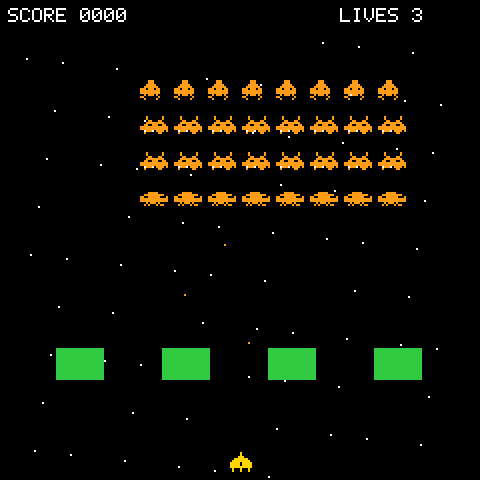
A clone of the classic fixed-shooter, rebuilt on this engine as a teaching demo: four rows of aliens marching down toward four degradable bunkers, one bullet on screen at a time, three lives, and a bass line that speeds up as the formation gets closer. The single idea it is about is a fixed memory budget: the scene arena, the projectile pool, and the explosion slots are all sized once at compile time, so a full game runs without a single runtime allocation.
Language: C++17
Engine: gperez88/PixelRoot32-Game-Engine@^1.9.0
Environments: native, esp32dev
Category: Games
Requirements (build flags)
Set in lib/platformio.ini's [base] template, so every environment inherits them:
PIXELROOT32_ENABLE_SCENE_ARENA— selects the arena path. With the flag set, every entity is placed witharenaNewinto the scene'sSPACE_INVADERS_SCENE_ARENA_BUFFER(4 KB, a file-scope array); without it the same code compiles tostd::unique_ptrand the heap. Both branches are insrc/SpaceInvadersScene.cpp, guarded by#ifdef, so the demo is also a side-by-side of the two ownership models. If the buffer runs out,arenaNewreturnsnullptrand the scene skips that entity rather than crashing.PIXELROOT32_ENABLE_PHYSICS=1— required, not optional.RigidActor(projectiles),KinematicActor(the ship),StaticActor(bunkers) and the swept-collision helpers inphysics/CollisionSystem.hall live behind this flag, so the demo does not compile without it.PIXELROOT32_ENABLE_AUDIO=1— needed for the three-speed bass loop, the win/lose fanfares, and the shot/hit cues. Building without it is not a compile error — it is silence, and the tempo ramp that carries most of the tension disappears with it.PIXELROOT32_ENABLE_PARTICLES=0— not used. Enemy hits are four one-pixel-wide bars drawn straight by the scene, and the player death is a three-frame sprite animation.PIXELROOT32_ENABLE_UI_SYSTEM=0— the score and lives readouts areRenderer::drawTextcalls, not UI widgets.
Display size is 240×240 in the project platformio.ini (see PHYSICAL_DISPLAY_*). Formation width, bunker spacing, and the ship's start position are all derived from DISPLAY_WIDTH / DISPLAY_HEIGHT in src/GameConstants.h, so a different resolution re-lays-out the screen instead of clipping it.
Platforms
| Environment | Display | Audio backend |
|---|---|---|
native | SDL2, 240×240 | SDL2_AudioBackend in src/platforms/native.h |
esp32dev | ST7789 240×240 | ESP32_I2S_AudioBackend in src/platforms/esp32_dev.h |
Pin choices (ST7789 SPI, I2S audio, D-pad + two buttons) are in src/platforms/esp32_dev.h — edit there if your wiring differs.
Controls
| Action | native (keyboard) | esp32dev (GPIO) |
|---|---|---|
| Move ship | Left / Right arrows | D-pad Left / Right |
| Fire | Space | Button A |
| Restart (from Game Over) | Space | Button A |
The ship moves between nine discrete lanes, not freely: a tap steps one lane, holding for 300 ms starts an arcade-style auto-repeat every 150 ms, and each step is interpolated over 100 ms with an ease-out-cubic curve. Only one player bullet may be in flight at a time, which is what makes aiming a decision.
What it demonstrates
- Everything allocated once. Twelve
ProjectileActors are constructed deactivated at reset and recycled byreset()for the rest of the game; enemy hit effects use eight fixedEnemyExplosionslots; the shooter candidate list inenemyShoot()is a stack array sized byALIEN_COLS. Combined with the arena, nothing inupdate()reaches the allocator. - Swept-circle collision for fast, small targets. A projectile at 80 px/s can pass through an 8-pixel alien between two frames.
ProjectileActorkeeps itspreviousPosition, andhandleCollisions()runssweepCircleVsRectfrom the previous position to the current one, falling back to a plain overlap test. Discrete tests alone would drop hits. - Animation driven by the game clock, not a frame timer. Aliens never animate themselves:
AlienActor::update()is empty, and the scene callsmove()on every alien on each formation step, which advances position andSpriteAnimation::step()together. The whole formation therefore flips frames in perfect lockstep, which is the effect the original arcade cabinets got for free by redrawing one alien per step. - The music is the difficulty readout.
updateMusicTempo()maps the lowest living alien's Y to a tempo factor between 1.0 and 1.9, eased toward the target at 5 % per frame, and that same factor scales the formation's step timer. Sound and speed cannot drift apart because they read one number. - Two sprite paths from one animation type. Squid and Octopus use single-colour
Spriteframes; the Crab uses aMultiSprite— two 1bpp layers, body in orange and an eye highlight in white.SpriteAnimationFrameholds either, soAlienActor::draw()asks the animation which one it has and callsdrawSpriteordrawMultiSpriteaccordingly. - Damage as geometry. A bunker's remaining health is drawn as remaining height, shrinking from the bottom up and shifting green to yellow to red. The hitbox shrinks with it, so a chewed-up bunker really does cover less.
- A death that pauses the world. A player hit starts a three-frame explosion and sets
isPaused, which short-circuitsScene::update()entirely — aliens stop marching while the animation plays — then respawns the ship centred under the first surviving bunker.
Project layout
src/
├── GameConstants.h              layout, sprite scale, timing, button IDs
├── PlayerActor.h/.cpp           nine-lane ship: auto-repeat input, eased motion
├── AlienActor.h/.cpp            one alien: type, score value, stepped animation
├── ProjectileActor.h/.cpp       pooled bullet with previous-position tracking
├── BunkerActor.h/.cpp           StaticActor barrier with health-as-height
├── SpaceInvadersScene.h/.cpp    arena, formation march, collisions, music tempo
├── assets/
│   ├── AlienSprites.h           squid/crab/octopus bitmaps + the crab MultiSprite
│   ├── PlayerSprites.h          ship bitmap
│   ├── PlayerExplosionSprites.h three explosion frames
│   └── Background.h/.cpp        starfield coordinate tables
├── main.cpp                     platform selector
└── platforms/ native.h, esp32_dev.h — backend wiring per targetEngine documentation
Build
From games/space_invaders:
pio run -e native
pio run -e esp32devUpload (ESP32)
pio run -e esp32dev --target uploadLicense
Source code: MIT.
| Asset | Author | License | Source |
|---|---|---|---|
| Ship, squid, crab, octopus and explosion bitmaps | This repository | CC0 1.0 (public domain) | Original work, written as uint16_t row data in src/assets/ |
| Starfield coordinate tables | This repository | CC0 1.0 (public domain) | Original work, src/assets/Background.cpp |
| All audio cues and music tracks | This repository | CC0 1.0 (public domain) | Original work, synthesised at runtime from AudioEvent / MusicTrack definitions in src/ |
Nothing here is derived from third-party game artwork, so the demo carries no attribution requirement of its own.
Trademark. Space Invaders is a trademark of Taito Corporation. This demo is an unofficial clone published for demonstration purposes only, is not affiliated with or endorsed by Taito, and contains none of the original game's code, data, or assets. The name appears here descriptively — to say which game the demo clones — and no claim to it is made.
Source code: https://github.com/PixelRoot32-Game-Engine/PixelRoot32-Demo-Projects/tree/main/games/space_invaders