
Metroidvania-Style Example
Demonstration project — provided as an example of what the PixelRoot32 Game Engine can do. It is not a product: parts may be incomplete, experimental, or deliberately simplified to keep one idea in focus.
Language: C++17
Engine: gperez88/PixelRoot32-Game-Engine@^1.9.0
Environments: native, esp32dev
Category: Gameplay
Why
gameplay/and notgames/. The platformer is the vehicle, not the subject. What this demo is here to show is the path from a sensor overlap to game logic:InteractionTrackerturns the per-frame contact set intoonEnter/onExitedges, and the engine-owned event bus delivers what happens next. No other demo in this repository owns that path.It is honest about its size. Six systems are in play — 4bpp tilemaps,
StaticTilemapLayerCache, dirty regions, a gravity-and-climbing controller, interaction triggers and the event bus — which is more than the one-idea rule inCONTRIBUTING.mdasks for. Splitting the trigger-and-bus path into its own minimalgameplay/interaction_triggersdemo is tracked as a follow-up; this migration moves the project as it stands rather than rewriting it in transit.
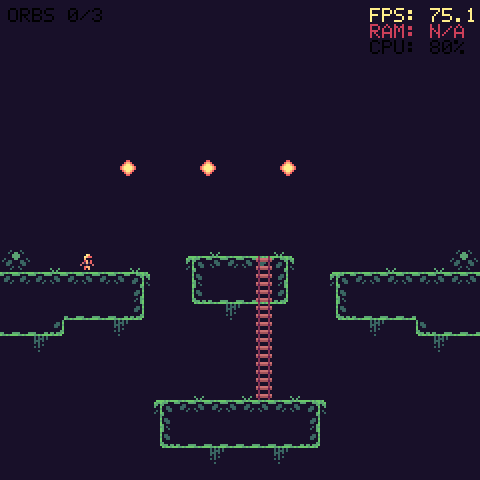
A compact platformer sample with 4bpp tilemap layers, StaticTilemapLayerCache for the ESP32 fast path when available, and a KinematicActor-based player with gravity, climbing, and jump rules tailored to the sample map.
Requires PIXELROOT32_ENABLE_4BPP_SPRITES — the scene is guarded in src/MetroidvaniaScene.h.
Requirements (build flags)
PIXELROOT32_ENABLE_4BPP_SPRITESPIXELROOT32_ENABLE_2BPP_SPRITES(enabled alongside 4bpp in this example'splatformio.ini)PIXELROOT32_ENABLE_SCENE_ARENAPIXELROOT32_ENABLE_DIRTY_REGIONSPIXELROOT32_ENABLE_CAMERA_EFFECTS— camera shake when player falls into voidPIXELROOT32_ENABLE_GAMEPLAY_STATE_MACHINE— required, not optional.PlayerActorholds agameplay::StateMachinemember and the whole class lives behind this flag (default0), so the actor does not compile without it.PIXELROOT32_ENABLE_INTERACTION_TRIGGERS=1— the collectible orbs.PIXELROOT32_ENABLE_GAMEPLAY_EVENTS=1— optional companion to the above; with it off the orbs still work, they just stop publishing to the bus.
Collectible orbs (interaction triggers + event bus)
Three pulsing orbs sit along the player's path; the HUD counts them. They are the reference for two capabilities that are usually reached for together.
The orbs are 4bpp sprites (assets/PickupSprites.h) drawn from the player's palette rather than from flat Color constants, and that is not a cosmetic choice. This scene runs in dual-palette mode, and Scene::draw() picks the palette context from the entity's render layer — layer 0 gets the Background palette, everything else the Sprite one. An orb is an ordinary actor on the default layer 1, so its colours resolve through PLAYER_SPRITE_PALETTE_RGB565, which defines indices 0-7 and leaves 8-15 at 0x0000. Color::Yellow is PR32 index 8, so a drawFilledRectangle(..., Color::Yellow) here paints solid black. Any actor you add to this scene must stay inside indices 1-7 of the sprite palette, or pick its own via setSpriteCustomPalette().
PickupActor is a sensor — the physics step still produces a contact for the pair but resolves no response, so the player walks through the orb instead of standing on it. A solid pickup would be a wall.
The part that is easy to get wrong is that contact is not collection. The engine reports a contact on every frame the boxes overlap. InteractionTracker diffs each frame's contact set against the previous one and calls onEnter exactly once, on the frame the overlap begins. Without that edge detection the callback would fire ten times as the player crossed a single orb.
Two ordering rules the example depends on:
registerActor()keys onentityId, which the collision system assigns duringaddEntity(). Register after adding, or the orb silently stores id 0 and never dispatches.- The orbs use
Layers::ENEMY, the layerGameLayers.hreserves for enemies, projectiles and pickups. The player already carries it in every branch of its mask — including while climbing — so no change toPlayerActor's mask juggling was needed.
Attaching the event bus is optional and additive: the component callbacks fire either way, and a bus additionally receives a TriggerEnter/TriggerExit event per edge. That is what lets an unrelated system (an achievement tracker, a sound director) observe contact without knowing PickupActor exists. The bus is a fixed-capacity FIFO whose overflow policy is drop-newest, so a consumer that skips a frame loses the newest events, not the oldest — draining every frame is the contract, not an optimisation.
See platformio.ini for native and esp32dev presets (no esp32cyd environment in this project).
extern pixelroot32::core::Engine engine is wired in the platform headers under src/platforms/.
Platforms
| Environment | Display |
|---|---|
native | SDL2, 240x240 |
esp32dev | ST7789 240x240 |
Controls
Uses GameConstants.h button IDs: Up / Down / Left / Right and Jump (BTN_UP ... BTN_JUMP). Map these to your InputManager / GPIO / keyboard mapping for the platform file you use.
Player Actor
The PlayerActor extends KinematicActor and implements:
Gravity + horizontal movement with configurable
PLAYER_GRAVITY,PLAYER_MOVE_SPEED,PLAYER_JUMP_VELOCITYLadder climbing via
setStairs()/buildStairsCache()— a bitmask RAM cache of climbable tilesState machine:
IDLE,RUN,JUMP,CLIMBINGwith sprite animation per state, dispatched through the engine'sgameplay::StateMachinerather than a hand-writtenswitch. The state graph is declared in astatic consttable onPlayerActor;IDLE/RUN/JUMPcarryonUpdatecallbacks that request the next transition.CLIMBING's callback is deliberately null — that state is entered and left by ladder presence and vertical input, from outside the machine.Animation timing keeps an explicit accumulator reset from
onEnter, rather than deriving frames fromgetTimeInState(). That is not an oversight:StateMachine::update()adds the frame delta before dispatchingonUpdate, andrequestState()then resets time-in-state to0, so a transition made from insideonUpdatewould lose one frame per transition. See the@warningonupdate()ingameplay/StateMachine.h.Collision layers:
PLAYER,PLATFORM,GROUND,ENEMY(for future extension)
How this scene uses the tilemap cache
Drawing goes through StaticTilemapLayerCache: allocate for the renderer when layers are ready, draw static groups with camera offsets, and invalidate() when static tile data or relevant animators change. See Animated Tilemap README for the detailed invalidation table and Architecture — static tilemap cache.
Note: During camera shake, the StaticTilemapLayerCache auto-invalidates each frame because the renderer offset changes. This ensures tilemaps shake along with entities. After the shake ends, the cache resumes its fast memcpy path.
Dirty Regions
This example enables PIXELROOT32_ENABLE_DIRTY_REGIONS for targeted clearing on ESP32. The rendering pipeline uses a dirty-grid approach to selectively clear only the regions that changed between frames, reducing SPI transfer overhead on the display.
Features
- 4bpp tilemaps and layered level data (background, platforms, stairs)
StaticTilemapLayerCachesnapshot path when the driver exposes a logical framebuffer- Dirty Regions — targeted clearing via dirty-grid pipeline on ESP32
- Player actor with gravity, stairs/climb behavior, and manual tilemap collision
- Stairs mask cache — bitmask RAM cache built once from tile indices for fast overlap checks
- State-driven sprite animation —
IDLE,RUN,JUMP,CLIMBINGstates - Scene arena + owned layer entities
- Camera shake on void fall — when the player falls below the world boundary, the entire screen (tilemaps + entities) shakes for 200ms before respawning
Documentation links
- Graphics — tilemaps &
StaticTilemapLayerCache - Architecture — static tilemap layer cache
- Architecture — ESP32 rendering / tilemap caching
- Physics API
- Core API
Build
From examples/metroidvania:
pio run -e native
pio run -e esp32devUpload (ESP32)
pio run -e esp32dev --target uploadSource code: https://github.com/PixelRoot32-Game-Engine/PixelRoot32-Demo-Projects/tree/main/gameplay/metroidvania